
NEW
Font size
 Worksheets
Biomolecules
Total questions: 28
Worksheet time: 9mins
Amino Acids are the monomers of __________.
Nucleic Acids
Proteins
Carbohydrates
Lipids
The monomer of carbohydrates are known as _______.
Amino Acid
Fatty Acid
Nucleotide
Saccharide
Glycerol and fatty acids are the monomers of _________.
Lipids
Carbohydrates
Proteins
Nucleic Acids
The monomers of Nucleic Acids are known as _________.
Amino Acid
Fatty Acid
Nucleotide
Saccharide
The four most common elements found in biomolecules are __________.
Sulfur, Phosphorus, Carbon, Oxygen
Carbon, Oxygen, Nitrogen, Hydrogen
Sulfur, Nitrogen, Carbon, Iron
Carbon, Nitrogen, Hydrogen, Sulfur
Lipids are insoluble in water because lipid molecules are _________?
hydophilic
hydrophobic
neutral
Which of the following term refers to the combination of two types of monosaccharides?
Monosaccharide
Disaccharide
Polysaccharide
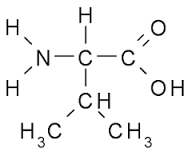
Which biomolecule sometimes contains sulfur?
Carbs
Lipids
Proteins
Nucleic Acids

The molecule presented is an example of a _____
Nucleic Acid
Carb
Lipid
Protein

The molecule presented is an example of a _____
Nucleic Acid
Carb
Lipid
Protein

The molecule presented is an example of a _____
Nucleic Acid
Carb
Lipid
Protein

The molecule presented is an example of a _____
Nucleic Acid
Carb
Lipid
Protein

The molecule presented is an example of a _____
Nucleotide
Monosaccharide
Amino Acid
Polysaccharide

The molecule presented is an example of a _____
Steroid
Monosaccharide
Amino Acid
Polysaccharide

The molecule presented is an example of a _____
Nucleoside
Nucleotide
Monosaccharide
Polysaccharide

The molecule presented is an example of a _____
Nucleoside
Nucleotide
Monosaccharide
Polysaccharide

Which of the following best describes the polarity of the R-group?
Unpolar
Nonpolar
Expolar
Polar

Which of the following best describes the polarity of the R-group?
Unpolar
Nonpolar
Expolar
Polar

What does W represent in the Nucleic Acid structure?
Purine
Pyrimidine
Phosphate
Pentose Sugar
What does X represent in the Nucleic Acid structure?
Purine
Pyrimidine
Phosphate
Pentose Sugar
What does Y represent in the Nucleic Acid structure?
Purine
Pyrimidine
Phosphate
Pentose Sugar
What does Z represent in the Nucleic Acid structure?
Purine
Pyrimidine
Phosphate
Pentose Sugar
Phospholipid

Which best describes the top fatty acid chain in the structure?
Saturated
Unsaturated
Equal
Neutral
Which best describes the middle fatty acid chain in the structure?
Saturated
Unsaturated
Equal
Neutral
A __________ consists of many monomers bonded together.
monomer
hydrocarbon
peptide
polymer
Macromolecules are made of repeating subunits called
monomers
monosaccharides
polymers
polysaccharides

