wayground logo

Free Printable Worksheets

Font size

S
M
L
XL
Worksheets

Resultant Forces

Total questions: 28

Worksheet time: 16mins

Name
Class
Date
1.
What is the force that pulls us towards the Earth?
a)
gravity
b)
weight
c)
friction
d)
mass
2.
What is 'drag' another name for?
a)
dressing up
b)
air resistance
c)
friction
d)
weight
3.
Name two quantities that are vectors.
a)
force and speed
b)
speed and acceleration
c)
force and acceleration
d)
mass and weight
4.
What are balanced forces?
a)
forces of the same size, in opposite directions
b)
the same size in the same direction
c)
forces in opposite directions
d)
forces at right angles to each other
5.
What do we call the forwards force produced by an aeroplane's engine or propeller?
a)
thrust
b)
friction
c)
weight
d)
gravity
6.
What word describes both the speed and direction of movement of an object?
a)
speed
b)
acceleration
c)
displacement
d)
velocity
7.
What is the name for a single force on an object with the same effect as all the forces combined?
a)
big
b)
total
c)
resultant
d)
sum
8.
Is the car
a)
Stationary
b)
Moving at constant speed
c)
Accelerating
d)
Decelerating
9.
Is the car
a)
Stationary
b)
Moving at constant speed
c)
Accelerating
d)
Decelerating
10.
Is the car
a)
Stationary
b)
Moving at constant speed
c)
Accelerating
d)
Decelerating
11.
In a tug of war the left team pulls with a force of 200N. The right team pulls with a force of 150N.What is the resultant force?
a)
50N to the left.
b)
350N to the left.
c)
350N to the right.
d)
50N to the right.
12.
The force that opposes the motion of two surfaces sliding past each other is called ___________.
a)
acceleration
b)
inertia
c)
friction
d)
unbalanced
13.
What is it called when the force of gravity is acting on an object?
a)
Weight
b)
Sliding Friction
c)
Momentum
d)
Projectile Motion
14.
What is the attraction between two objects because of their mass?
a)
Inertia
b)
Gravity
c)
Gravitational Force
d)
Weight
15.
A ____________ is a push or a pull on an object.
a)
chemical
b)
force
c)
magnet
d)
gravity
16.
___________ is the amount of matter in an object.
a)
mass
b)
weight
c)
volume
d)
force
17.

What is the resultant force?

a)

40 N, Left

b)

0 N, Balanced

c)

400 N, Right

d)

40 N, Right

18.

What is the resultant force?

a)

400 N, Up

b)

400 N, Down

c)

800 N, Up

d)

800 N, Down

19.

What is the resultant force?

a)

17 N, Left

b)

6N, Right

c)

11N , Left

d)

12N, Left

20.

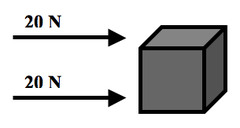
What is the resultant force?

a)

40N, Left

b)

40N, Right

c)

0N, Balanced

d)

75N, Right

21.

What is the resultant force?

a)

5000 N, Right

b)

4000 N, Right

c)

40 N, Left

d)

4000 N, Left

22.

Calculate the resultant force acting

on the parachute.

a)

85 N upwards

b)

85 N downwards

c)

215 N upwards

d)

215 N downwards

23.

When was the object sitting still?

a)

between 5 and 6 seconds

b)

between 2 and 5 seconds

c)

between 1 and 2 seconds

d)

between 0 and 1 second

24.

(a)   is the how far an object travels over time.

25.

How do you calculate time?

a)

multiply distance and speed

b)

distance divided by speed

c)

speed divided time

d)

divide distance and density then multiply by volume

26.

How do you calculate speed?

a)

multiply distance and speed

b)

distance divided by time

c)

speed divided by time

d)

divide distance and density then multiply by volume

27.

Michael walked at 2 m/s for 3 minutes. How far did he walk?

a)

360 m

b)

6 m

c)

18 m

d)

5 m

28.

A train begins a journey from a station and travels 60 km in a time of 20 minutes. What is the average speed of the train?

a)

3.0 m / s

b)

5.0 m / s

c)

50 m / s

d)

60 m / s