
 Worksheets
Cell Transport and Osmosis
Total questions: 33
Worksheet time: 21mins
Diffusion is a form of __________ transport.
Passive
Active
Easy
Free
Passive Transport uses ____ energy
no
a lot of
a little bit of
some
_____________ is the free movement of particles across the membrane with the concentration gradient
diffusion
facilitated diffusion
active transport
fusion
What is the movement of particles with the concentration gradient using protein "helpers"?
diffusion
facilitated diffusion
active transport
enzymatic reactions
The general name for movement of substances across cell membranes without need of energy input
passive transport
active transport

Some cells move large particles out of the cell through the process of:
Protein Synthesis
Endocytosis
Exocytosis
Cytoplasmic Streaming
Particle of movement from an area of lower concentration to an area of higher concentration.
Active transport
Passive transport
Particle of movement from an area of higher concentration to an area of lower concentration.
Active transport
Passive transport
Which type of transport uses energy in the form of ATP to transport substances?
Active transport
Passive transport
Which type of transport does not use energy to transport substances?
Active transport
Passive transport
Which type of passive transport uses transport proteins to transport items such as glucose through the membrane?
Facilitated diffusion
Osmosis
Diffusion
Which type of passive transport focuses on the movement of water through the membrane?
Facilitated diffusion
Osmosis
Diffusion
Which type of solution has the same solute concentration inside of and outside of the cell?
Hypertonic
Hypotonic
Isotonic

The cell shrunk in size, which means it was placed in a ____ solution.
Isotonic
Hypertonic
Hypotonic

The cell expanded in size to the point of lysing (bursting), which means it was placed in a ____ solution.
Isotonic
Hypertonic
Hypotonic

The cell shows water moving in and out equally, which means it was placed in a ___ solution.
Isotonic
Hypertonic
Hypotonic
What is the term to describe maintaining internal balance in the cell?
Diffusion
Homeostasis
Osmosis
Active transport
Which of these is not a form of passive transport?
Endocytosis
Diffusion
Osmosis
Facilitated Diffusion
What type of active transport does waste move out of the cell?
Endocytosis
Exocytosis
Sodium Potassium Pump
Diffusion
What type of active transport does food move into the cell?
Endocytosis
Exocytosis
Sodium Potassium Pump
Diffusion
Active transport requires
A concentration gradient
Osmosis
Energy
Hypertonic solution
What is the job of the cell membrane?
Make proteins
Fold proteins
Direct cell's activities
Allow things in and out of the cell

What type of transport is occurring in the diagram?
diffusion
facilitated diffusion
active transport
Diffusion is a form of __________ transport.
Passive
Active
Easy
Free

Nemo and other ocean dwelling fish cannot survive in freshwater because......
freshwater is hypertonic to Nemo's cells and will result in water leaving them causing the cells to shrink
freshwater is hypotonic to Nemo's cells and will result in water leaving them causing the cells to shrink
freshwater is hypertonic to Nemo's cells and will result in water entering them causing the cells to swell and burst
freshwater is hypotonic to Nemo's cells and will result in water enter them causing the cells to swell and burst

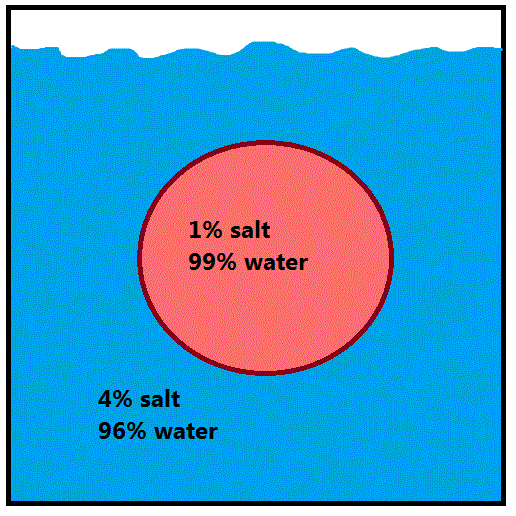
In the cell pictured, which way would water move?
Into the cell, causing the cell to swell
Out of the cell, causing the cell to shrink
In and out of the cell equally, keeping the shape the same

In the cell pictured, where would water move?
Into the cell, causing it to swell
Out of the cell, causing it to shrink
In and out of the cell equally, causing the shape to stay the same

In the cell pictured, which way would water move?
Into the cell, causing the cell to swell
Out of the cell, causing the cell to shrink
In and out of the cell equally, keeping the shape the same

In the cell pictured, which way would water move?
Into the cell, causing the cell to swell
Out of the cell, causing the cell to shrink
In and out of the cell equally, keeping the shape the same

In the cell pictured, which way would water move?
Into the cell, causing the cell to swell
Out of the cell, causing the cell to shrink
In and out of the cell equally, keeping the shape the same

