
 Worksheets
Ecological Succession
Total questions: 29
Worksheet time: 58mins
___ are the first organisms to colonize an area and begin the process of ecological succession.
foundational organisms
introductory organisms
primary organisms
pioneer species
Primary succession occurs in an area that has:
Has Soil
Has No Soil
Has Some Soil
none of these
What is the main difference between primary and secondary ecological succession?
Primary begins WITHOUT soil; Secondary begins WITH soil
Primary is the first state and secondary is the second stage
Primary builds plant community; secondary builds animal community.
Primary begins WITH soil; Secondary begins WITHOUT soil
What is an example of an area that is likely to undergo primary succession?
Glaciers melt and leave exposed rock
Plants die from drought and decompose
Land is bulldozed and soil remains
Which is faster: Primary or Secondary Succession?
Primary Succession
Secondary Succession
Both Take The Same Amount of Time
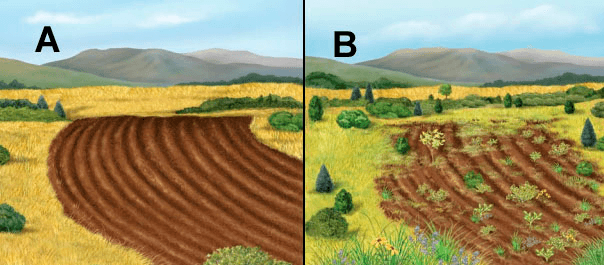
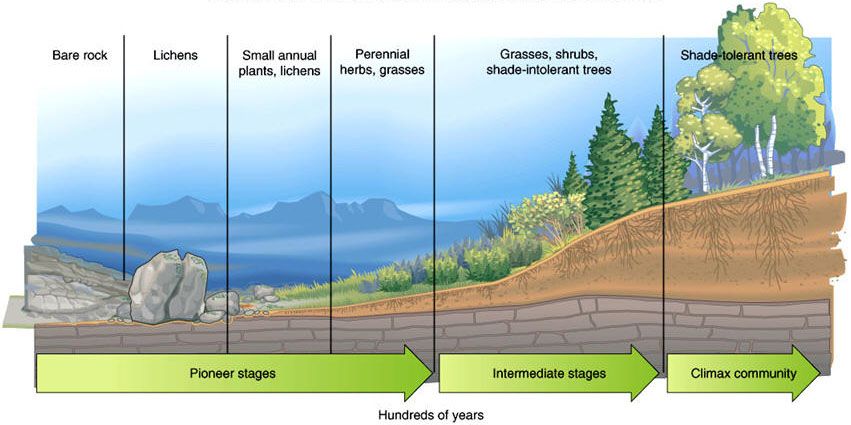


Which of the following best describes primary succession?
Volcano wipes out ecosystem that gradually grows back from ash covered soil
Volcano creates a new island of rock that must break down to form an ecosystem
Forest fire burns down forest that must bounce back over time
Tornado destroys a crop that must slowly grow back over time.
What is an example of a disturbance that could bring about secondary succession?
Humans cut down many trees in a small region
A volcanic eruption covers a village in lava.
How is commensalism different from mutualism?
In commensalism, one species benefits while the other is unharmed; in mutualism, both species benefit
In commensalism, one species is harmed while the other benefits; in mutualism, both species benefit
In commensalism, neither species is harmed; in mutualism, one species is harmed
In commensalism, both species benefit; in mutualism, one species is harmed
When a honeybee pollinates flowers, the bee gets access to nectar, while the flowers gain the chance to reproduce. This is an example of:
Amensalism
Commensalism
Parasitism
Mutualism
Remoras are fish that swim alongside sharks, eating scraps that the sharks leave behind. This is an example of:
Amensalism
Commensalism
Parasitism
Mutualism


One species benefits, the other species is harmed
symbiosis
parasitism
mutualism
commensalism
One species benefits, the other is unaffected
symbiosis
parasitism
mutualism
commensalism
Both species benefit
symbiosis
parasitism
mutualism
commensalism
Epiphytes are a class of plants that grow in the crooks of tree branches. They simply use the tree branches as a way to be higher—closer to the sunlight needed for photosynthesis. The trees aren’t affected by this relationship.
symbiosis
parasitism
mutualism
commensalism
E. Coli is a bacteria that lives in the gut of humans. The human provides the ideal habitat for e coli reproduction and the e coli provides the extra vitamin K that we use.
symbiosis
parasitism
mutualism
commensalism
The tick feeds off the blood of the deer.
symbiosis
parasitism
mutualism
commensalism
This is any close relationship between any two different species in an ecosystem
symbiosis
parasitism
mutualism
commensalism

