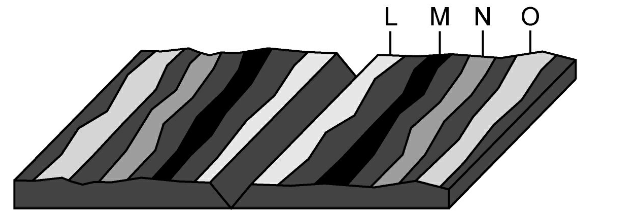
Worksheets
Plate Motion Practice
Total questions: 38
Worksheet time: 35mins

a diagram that shows what the inside of something looks like
inner peek
cross section
insider info
cross stitch
plates moving toward each other
togetherness
convergent
divergent
mergent
hot liquid rock UNDER the surface of Earth
lava
titanium
soup
magma
a layer of soft, solid rock under Earth's plates that causes the plates to move
core
crust
mantle
outer core
Earth's outer layer is divided into sections called ...
continents
countries
oceans
plates
Earth's mantle is made of hard, solid rock.
True
False
plates moving away from each other
splitting
earthquakes
divergent
convergent
rock is added to edges of plates at _____ boundaries
divergent
convergent
ancient
active

This is a __________ boundary.
Continental Convergent
Oceanic-Continental Divergent
Oceanic Transform
Oceanic-Continental Convergent

This is a ________ boundary.
Oceanic Convergent
Oceanic Divergent
Oceanic Transform

When denser oceanic plate forces it's way under another plate at a convergent boundary.
convection
boundary
subduction
Which of the following is the definition of "pattern"?
how often or fast something happens
a diagram that shows what the inside of something looks like
something we observe to be similar over and over again
to examine in detail for a purpose
Any of Earth's main continuous areas of land, such as Africa, Asia, and North America.
continent
convergent
divergent
cross section
Evidence of life from the past, such as preserved bones, footprints, or leaf prints.
eruption
fossil
landform
cross section
A feature that forms on the surface of a planet, such as a mountain, channel, or sand dune.
geyser
mantle
eruption
landform
A long, deep indentation in the ocean floor formed when two plates move together
mid-ocean ridge
rift valley
trench
mantle
Which of the following is the definition of "mid-ocean ridge"?
the outside or top layer of something
hot liquid rock below the surface of Earth
the slow pulling apart of continental land that is caused by plate movement
an underwater volcanic mountain range formed when two plates move apart
True of False:
The Mesosauras had webbed feet?
True
False
How long ago did the Mesosaurs live?
3 million years ago
30 million years ago
300 million years ago
3,000 million years ago
True of False:
The Mesosauras' body was built to swim long distances.
False
True
What two continents were the Mesosaurus fossils found?
South America and Africa
Antarctica and Europe
North America and Asia
Australia and Asia
Which feature did the Mesosaurus have?
Webbed feet
Lungs
Nostrils on top of their head
All of the above
Where did they find the Mesosaurus fossils?
soft rock
sand
hard, solid rock
under the ocean
Who is a scientist who studies fossils or bones that are embedded in rocks, in order to learn about the history of life on Earth
geologist
fossilologist
dinosaur
paleontologist
The place where to plates meet?
Pattern
Plate Boundary
Mantle
Earthquake
Examples of places we have drilled for core samples.
Arizona, USA
Guadalupe Island, Mexico
Ross Ice Shelf
All the Above

What type of landforms are represented by the boundary in the picture?
mid-ocean ridge
trench
Rift Valley
Folded mountains
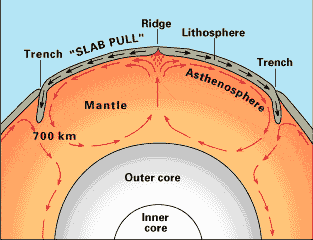
What is the source of energy that drives plate movement?
the subducton of the sea floor
the different densities of the oceanic and crustal plates
convection currents in the mantle
the friction force between the plates that move past each other

The diagram below shows a cross section of a portion of the Earth. The mountain ranges at location B are most likely volcanic.
True
False

The letter B represents
Subduction zone
Trench
Oceanic crust
Island Volcano Arc
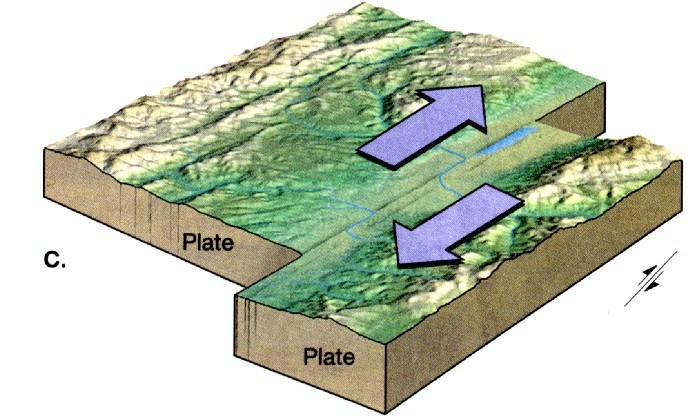
What is the only event associated with ALL plate boundaries?
Volcanoes
Earthquakes
Subduction
Deep Trenches

The diagram shows a landform on Earth. How did the movement of Earth’s plates form the landform?
Two oceanic plates slid past each other.
Two continental plates collided.
One continental plate slid past an oceanic plate.
One continental plate subducted beneath an oceanic plate.

Use the diagram to answer the question. What results as the two oceanic plates converge?
formation of a deep sea trench and island volcanoes
earthquake activity and appearance of a transform fault
volcanic eruption along both oceanic plate edges
formation of a continental mountain range

What geologic feature/event would you most likely to find at a divergent boundary between two pieces of continental crust?
Mid-Ocean Ridge
Mountain
Rift Valley
Island Arc

What geologic feature/event would you most likely to find at a divergent boundary between two pieces of oceanic crust?
Rift Valley
Mid-Ocean Ridge
Island Arc
Flat land