
 Worksheets
Functions and Relations
Total questions: 56
Worksheet time: 2hrs 57mins

Is it a function?
It IS a function.
It IS NOT a function

Is it a function?
It IS a function.
It IS NOT a function

Is it a function?
It IS a function.
It IS NOT a function

Is it a function?
It IS a function.
It IS NOT a function

Is it a function?
It IS a function.
It IS NOT a function
1. Let 𝐹 be a set of ordered pairs such that {(−3,5),(3,0),(2,2)}. Which of the following statements about the relation is true?
The relation is a function because no value in the domain goes to multiple values in the range.
The relation is a function because all values in the range are different.
The relation is not a function because one value in the domain goes to multiple values in the range.
The relation is not a function because there is an ordered pair where the domain is equal to the range.


What is the domain?
the set of all x-values
the set of all y-values
What is the range?
the set of all x-values
the set of all y-values
A relation where every input in matches with exactly one output is called what?
Relation
Linear
Exponential
Function
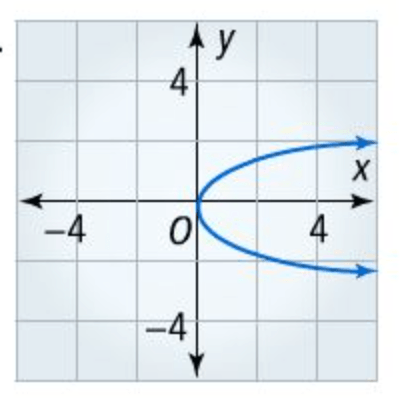

The numbers (3, 4) represent a(n) _____.
x-coordinate
x-axis
y-coordinate
y-axis
ordered pair
In the ordered pair (3, 4), 3 represents a(n) _____.
x-coordinate
x-axis
y-coordinate
y-axis
ordered pair
In the ordered pair (3, 4), 4 represents a(n) _____.
x-coordinate
x-axis
y-coordinate
y-axis
ordered pair
Is this set of ordered pairs a function or not a function?
{5,-2), (3,-5), (2,-5), (0,-2), (-1,-3)}

Does the given table represent a function?

Does the given table represent a function?
Which relation is a function?
(-2,0), (-1,-6), (0,-6), (1,0), (5,0)
(-3,5), (-2,6), (-1,7), (-2,8), (-3,9)
(11,2), (8,4), (5,6), (5,8), (-1,10)
(2,-1), (2,-2), (2,-3), (2,-4), (2,-5)
Which relation is not a function?
(2,2), (4,4), (6,6), (8,8), (10,10)
(1,5), (3,5), (5,5), (7,5), (9,5)
(-4,1), (-2,3), (0,5), (2,7), (4,9)
(1,8), (2,7), (3,6), (4,5), (4,4)
Which graph shows a relation that is not a function?


Which graph shows a relation that is a function?


Which graph shows a relation that is not a function?


Is y a function of x?
function
not a function

Is y a function of x?
function
not a function

Is y a function of x?
function
not a function

Is y a function of x?
function
not a function
Which graph represents a function?


Which image is NOT the graph of a function?


Is y a function of x?
function
not a function

Find the DOMAIN
{-5, -2, 1, 4}
{1, -2, 4, -5}
{-1, 0, 2, 3}
{0, -1, 2, 3}
Find the RANGE
{-5, -2, 1, 4}
{1, -2, 4, -5}
{-1, 0, 2, 3}
{0, -1, 2, 3}


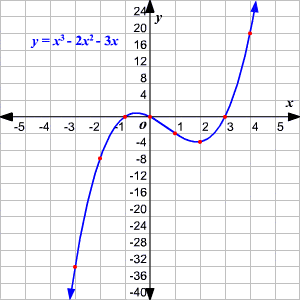
What variable typically represents the domain?
x
y
What variable typically represents the range?
x
y

What is the domain?
{1, 2, 3, 4, 5, 6}
{0, 1, 2, 3, 4, 5, 6}
{2, 4, 8}
{-1, 0, 1, 2, 3, 6}
What is the range?
{1, 2, 3, 4, 5, 6}
{0, 1, 2, 3, 4, 5, 6}
{2, 4, 8}
{-1, 0, 1, 2, 3, 6}
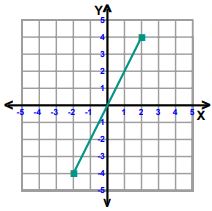
What is the domain in Interval notation?
[ -2 , 2 ]
[ 4 , -4 ]
(-2 , 2 )
(4 , -4 )
with infinity?

What is the range of the graph?
[-7, 5)
(-3, 1]
[-3, 1)
(-7, 5]

What is the range?
[0, ∞)
(−∞, ∞)
None of the answer choices

What is the domain?
(−∞, −3]
[3, −∞)
(−∞,3]
(−∞,∞)
None of the answer choices

