
 Worksheets
Matter: Solubility, Density, Phases and Changes Review
Total questions: 67
Worksheet time: 53mins
Serena is mixing a material into a beaker filled with a liquid. She notices that the material seems to disappear into the liquid. What physical property of the material is Serena most likely observing?
solubility
conductivity
magnetism
density
What happens when a substance undergoes a physical change?
Some physical properties change, but the substance keeps its identity.
No physical properties change, and the substance keeps its identity.
Some physical properties change, and the substance changes its identity.
No physical properties change, but the substance changes its identity.
Which scenario is an example of a physical change?
Wood is burned in a campfire and is turned into ash and smoke.
A piece of metal is left in the rain and forms rust.
Lead is melted into a liquid to form pellets.
Yeast turns sugar into energy, water, and carbon dioxide gas.
Which event always involves a chemical change?
boiling
melting
conducting
burning
Which of the following are examples of a Chemical Change? Check all that apply.
Iron Rusting
Gas Burning
Breaking a glass
Boiling water
Burning Wood
Which process is a sign of a chemical change?
A rotting potato gives off a bad smell
A melting block of ice leaves a large puddle
A cloud quickly changes shape when blown by wind
A plaster statue breaks when it falls onto the floor
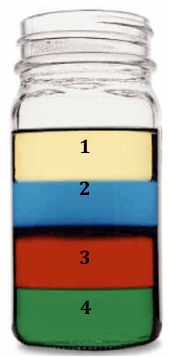

Which box has a higher density?
A
B
They are the same

If a liquid has a density of 3 g/mL and a mass of 9 g. What is the volume? Use the density triangle to solve the problem
24 mL
18 mL
3 mL
12 mL


What is the volume of 55 grams of lead if it has a density of 11 g/cm3?
605 cm3
5 cm3
66 cm3
.2 cm3

What is the mass of a 25 cm3 liquid if it has a density of 5 g/cm3?
125 g
5 g
30 g
.2 mL
True or False: The density of a specific type of material never changes.
true
false


All matter is made up of tiny _______________
energy
particles (atoms and molecules)
bits
antimatter

The tool pictured here is...
a buret
an erlenmeyer flask
a graduated cylinder
a beaker
This tool is used to measure...
volume
mass
density
moles
Mass is the amount of _______ an object has
Matter
weight
The unit for volume is (Select all that apply)
grams
milliliters (mL)
Newton
cm3
What process occurs when you place an object in a graduated cylinder with water and measure how much the water level changes?
Relative Water Density
Water Displacement
Density


At what temperature can you fully dissolve 140g of NaNO3?
61
73
81
You cannot determine this
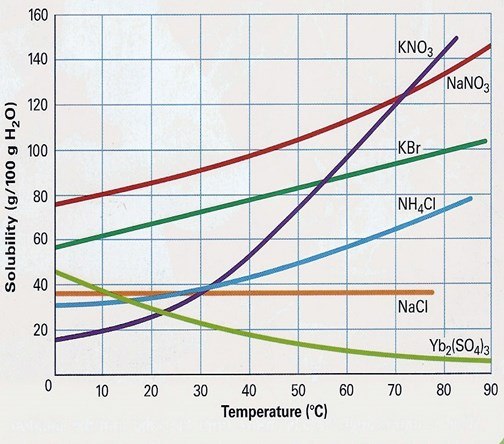
At 80'C, KBr's solubility is:
100
90
80
0
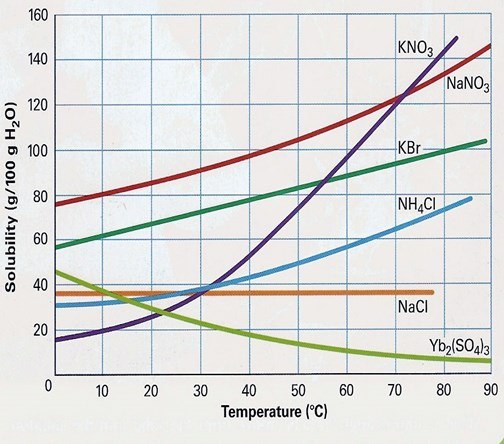
At 30'C, which substance has the lowest solubility?
KNO3
KBr
NaCl
Yb2(SO4)3
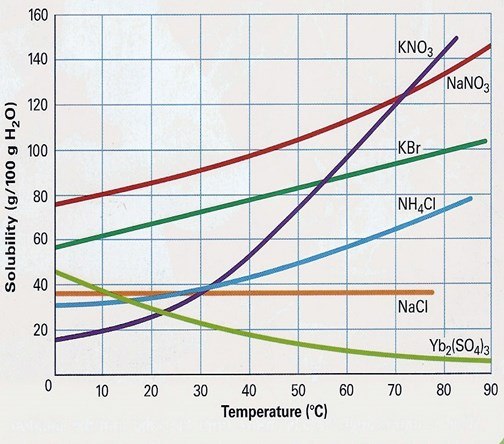
Identify if the following solution would be saturated, unsaturated, or supersaturated: 110g KBr at 70'C.
Unsaturated
Saturated
Supersaturated
Stirring the solution...
decrease the rate of solubility
Doesn't change the rate of solubility
increase the rate of solubility
None of the above

store the mixture in a cold dark place
In general as temperature increases, the solubility of a liquid or a solid tends to ...
increases
decreases
stays the same
Is shaking increases the solubility of a solution?
Yes
No
Maybe

Which letter would be the phase change of freezing?
F
C
A
D
The opposite phase of melting is
The change of one state of matter to another is called
Osmosis
Phase Change
Matter
Energy
Change of a gas directly into a solid
Sublimation
Condensation
Evaporation
Deposition

The temperature at which a liquid evaporates to a gas is called
freezing point
boiling point
melting point
condensation point
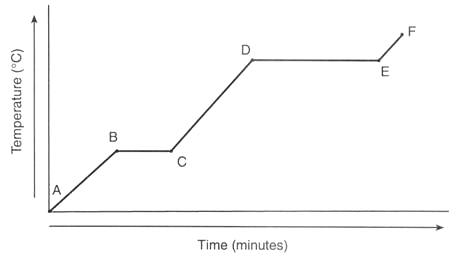
Is the substance gaining or losing energy as it moves to the right?
Gaining
Losing
Are the particles moving faster or slower as time goes on?
Faster
Slower
What state/phase is the object likely from points A to B?
Solid
Liquid
Gas
Plasma
What is happening to the particles in the substance between points A and B?
Melting
Freezing
Speeding Up
Slowing Down
What is happening to the particles in the substance between points D and E?
Melting
Freezing
Vaporizing
Sublimating

Is the substance gaining or losing energy?
Gaining
Losing

Where on the graph are phase changes taking place? Select all that apply.
1
2
3
4
5

The specific heat of aluminum is 0.21 J/g°C. How much heat (Q) is released when a 10 g piece of aluminum foil is taken out of the oven and cools from 100° to 50°?

The specific heat(c) of copper is 0.39 J/g °C. What is the temperature change(∆t) when 100 Joules of heat(Q) is added to 20 grams of copper? ΔT= mcQ
Use the following equation to answer the question.
Q=mcΔT
What does the C stand for?
Final temperature
Change in temperature
Mass
Specific heat
Use the following equation to answer the question.
Q=mcΔT
What does the m stand for?
Mass
Energy
Specific Heat
Final Temperature
What unit do you use to measure Heat or Thermal Energy?

This tool is used to measure...
volume
mass
density
moles
In general as temperature increases, the solubility of a gas tends to...
increases
decreases
stays the same

