
 Worksheets
Geo - Chapter 2 - Review
Total questions: 94
Worksheet time: 2hrs 16mins

Find the midpoint:
(−1,3)
(3,4)
(4,3)
Find the midpoint: (3,9),(−1,−5)
(−1,−2)
(2,7)
(−2,−7)
(1,2)
∠ABC and ∠CBD are supplementary angles, m∠ABC = (5x + 12)° and m∠CBD = (13x + 24)°. Find x.
(a)
∠ABC and ∠CBD are supplementary angles. m∠ABC = (5x + 12)° andm∠CBD = (13x + 24)°. Find m∠ABC.
(a)


Are the points shown collinear?
Yes
No

Are the points shown coplanar?
Yes
No

Choose the points that are collinear.
A, B, and C
A, C, and D
A, E, and F
B, C, and D

Are points B and C collinear? Yes, they are on the same line THROUGH the plane.
Yes
No
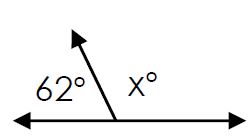
x = 118
x = 108
x = 28
x = 58


What are supplementary angles?
Angles that add up to 180°
Angles that add up to 90°
Angles that are equal to each other
Angles that are opposite of each other when lines intersect


similar for shapes OR negation for conditional statements


Which of the following is true about the conditional statement below?
If a man is 7 feet tall, then he plays basketball.
Hypothesis: a man is 7 feet tall
Conclusion: he plays basketball
Hypothesis: IF a man is 7 feet tall
Conclusion: THEN he plays basketball
Hypothesis: THEN he plays basketball
Conclusion: IF a man is 7 feet tall
Hypothesis: he plays basketball
Conclusion: a man is 7 feet tall

Which of the following is true about the conditional statement below?
If you are in Alaska, then you are
cold.
Hypothesis: you are in Alaska
Conclusion: you are
cold
Hypothesis: IF you are in Alaska
Conclusion: THEN you are
cold
Hypothesis: THEN you are
cold
Conclusion: IF you are in Alaska
Hypothesis: you are
cold
Conclusion: you are in Alaska
Which of the following is the CONVERSE of the statement below?
If an object is a ring, then it is
made of gold.
If an object is made of gold, then it is a ring.
If an object is not a ring, then it is not made of god.
If an object is not made of gold, then it is not a ring.
There is no converse of the statement.

Which of the following is the CONVERSE of the statement below?
If an object is a bird, then it can fly.
If an object can fly, then it is a bird.
If an object is not a bird, then it cannot fly
If an object cannot fly, then it is not a bird
There is no converse of the statement
Which of the following is the INVERSE of the statement below?
If an object is a computer, then it
has a hard drive.
If an object is not a computer, then it does not have a hard drive.
If an object does not have a hard drive, then it is not a computer.
If an object has a hard drive, then it is a computer.
There is no inverse of the statement.

Which of the following is the INVERSE of the statement below?
If an object is a battery, then it is
rechargeable.
If an object is not a battery, then it is not
rechargeable.
If an object is rechargeable, then it is not a battery.
If an object is not rechargeable, then it is not a battery.
There is no inverse of the statement.

Which of the following is the CONTRAPOSITIVE of the statement below?
If a species walks on two feet, then
it is human.
If a species is not human, then it does not walk on two feet.
If a species is human, then it walks on two feet.
If a species does not walk on two feet, then it is not human.
There is no contrapositive of the statement.

Which of the following is the CONTRAPOSITIVE of the statement below?
If a species is a fish, then it lives in
water.
If a species does not live in water, then it is not a fish.
If a species is not a fish, then it does not live in water.
If a species lives in water, then it is a fish.
There is not contrapositive of the statement.
Which of the following is the BICONDITIONAL of the statement below?
If there is lightning, then there is thunder.
If there is not lightning, then there is not thunder.
If there is thunder, then there is lightning.
There is lightning if and only if (iff) there is thunder.
There is no biconditional statement.

Which of the following is the BICONDITIONAL of the statement below?
If it is water, then it is wet.
If it is not wet, then it is not water.
If it is wet, then it is water.
It is water if and only if (iff) it is wet.
There is no biconditional statement.
Which of the following is a valid conditional statement for the following phrase:
An acute angle has a measure less than 90°.
If an angle is acute, then it has a measure less than 90°.
If an angle is not acute, then it does not have a measure less than 90°.
If an angle is acute, then it is acute.
If an angle does not measure less than 90°, then it is not acute.
If the conditional statement was "If an angle is acute, then it has a measure less than 90°.", which type of statement is the following?
An angle is acute if and only if (iff) it has a measure less than 90°.
Biconditional
Converse
Inverse
Contrapositive
If the conditional statement was "If an angle is acute, then it has a measure less than 90°.", which type of statement is the following?
If an angle does not have a measure less than 90°, then it is not acute.
Contrapositive
Converse
Biconditional
Inverse
If the conditional statement was "If an angle is acute, then it has a measure less than 90°.", which type of statement is the following?
If an angle has a measure less than 90°, then it is acute.
Converse
Contrapositive
Biconditional
Inverse
If the conditional statement was "If an angle is acute, then it has a measure less than 90°.", which type of statement is the following?
If an angle is not acute, then it does not have a measure less than 90°.
Inverse
Contrapositive
Biconditional
Converse
What is a conditional statement?
if-then statement
if part
then part
a true or false statement
What is a hypothesis?
if-then statement
if part
then part
a true or false statement
What is a conclusion?
if-then statement
if part
then part
a true or false statement

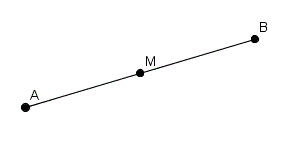
Given that M is the midpoint of
AB and AB=30 find AM.15
30
10
not enough information

What ray is the bisector of ∠AOC ?
OB
OC
BO
OB

If KM bisects ∠LKJ and m∠JKM=22° find m∠LKM .
22
44
11
68
not enough information given

Fill in the blank:
A point that is the same distance from two figures is ___________________ from from the two figures.
Equidistant
Congruent
Vertical
Corresponding
Fill in the blank:
A perpendicular bisector is perpendicular to and passing through the ___________________ of a segment.
endpoint
corner
midpoint
side
A ray that divides an angle into two congruent angles is called .............
perpendicular bisector
angle bisector
vertex
divider

∠1 and ∠2 are
adjacent
complementary

∠1 and ∠2 are
adjacent
linear pair

∠1 and ∠2 are
adjacent
linear pair

∠1 and ∠2 are
vertical
adjacent

∠1 and ∠4 are
supplementary
complementary

Buzz graphed two lines in order to find the solution(intersection point).
What is the solution?
(-1, 4)
(1, -4)
(-4, 1)
(4, -1)

A _____ is a specific location. It has no dimension width or height.
Plane
Line Segment
Point
Ray
___ _____ is a point at either end of a line segment or the starting point of a ray.
End point
Midpoint
Starting point
Plane
A _____ is a 2D surface that extends infinitely.
Ray
Line Segment
Line
Plane

What is the correct name of the plane?
N
n
AE
C
To fully disprove a conjecture, one needs to find only ONE counterexample.
True
False
A concluding statement reached using inductive reasoning is called a _______
compound statement
conjecture
condition
counterexample

Which of the following provide a counterexample to the claim:
"If two angles are supplementary, then they are not congruent."
40° and 140°
80° and 80°
30° and 150°
90° and 90°

Which property is used in the following?
7(8 + 2) = 7 x 8 + 7 x 2
Identify the property:
39 = 39
Identify the property:
If 31 = 2x - 5, then 2x - 5 = 31
Which property says that order doesn't matter in addition and multiplication?
Commutative Property
Associative Property
Identity Property
Reflexive Property
Identify the property:
10 + 0 = 10
Inverse Property
Commutative Property
Associative Property
Identity Property
Identify the property:
6 + (21 + 3) = (6 + 21) + 3
Commutative Property
Distributive Property
Inverse Property
Associative Property
Commutative Property
Associative Property
Inverse Property
(−b)+b=0
Commutative Property
Associative Property
Inverse Property
Identity Property
a×1=a
Identity Property
Inverse Property
Symmetric Property
Reflexive Property
Given:
p: It will rain on Saturday.
q: We will play in the park.
Write the following statement using logic symbols.
If it does not rain on Saturday, then we will play in the park.
∼p→q
p→q
∼p∧q
∼q→p
Given:
p: Each student enrolls in a foreign language.
q: All students pass history.
Write the following in logic symbols: Each student enrolls in a foreign language if and only if all students pass history.
p↔q
p→q
p∧q
p∨q
What is the inverse?

