
 Worksheets
Science TE21 Review
Total questions: 51
Worksheet time: 33mins

Josie likes to visit the park in her neighborhood to watch hummingbirds. Based on the beak of the hummingbird, what does it most likely eat?
Fish
Nuts
Insects
Flower Nectar

The picture shows flowers with an unusual shape. Which beak shape would best allow a bird to reach the nectar inside the flower?
Long and thin
Short and thick
Short and thin
Long and thick
Bullfrogs are Florida’s largest frog. Frogs spend part of their life cycles in water and part on land. Which physical characteristic is most useful for a water environment?
Thin skin
Large eyes
Webbed feet
Long, strong legs
In the fall, a ground squirrel will store the energy from food as a thick layer of fat. What is most likely the reason for this adaptation?
It keeps the animal from being exposed to diseases in winter.
It keeps the animal from being eaten by predators that hunt during winter.
It helps the animal get exercise during winter when it is snowing.
It helps the animal survive a cold winter when there is very little food.
It is estimated that fewer than 100 Florida panthers are still living. Florida now has a protected habitat for the panther. How will the protected habitat affect the panthers?
The panthers will probably become extinct.
Panthers will no longer be adapted to living in Florida.
The Florida panther population will decrease in the near future.
The panther population may increase now that they are being conserved in a protected habitat.
Physical characteristics that help an organism survive are called:
Habitats
Extinction.
Adaptations.
Learned behaviors.
A native species is...
A species that originated in the ecosystem in which it lives.
when an animals has fit to survive in their environment.
indicates the state or level of the ecosystem.
is used to study the biodiversity in an ecosystem.
Which of the following are not characteristics of an invasive species?
Non-native
Fast growing or reproducing.
Threat to other species.
Easy to eliminate.
An invasive species is...
A species that out competes other species in its ecosystem.
used to study an ecosystem, which helps to indicate the state of an ecosystem.
The changes an animal has made to allow it to better fit its environment.
Where do plants get the energy for photosynthesis to take place?
nutrients in the soil
the sun
chlorophyll
bee pollination
What part of the plant soaks up water for photosynthesis?
roots
petals
leaf
stem
What is the food manufacturing process in plants?
respiration
chlorophyll
glucose
photosynthesis
If plants breathe in carbon dioxide, what do they breathe out?
nitrogen
oxygen
carbon
helium
TRUE or FALSE: Plants make their own food and use the energy from the food that is made.
True
False
What creates the green color in plants?
chlorophyll
clorox
chemical
chromosomes
Plants need photosynthesis to make ___.
oxygen
carbon dioxide
food
new plants
A spider eats flies regularly. Which is the prey in this example?
the spider
the fly
neither
them both
Why do consumers need producers?
to stay healthy
to collect sunlight
to provide them energy
they don't need producers
Why are decomposers important?
they break down dead animals and replace nutrients in the soil.
they provide energy to consumers
they make their own food
they collect sunlight
All parts of the food chain are important but which part is the MOST IMPORTANT?
the producers
the primary consumers
the secondary consumers
none of the above
In the a food chain, there is the sun and then the producer. What comes after the producer?
the primary consumer
the secondary consumer
a secondary producer
a tertiary consumer
You ate steak and salad for dinner last night. What does that make you?
a herbivore
a carnivore
an omnivore
a producer
Which of the following is NOT a producer?
algae
trees
mold
plant
Which of the following is an example of a predator and prey relationship?
a frog eats a housefly
a person eats an orange
a frog eats a racoon
a rabbit eats grass
Which of the following is a correct food chain?
grass - fox - rabbit
owl - mouse - seed
leaf - deer - wolf
leaf - snake - worm
A prey is an animal that...
is killed and eaten by other animals
kills other animals
only eats plants
is not in a food chain

Which animal in the food chain is an herbivore and eats only plants?
wolf
hedgehog
fox
grasshopper

Producers are ...
plants
able to do photosynthesis
also called autotrophs
all of these are true

An animal that hunts other animals for food is a ___________
herbivore
predator
prey
omnivore

Which of the following is NOT a consumer
grass
dog
shark
fish


Living things that can make their own food are called ________.
consumers
herbivores
producers
carnivore
An animal that only eats other animals is called a ________.
consumer
herbivore
producer
carnivore
Living things that eat plants and animals are called ________.
consumers
herbivores
producers
carnivore

The original source of energy for a food web is...
plants
sun
producers
decomposers

Decomposers get energy from...
the sun
eating plants
eating animals
dead things and waste

Arrows in a food web represent...
eating
sunlight
energy
matter
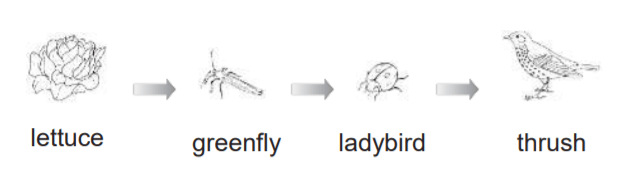
Who is the producer?
lettuce
greenfly
ladybird
thrush

What is a producer?
an organism that gets energy from eating other organisms
an organisms that uses sunlight to make its own food
an organism that gets energy from eating dead organisms, non-living material or waste

A connection of food chains with many food energy paths in an ecosystem is a ____________
ecosystem
food web
environment
I am an autotroph.
Carnivore
Producer
Omnivore
Consumer

I make my own food.
Carnivore
Producer
Omnivore
Consumer

*Remember Humans are on the top of all food chains because we do not get hunted.


Which of these completes the food chain correctly?
a rock
a fox
a plant
an egg

Which of these is a possible food chain for this environment?
Sun → grass → fly → frog
frog → fly → grass → Sun
Sun ← grass ← fly ← frog
Sun → fly → frog → snake

