
 Worksheets
1st 9 Weeks Exam
Total questions: 133
Worksheet time: 1hrs 28mins

Which of these did the Homestead Act do?
Allowed settlers to build two-story homes
Allowed settlers to settle into Florida
Allowed settlers to claim 160 acres in the West for free
What was the main purpose of the Transcontinental Railroad
To make China powerful
To make Native Americans move off their land.
To help with transportation, communication, and to connect the nation
To give immigrants a job, to feel important, and needed in America
The Central Pacific and the Union Pacific companies hired workers from _________ and _________ to build their railroads.
Japan and Germany
China and Germany
China and Ireland
Ireland and Japan
Which animals were greatly affected by the Transcontinental Railroad being built?
buffalo
horses
cattle
birds
The Transcontinental Railroad connected the __________________________.
north and south
north and west
east and west
east and south
Which amendment gave African-Americans the right to vote in 1869?
13th Amendment
15th Amendment
14th Amendment
Democratic
Targaryen
The Populist Party arose in the late 1800s out of the concerns of:
the middle class
the wealthy
factory owners
farmers
Which of the following always hurt farmers?
Gold Miners
Railroads
American Indians
Exodusters
Agricultural overproduction, scarcity of money, high shipping costs, debt, and rural isolation.
Monopoly
Farmers Problems
Pull Factors of Westward Expansion
Cross of Gold Speech
The process where one person or group blends and becomes part of a larger group
cultural diffusion
amalgamation
assimilation
cultural absorption
Which of the following was intended to assimilate Native Americans?
Homestead Act
Dawes Act
Chinese Exclusion Act
Interstate Commerce Act
Why was it called the "Gilded Age"?
America had many organizations for immigrants to join.
America looked bright and shiny from the outside, but had problems, like corruption.
It was beginning to build many large cities, with skyscrapers.
Andrew Carnegie and John D Rockefeller created monopolies. What is a monopoly?
When one person or company controls a market
a board game created by Rockefeller and Carnegie
a law that gave them advantages in business
______ invented the ______, a car that was created on the assembly line and inexpensive enough for regular Americans to buy.
Alexander Graham Bell, Rolls Royce
Henry Ford, Model T
Thomas Edison, Tesla
The growth of cities is called:
assimilation
ruralization
mechanization
urbanization
During the Gilded Age there was a notable increase in federal support for-
the growth of big business
involvement in foreign wars
the acquisition of foreign territories
increased temperance regulations

Which Andrew Carnegie quotation best explains why he funded libraries other philanthropic ventures like the one in this photograph?
"The best means of benefiting the community is to place within its reach the ladders upon which the aspiring can rise"
"Under the law of competition, the employer of thousands is forced into the strictest economies... and often there is friction between the employer and the employed"
"The price which society pays for the law of competition, like the price it pays for cheap comforts and luxuries, is... great"
"This, then, is... the duty of the man of wealth: To set an example of modest, unostentatious living, shunning display or extravagance"
- Founded what became US Steel
- Wrote the Gospel of Wealth
- Used profits in philanthropic activities
What Gilded Age individual best represents the description above?
John D. Rockefeller
Andrew Carnegie
George Pullman
Thomas Edison
Which sentence best describes a labor union
An organized group of child laborers fighting for better treatment
An organized group or workers fighting for better rights
An organized group of bosses and owners fighting for better rights
A long-term impact of labor unions was
Improvement of working and living conditions for workers
Unsanitary and dangerous working conditions
Labor Unions lost the ability to go on Strike
The creations of capitalism and communism
Capitalism is best described as
The idea that government should stay out of the economy and people should have unrestricted competition
The idea that government must be strong and create an equal society with no economic competition
There needs to be a balanced approach with government control of part of the economy with economic competition
Reforming means
Changing something for the better
Controlling something
Buying something
Approving Something
Regulate means -
to buy
To accept
To control
to change
Which 2 people helped the poor during the Progressive Era?
Henry Bessemer
Jacob Riis
Thomas Edison
Jane Addams
During what Era could Muckrakers be found?
The Progressive Era
The Gilded Age
During what Era was rapid Industrialization happening?
The Gilded Age
The Progressive Era
During what Era did the government follow a
laissez-faire policy towards the Economy?
The Progressive Era
The Gilded Age
Suffrage is -
the right to vote
the right to suffer
the right to live
the right to speak
Jacob Riis and Jane Addams fought to improve the lives of which group?
African Americans
Immigrants
Miners and farmers
the working class and poor
In what states did women have suffrage before the 19th Amendment passed in 1920?
Western states
Eastern states
Southern states
Northern states
Which factor encouraged Progressive reform efforts in the early 1900s?
rapid growth of immigrant populations in urban areas
quotas that were enacted to limit the number of immigrants
transportation improvements that linked sections of the country
unions coming to agreements with businesses to avoid lockouts
The first antitrust law to include a provision prohibiting price setting and price discrimination was the
Federal Trade Commission Act.
Interstate Commerce Act.
Sherman Antitrust Act.
Clayton Antitrust Act.
Which of the following can be attributed to W.E.B. Du Bois?
the weakening of the Back to Africa movement
the development of the Underground Railroad
the increase of industrial education available for African Americans
the founding of the National Association for the Advancement of Colored People (NAACP)
Which amendment established Prohibition in the United States?
24th Amendment
21st Amendment
18th Amendment
15th Amendment
writers who raked up the 'muck' or dirt of American life.
muckrakers
imperialists
progressives
idealists
creator of settlement houses to assist immigrants moving to the United States
W.E.B. Dubios
Elizabeth Canton
Jane Addams
Ida B. Wells
Considered a Progressive President who initiated the 'Square Deal'
Theodore Roosevelt
Franklin D. Roosevelt
Harry Truman
William Jennings Bryan
Responsible for the 'New Freedom' taming big business and encouraging greater competition. Would later be the President during World War I
Woodrow Wilson
Franklin D. Roosevelt
William Howard Taft
Harry Truman

F
G
H
J

F
G
H
J
Who wrote The History of Standard Oil, a book which describes how John D. Rockefeller used ruthless business practices in the oil industry?
Ida Tarbell
Jane Addams
Jacob Riis
Lincoln Steffens
Look at the following list, which shows the goals of a movement from the early 1900's , and answer the question below.
-Abolish child labor
-Restrict working hours for mothers
-Enact public health programs
-Raise wages for workers
These goals are MOST closely associated with which movement?
Civil Rights
isolationist
Social Gospel
temperance

In the cartoon above, President Theodore Roosevelt is depicted doing which of the following?
Standing guard to protect big business
Enforcing the Sherman Anti-Trust Act
Leading a government take-over of large industries
Putting an end to industries that might harm the environment

Leader of the Tuskegee Institute that provided vocational education & job training for African Americans
Booker T. Washington
WEB Dubois
Believed that African Americans should first establish themselves by hard work to earn the respect of whites before pushing for civil rights
Booker T. Washington
WEB Dubois
Called for full and immediate civil rights for African Americans
Booker T. Washington
WEB Dubois
________________was a widely held belief in the 19th century United States that its settlers were destined to expand across North America.
Imperialism
Annexation
Monroe Doctrine
Manifest Destiny
Which president said “speak softly and carry a big stick; you will go far.” The U.S. Navy is the “big stick” he is referring to.
Woodrow Wilson
William H. Taft
Teddy Roosevelt
Why did the United States "need" territories like the Philippines and Hawaii?
they acted as refueling stations for ships
they had once belonged to the United States
to rid the Americas of European powers
so that those countries did not imperialize the US
Which of the following is not a territory that the US acquired through war?
Alaska
Puerto Rico
Guam
Philippines
As a result of helping Cuba win independence from Spain, the US gained Guantanamo Bay and...
the ability to intervene in Cuba whenever the US saw fit to do so
the ability to have US representatives in the Cuban government
the ability to control the Cuban economy
the ability to annex Cuba
How did the US gain the rights to build the Panama Canal?
the US helped Panama achieve independence from Colombia
a treaty with Colombia whom controlled Panama
the US purchased the land from Panama for 7.2 million dollars
the US helped Colombia put down a rebellion in Panama
What was the name given to Taft's foreign policy?
Dollar Diplomacy
Big Stick
Moral Diplomacy
Taft Corollary
What were the two main locations of fighting during the Spanish-American War?
Alaska and Hawaii
Puerto Rico and Guam
Cuba and the Philippines
Spain and the United States
Most US overseas possessions in 1900 were located in the ___________ Ocean
Pacific
Atlantic
What is yellow journalism?
A kind of news writing that readers believe to be lies
A kind of news writing that readers blame for starting wars
A kind of writing that tells the truth to attract readers
A kind of writing that exaggerates the news to shock and attract readers
A policy in which a strong nation seeks to dominate other countries politically, economically, or socially. This led to the creation of a number of European empires which extended around the world.
annexation
imperialism
manifest destiny
expansionism
This is the belief in regards to imperialism that it must be done so as to lead "backwards" people towards the light of democracy...
White Man's Burden
Open Door Policy
Self-determination
Sphere of Influence
Which significant event led to the start of the Spanish-American War?
sinking of the USS Maine
sinking of the USS Lusitania
attack on southern Florida by Cuba
the coronation of Liliuokalani
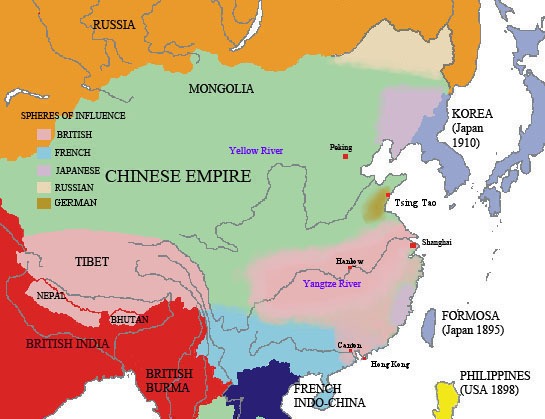
This gave every country equal access to trade with China.
Boxer Rebellion
Open Door Policy
Modernization
Sphere of Influence

This political cartoon from 1908 titled "No Limit" demonstrates which one of the causes of World War I?
Imperialism
Militarism
Alliance Systems
Nationalism
Wilson envisioned an international body empowered to resolve multinational disputes peacefully known as _________?
United Nations
League of Nations
Fourteen Points
Postwar League

What is the artists message in this political cartoon?
The League of Nations helps keep the United States close to its allies.
The League of Nations forces the United States to be bound to foreign nations.
The League of Nations will save the United States from future conflicts.
Americans enjoy being controlled by foreign nations.
Payments to cover war costs
mandate system
Lloyd George
armistice
Georges Clemenceau
reparations

What is the policy of glorifying power and keeping an army prepared for war?
Nationalism
Militarism
Imperialism
Patriotism

The purpose of propaganda during World War I was to
censor the press
inform the public
expose antiwar activity
influence public opinion

The Zimmerman note, which pushed the United States to enter the war, exposed the German plan to
make a truce with Russia
help Mexico regain U.S. territory
sink passenger ships without warning
plant German spies in the United States
What treaty ended World War I?
The Treaty of Paris
The Treaty of London
The Treaty of Belgium
The Treaty of Versailles
What country was blamed for WWI?
USA
Russia
Germany
Serbia
The Roaring Twenties were characterized by-
internment camps, the rationing of goods, and the first use of an atomic bomb
bank failures, the New Deal, and bread lines
installment plans, prohibition, and flappers
brinkmanship, McCarthyism, and a policy of containment
Which pull factor contributed to the Great Migration?
The availability of land grants for homesteaders
Economic opportunities in industrialized cities
Better soil conditions in previously uncultivated areas
The lower cost of living in urban areas
The establishment of speakeasies in the 1920's was an unintended consequence of which federal government action?
The taxation of imported luxury goods
The deportation of suspected communist sympathizers
The prohibition of the sale of alcoholic beverages
The implementation of immigration restrictions

Which inference about the 1920s is supported by this illustration?
Women confronted discrimination in employment and education.
Women challenged traditional attitudes and social norms.
Reform organizations targeted women's issues.
Mass media reflected trends popular in rural communities.
Attorney-General A. Mitchell Palmer conducted a series of raids... The most spectacular of the "Palmer Raids" occurred in January 1920.
-"Start-up of the Department and WWI, 1913-1921," U.S. Department of Labor, www.dol.gov (accessed November 21, 2013)
What was the primary reason for the raids described in this excerpt?
To prevent workers from joining labor organizations
To block civil rights advocates from staging public protests
To suppress the teaching of evolution in college
To halt the spread of communist ideas by radicals
Many Progressives opposed social Darwinism because it promoted the idea that -
people in lower classes were not capable of economic success
immigration weakened national unity
the government should take responsibility for the well-being of people
poverty could be eradicated through increased economic regulation

Cartoons such as this one took the position that deportation was necessary because-
assimilation programs in the United States had been unsuccessful
economic decline had increased the competition for jobs
communists were infiltrating the United States
political machines had too much power in urban areas
Which of these resulted from the prohibition of alcohol during the 1920s?
A decline in immigration rates
A growing fear of communism
The expansion of the consumer economy
The rise of organized crime
During the 1920s, Clarence Darrow and William Jennings Bryan were most closely identified with the-
increased use of credit by US consumers
development of new forms of popular entertainment
decline of public support for Progressive reforms
conflict between modernism and traditionalism
Which of these cause-and-effect relationships is accurate?
The ideas of social Darwinism led to the passage of Prohibition laws.
The signing of the Treaty of Versailles contributed to the implementation of the New Deal.
The ideas of the Harlem Renaissance influenced the growth of the Civil Rights movement.
The rise of fascism in Italy influenced the onset of the Red Scare
Which of the following was a major contribution of the Harlem Renaissance to US culture?
It led to the increased popularity of vaudeville stage performers.
It brought the most significant beat poets together.
It established jazz as a prominent musical form.
It focused attention on the antiwar literary genre.

SS.912.A.5.2
Which event do these newspapers describe?
Cold War
Red Scare
Prohibition
Great Migration
SS.912.A.5.10
Why was there racial unrest in Northern cities after World War I?
African Americans had been given the right to vote for the first time.
African-American baseball players were being allowed to play on previously all-white teams.
The arrival of large numbers of immigrants from Eastern Europe caused tensions with African Americans.
The migration of African Americans and returning African-American veteran had created greater competition for jobs and housing.
SS.912.A.5.9
Which best describes the activities of the Ku Klux Klan during the 1920s?
successfully achieved control of both the Congress and the Presidency
assisted Marcus Garvey in transporting African Americans "back to Africa"
were mainly directed at preventing African Americans from voting in the South
promoted anti-immigrant, anti-African-American, anti-Catholic, and anti-Jewish sentiments

SS.912.A.5.8
What do the philosophies of these three African-American leaders suggest?
African Americans believed that racial equality could not be achieved in the United States.
Only Booker T. Washington felt that whites would accept African Americans as equals.
Conditions were generally acceptable to the African-American community as they were.
Frustrations with continuing inequality led African Americans to fight discrimination in different ways.
SS.912.A.5.6
What did African-American writers, artists, and musicians hope to achieve during the Harlem Renaissance?
to display their ability as conscientious workers in the workplace
to show that the pursuit of material success can often lead to tragedy
to demonstrate that African Americans could produce great works of literature and art
to reveal that conditions for African Americans in the South were almost as bad as in the North
After the Great Migration this was an awakening of African American culture in the 1920s defined by art, literature and jazz.
The Great Awakening
The Harlem Renaissance
Tin Pan Alley Movement
The March on Washington
Which Civil Rights leader believed African-Americans should form their own communities or move to Africa?
Susan B Anthony
WEB Du Bois
Booker T Washington
Marcus Garvey
Secretary of the Interior—leased oil-rich government land to two business friends in exchange for personal bribes, during Warren H. Hardings Administration
Ku Klux Klan
Whitewater
TeaPot Dome Scandal
Watergate
a successful, flourishing, or thriving condition, especially in financial respects; good fortune. prosperities, prosperous circumstances, characterized by financial success or good fortune.
Healthy
Prosperity
Loving
Migration
How did FDR plan to change the role of the federal government?
He wanted to increase the role of the executive branch and its power over Congress and the Supreme Court
He wanted to put Congress in charge of the Supreme Court
He wanted to follow the direction of Congress to solve the Great Depression
He wanted to reduce the overall power of the federal government over the states
The purpose of the FDIC was to
provide insurance on bank deposits and restore people's faith in the banking industry
provide increased job opportunities through government jobs
re-open the Stock Market with increased regulations and safety nets
grant tax relief to citizens who deposit money in the bank
How did Americans feel about Hoover's approach to the Great Depression?
They accepted his "hands-off" approach and policy of "rugged individualism"
They were glad that Hoover did not increase federal programs and therefore increase taxes
They expected Hoover and the federal government to help them, and nicknamed shantytowns "Hoovervilles" in anger
They began promoting radical communism in an attempt to overthrow Hoover's capitalist policies
What is the significance of FDR's "court-packing" plan?
He successfully increased his influence over the Supreme Court
The Supreme Court came to pass all New Deal policies
Congress upheld the separation of powers and shut down FDR's plan
Congress granted FDR total control over the federal government, creating uproar among the American people
Which event marked the end of the Roaring 20's and the started of the Great Depression in the 1930s?
The election of Herbert Hoover
The Stock Market Crash
The Dust Bowl
The Election of Franklin D. Roosevelt
Which New Deal organization provided electricity to the states in the south through the building of dams?
Civilian Conservation Corps
Works Progress Administration
Tennessee Valley Authority
Agricultural Adjustment Administration
Which New Deal organization worked to build infrastructure, including roads, schools, parks, etc?
Civilian Conservation Corps
Works Progress Administration
Agricultural Adjustment Administration
Social Security Act

What was the time span of The Great Depression?
1929-1940
1929-1937
1929-1944
1929-1911
What was the first order of business by FDR when he got into office?
End the depression
closed the stock market for a week
bank holiday
close Hoovervilles
shanty towns built of cardboard houses
Wall Street
Black Tuesday
Hooverville
Ruhr Valley


the nation's central bank
Associative State
Federal Reserve System
Gross National Product
Reconstruction Finance Cooperation
government funded building projects that provide jobs
Associative State
Cooperative
New Deal
Public Works
conversational radio address given by Franklin D. Roosevelt
Fireside Chats
Neighborhood Meetings
Public Works Campaign
New Beginnings

