
 Worksheets
Ch. 2 Test Review
Total questions: 29
Worksheet time: 23mins
What two types of measurements make up DENSITY?
Volume and Weight
Temperature and Mass
Mass and Volume
How is 0.000387 written in scientific notation?
387 x 106
3.87 x 10⁴
38.7 x 10⁻³
3.87 x 10⁻⁴
The standard form of 7.21 x 10⁶ is
721,000,000
721,000
7,210,000
7,210
How would 6.14 x 10⁻³ be written in standard form?
0.00614
6,140
0.000614
61,400
Which part of the scientific notation expression tells you whether the decimal point moves to the left or the right?
the exponent
the coefficient
the base of 10
The number 0.0069 has...
2 sigfigs
4 sigfigs
5 sigfigs
1 sigfig
The number 5003.20 has ....
4 sigfigs
2 sigfigs, same as decimal places
6 sigfigs
What is the proper way to report this calculation ?
17.34 / 3.45?
5.026 because the 17.34 has the most sigfigs
5.03 because the 3.45 has the fewest sigfigs
5.026087 because you need the most decimal places for accuracy
5 because you should round the final answer to the nearest whole number
Which is the proper way to report this calculation?
12.345 + 3.72
16.065 because 12.345 has the most sigfigs
16.1 because 3.72 has the fewest sigfigs
16.07 because 3.72 has the fewest decimal places
16 because you always round to the nearest whole number
"the amount of matter in a substance"
Volume
Mass
Length
Weight
2500 meters is ___ kilometers
250 km
25 km
2.5 km
25,000 km
Mass is
the same as weight
the amount of matter in an object
the amount if weight in an object
the amount of gravity in an object
What is an independent variable?
What a scientist changes in an experiment to test their hypothesis
What scientist measure to see if it responded to a change
What happens when you do an experiment
What you keep the same throughout all experimental groups
What is an dependent variable?
What a scientist changes in an experiment to test their hypothesis
What scientist measure to see if it responded to a change
What happens when you do an experiment
What you keep the same throughout all experimental groups
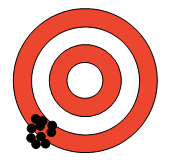
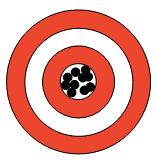
This bullseye demonstrates...
High Accuracy & High Precision
High Accuracy & Low Precision
Low Accuracy & High Precision
Low Accuracy & Low Precision
Accuracy means
the measurements are close to each other
the measurement is close to the true value
the measurements are close to each other
the measurements are close to each other and the true value.
What are the SI base units for length and volume?
cm and mL
g and L
m and L
kg and cm^3
A balloon expands when temperature is increased. What is the relationship between temperature and volume?
Direct Proportion
Indirect Proportion
Inverse Proportion
No Relationship
How close a measurement is to the accepted value is called..
Accuracy
Precision
Significant
Estimate
In the number 3.71 x 10^5, what does 3.71 represent?
exponent
sign
coefficient
standard notation

