
 Worksheets
Mr. Baker 5th Grade Trimester One Science Review Quiz
Total questions: 52
Worksheet time: 27mins
Gravity _____
PULLS on objects
PUSHES on objects
is only on EARTH
All of the Above
Which of the following has gravity?
The sun
A Building
A Mountain
All of the Above

A CURVED PATH an object takes around another object is called _____ .
Gravity
Orbit
Motion
Revolution

Gravity is a _____ that _____
2 objects towards one another.
thing
reaches
energy
pushes
force
pulls
weight
takes

Which of these has the strongest gravity?
Earth
Moon
Jupiter
Sun
Venus

What keeps the planets in orbit around the sun?
gravity
friction
magic
distance
An example of a gravity is that the Earth...
none of the above
Which of the following planets is closest to the Sun?
Venus
Jupiter
Mars
Neptune
Day and night on Earth occurs due to _____.
the rotation of the Earth
the tilt of the Earth's axis as it revolves around the Sun
the revolution of the moon around Earth
the rotation of our moon
Which diagram best explains why the sun appears to move across the sky each day?
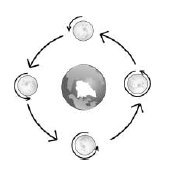


What do the Earth, Moon, and Sun have in common?
They all produce light.
They all have a rocky composition.
They all rotate.
They all are primarily composed of gases.
Which planet in our solar system is the furthest from the Sun?
Mercury
Neptune
Earth
Jupiter

What is an orbit?
A path an object takes while traveling around another object.
The time it takes an object to make a full turn on its axis.
An imaginary line that an object rotates around.
An invisible force that is determined by the distance between two objects and their masses.
This causes day and night:
rotation
revolution

The spinning of the Earth on its axis is called...
revolution
orbit
rotation
dizzy

This is the imaginary line that goes through the Earth. (hint: the Earth spins on this)
North Pole
South Pole
orbit
axis

What is the closest star to earth?
moon
star
sun
How many planets are there?
7
9
8
3
How many groups are the planets broken into?
3
2
1
4
What are the 4 inner planets?
Mercury, Jupiter, Saturn, Pluto
Earth, Venus, Mars, Neptune
Mercury, Venus, Earth, Mars
Jupiter, Saturn, Neptune, Uranus
What are the 4 outer planets?
Mercury, Venus, Earth, Mars
Uranus, Mercury, Earth, Mars
Jupiter, Uranus, Saturn, Neptune
Jupiter, Saturn, Earth, Mars
The first planet, closest to the Sun, and the smallest planet. Is extremely hot during the day and freezing cold at night.
Mercury
Jupiter
Venus
Uranus
The second planet from the Sun, the atmosphere is made up of 96% carbon dioxide, extremely hot and the atmospheric pressure is bone crushing.
Earth
Venus
Mars
Saturn
The third planet from the Sun, has liquid water, and keeps a temperature that allows humans to live
Earth
Venus
Mercury
Mars
The fourth planet from the Sun, called the Red planet, and extensively explored and observed
Neptune
Venus
Jupiter
Mars
What are the 2 characteristics of the 4 outer planets.
They are rocky and small in size
Larger planets and made of gas
Closer to the Sun and made of gas
Farther from the Sun and made of gas
The fifth planet, the largest planet and has a large storm called the Giant Red Spot that is visible from Earth
Neptune
Uranus
Jupiter
Earth
The sixth planet, known for its rings made of ice particles, considered the lightest planet and is 95% than Earth
Jupiter
Saturn
Neptune
Uranus
The seventh planet, originally called Herschel, rotates on its side due to the angle of the axis.
Uranus
Jupiter
Neptune
Mercury
The eighth planet, a dark blue color, windiest planet, with a set of rings including a set of rings that are braided
Neptune
Uranus
Earth
Mars
Discovered in 1930, originally a planet and then switched to a dwarf planet in 2006.
Pluto
Neptune
Uranus
Jupiter
Which planet is the smallest
Mercury
Venus
Earth
Mars
Which of the planets considered to be hospitable to life.
Mars
Venus
Mercury
Earth

This planet is a gas giant. (2 answers)
Saturn
Mercury
Earth
Jupiter

This planet spins on its side.
Neptune
Uranus
Earth
Jupiter

This planet is mostly covered in blue water and green land.
Earth
Mercury
Jupiter
Pluto

The hottest planet in our solar system
Mars
Earth
Venus
Saturn

This planet is the smallest planet in our solar system.
Neptune
Mercury
Saturn
Earth
The eighth planet, a dark blue color, windiest planet, with a set of rings including a set of rings that are braided
Neptune
Uranus
Earth
Mars

Identify the state of matter.
Solid
Liquid
Gas
None of these

Identify the state of matter.
Solid
Liquid
Gas
None of these
Gases and liquids are also called ______.
Fluids
Solid
Particles are packed very tightly with each other in a ______.
Liquid
Solid
Gas
Plasma
The process by which water changes into vapour is called ______.
Boiling
Condensation
Freezing
Sublimation
Snow ______ to form water.
Melts
Condenses
Freeze
Evaporate

The air in a balloon is a...
Solid
Pizza
Gas
Liquid

Water in a cup is a ....
Liquid
Solid
Gas
Ice Cream

A brick is a ...
Rock
Gas
Solid
Water
Solids
Don't have a definite volume
Have a definite shape but haven't a definite volume
Can hold its shape
Have a definite shape and volume
Liquids
have a definite shape and volume
don't have a definite shape
It flows or runs but it can't be stretched or squeezed.
What are the three forms of matter?
Space, Light, and Air
Solid, Licks, Gap
Solid, Liquid, Gas
Rocks, sand, pebbles
What would happen to ice cream left on the kitchen table during 3 hours?
It would freeze
It would turn into a solid
It would evaporate
It would melt

