wayground logo

Free Printable Worksheets

NEW

Font size

S
M
L
XL
Worksheets

Bonding and Nomenclature, FM, % comp, EF and MF Review

Total questions: 45

Worksheet time: 8hrs 30mins

Name
Class
Date
1.
Which pair has the same empirical formula?
a)
NaCrO4 and Na2Cr2O7
b)
C2H4O2 and C6H12O6
c)
C3H6Oand C2H6O2
d)
CH4 and C2H6
2.
A compound consists of 72.2% magnesium(Mg) and 27.8% nitrogen(N) by mass. What is the empirical formula?
a)
Mg4N3
b)
MgN2
c)
Mg3N
d)
MgN
3.
What is the molecular formula if the empirical formula is CH2O and the molecular molar mass is 180.18?
a)
CH2O
b)
C2H4O2
c)
C4H8O4
d)
C6H12O6
4.

What is the empirical formula of C4H6 ?

a)

CH

b)

CH3

c)

C2H3

d)

C4H6

5.

What is the molar mass of PbSO4?

a)

303.27 g/mol

b)

255.27 g/mol

c)

163.87 g/mol

d)

372.27 g/mol

6.

What is the equation for calculating percent composition?

a)

(total mass of element) / (formula mass of compound) x 100

b)

(formula mass of compound) / (mass of element) x 100

c)

(mass of element) / (formula mass of compound) x 100

d)

total mass of element) x (molar mass) x 100

7.

What is the percent composition by mass of magnesium in the compound MgSO4

a)

20%

b)

27%

c)

46%

d)

53%

8.
What is the empirical formula for the following molecular formula: C6H14
a)
C6H14
b)
C3H7
c)
CH2
d)
CH3
9.
What is the molecular formula if the empirical formula is C2H5 and the molecular molar mass is 58.14 g/mol?
a)
C2H5
b)
C4H10
c)
C1H2.5
d)
C4H8
10.
How to calculate molar mass of H2O?
a)
2+16=18
b)
1+16=17
c)
2+32=34
d)
1+31=32
11.

What is the molar mass of CO2?

a)

12 g/mol

b)

16 g/mol

c)

32 g/mol

d)

44 g/mol

12.
Which of the following is NOT needed to calculate percent composition?
a)
Mass of specific element
b)
Molar Mass
c)
Avogadro's Number
d)
Division
13.

Calculate the molar mass of Ba(C2H3O2)2

a)

255.3 g/mol

b)

237.3 g/mol

c)

228.3 g/mol

d)

196.3 g/mol

14.
What type of bond forms when electrons are transferred from one atom to another?
a)
ionic bond
b)
atomic bond
c)
covalent bond
d)
metallic bond
15.
The bond between Na & F.   Ionic or covalent?
a)
Ionic
b)
Covalent
16.
The bond between N & H.   Ionic or covalent?
a)
Ionic
b)
Covalent
17.
Which of the following gives the correct chemical formula for the compound Magnesium Phosphide?
a)
Mg2P3
b)
MgP
c)
Mg3P2
d)
MgP2
18.
Which of the following gives the correct chemical formula for the compound Dinitrogen Monoxide?
a)
NO
b)
N2O
c)
N2O2
d)
O2N2
19.
What is the correct chemical name for the ionic compound: Fe3N2
a)
Iron nitride
b)
Iron (III) nitride
c)
Iron (II) nitride
d)
TriIron dinitride
20.
What type of atoms make a covalent bond?
a)
only Nonmetals
b)
Metal and a Nonmetal
c)
only Metals
d)
only Noble Gases
21.
Ionic bonds are between...
a)
Metal and Non-metal
b)
Non-metal and Non-metal
c)
Metal and Metal
22.
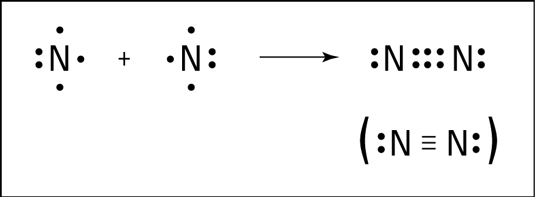
Given the picture, what type of bond is  holding the atoms together in this molecule?
a)
polar covalent bond
b)
nonpolar covalent bond
c)
ionic bond
d)
metallic bond
23.
How do covalent bonds form?
a)
Donating & receiving valence e- between atoms.
b)
Opposite slight charges attract each other between compounds.
c)
Scientists are still not sure how they form.
d)
Sharing valence e- between atoms.
24.
What do we call a covalent bond where electrons are shared UNEVENLY or UNEQUALLY?
a)
Ionic
b)
Polar Covalent
c)
Nonpolar Covalent
d)
Van der Waals Force
25.
Which of these forces applies to all molecules
a)
London Dispersion
b)
Dipole dipole
c)
Hydrogen Bonding
d)
Covalent bonding
26.

The difference in electronegativity affects the type of bond will be formed. What type of bond would be formed with a difference of 2.0?

a)

Covalent

b)

Polar Covalent

c)

Ionic

27.

The difference in electronegativity affects the type of bond will be formed. What type of bond would be formed with a difference of 0.3?

a)

Covalent

b)

Polar Covalent

c)

Ionic

28.
Metals tend to 
a)
gain electrons
b)
lose electrons
29.
Nonmetals tend to 
a)
gain electrons
b)
lose electrons
30.
If I gain electrons I become
a)
Positive because I've added to my atom
b)
negative because I've added electrons
c)
same because i'm balanced
d)
equal because now I have electrons
31.
Which of the following is NOT an ionic compound:
a)
CaO
b)
NaOH
c)
BaCl2
d)

OBr2

32.
How do the following two elements bond together?
Al3+  O2-         
a)
AlO
b)
Al2O3
c)
Al3O6
d)
Al3O2
33.

Name this compound: NH4F

a)

Ammonia fluoride

b)

Ammonium fluorite

c)

Ammonia fluorate

d)

Ammonium fluoride

34.

Name the following ionic compound: LiNO3

a)

lithium nitrate

b)

lithium III nitrate

c)

lithium nitride

d)

lithium oxide

35.
The proper formula for magnesium hydroxide:
a)
MgOH
b)
Mg2OH
c)
Mg(OH)2
d)
Mg2OH2
36.
The name of Al₂(SO₄)₃ is
a)
aluminum sulfur oxide
b)
aluminum sulfate
c)
aluminum trisulfate
d)
aluminum (III) sulfate
37.
Name the acid: HC2H3O2
a)
Acetic Acid
b)
Acetous Acid
c)
Hydrogen Acetate
d)
Hydrogen Dicarbon Trihydrogen Dioxygen
38.
What is the formula for nitric acid?
a)
HNO2
b)
HNO3
c)
HNO4
d)
H2NO3
39.

What is the formula for hydrochloric acid?

a)

HCl (aq)

b)

HClO

c)

H3ClO3

d)

HClO3

40.

When naming oxyacids, change "-ite" to:

a)

-ate

b)

-ic

c)

-ous

d)

-ite

41.

When naming oxyacids, change "-ate" to:

a)

-ate

b)

-ic

c)

-ous

d)

-ite

42.
Hydrogen bonding occurs when hydrogen is bonded to N, O, or F.  Which of the following has hydrogen bonding?
a)
CBr4
b)
NO2
c)
H2S
d)
NH3
43.
Does HCl have hydrogen bonding?
a)
yes
b)
no
44.

________________________ have the strongest intermolecular forces of attraction.

a)

Dipole- Dipole

b)

Dispersion

c)

Hydrogen Bonds

45.

Which compound is a binary molecular compound?

a)

N2O

b)

HCl (aq)

c)

BaCl2

d)

KBr2