
 Worksheets
Food Chain/Web & Life Cycles
Total questions: 54
Worksheet time: 42mins

The original source of energy for a food web is...
plants
sun
producers
decomposers

Decomposers get energy from...
the sun
eating plants
eating animals
dead things and waste

Arrows in a food web represent...
eating
sunlight
energy
matter
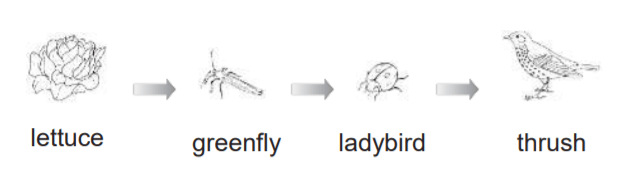
Who is the producer?
lettuce
greenfly
ladybird
thrush

What is a producer?
an organism that gets energy from eating other organisms
an organisms that uses sunlight to make its own food
an organism that gets energy from eating dead organisms, non-living material or waste

What is a herbivore?
an animal that gets energy from eating other animals
an organism that gets energy from eating only plants
an animal that gets energy by eating both plants and other animals

An organism that gets energy from eating other organisms is a ______________
producer
consumer
decomposer

What is a carnivore?
an animal that gets energy by eating other animals
An animal that gets energy by eating only plants
an animal that gets energy by eating both plants and animals

An animal that gets energy from eating both plants and animals is a(n)
herbivore
carnivore
omnivore

Which of the following is NOT a consumer
grass
dog
shark
fish
Why are decomposers important?
they break down dead animals and replace nutrients in the soil.
they provide energy to consumers
they make their own food
they collect sunlight
In the a food chain, there is the sun and then the producer. What comes after the producer?
the primary consumer
the secondary consumer
a secondary producer
a tertiary consumer
Which of the following is NOT a producer?
algae
trees
mold
plant
Which of the following is a correct food chain?
grass - fox - rabbit
owl - mouse - seed
leaf - deer - wolf
leaf - snake - worm
A prey is an animal that...
is killed and eaten by other animals
kills other animals
only eats plants
is not in a food chain

An animal that hunts other animals for food is a ___________
herbivore
predator
prey
omnivore

sun
tree
caterpillar
hawk

What is a Carnivore?
Animal that eats only plants
Animal that eats only meat
Animal that eats both plants and meat

Which organism is a consumer of the mouse?
cricket
grass
fox
Sun

This picture shows which stage of the butterfly?
pupa
egg
larva
adult
How are frogs and butterflies alike?
They both like flowers
They both eat fish
They both start out as an egg
They both like to swim
What is a life cycle?
a stage in an insect life cycle between egg and adult.
something the washing machine does
how a living thing starts life, grows, lives, and dies
the stage in the insect life cycle between larva and adult.
What does MOLT mean?
to lay an egg
growth stage
resting stage
shed it's outer layer
After a frog hatches from an egg it looks just like an adult frog.
TRUE
FALSE
People go through metamorphosis.
True
False
Metamorphosis is...
A total change or transformation.
Giving birth.
Hatching from an egg.
Blending into one's environment
_________ is a major change in the body form of an animal during its life cycle.
Larva
Pupa
Metamorphosis

This picture shows an insect that goes through ________ metamorphosis.
complete
incomplete

Grasshoppers go through incomplete metamorphosis. This means they go through _________ of development between the egg and the adult.
two stages
one stage

Butterflies go through ________ of development between the egg and the adult.
two stages
one stage

Complete metamorphosis
Incomplete metamorphosis
Not metamorphosis

Complete metamorphosis
Incomplete metamorphosis
Not metamorphosis

Complete metamorphosis
Incomplete metamorphosis
Not metamorphosis
the stage in which the young animal looks just like the adult.
Nymph
Metamorphosis
Larva
Heredity
Pupa
How many stages are in a complete metamorphosis lifecycle.
3
4
1
2
What are the stages of a butterfly's life cycle?
Pupa
Nymph
Larva
Egg
Select the animals that undergo a incomplete metamorphosis
Beatle
Cow
Butterfly
Dolphin
How do you know an insect has entered it's adult stage of metamorphosis?
It has legs
It has attennas
It has wings
It has hands

Which stage does this represent?
egg
larva
nymph
pupa

Which stage does this represent?
egg
larva
nymph
pupa

Which stage does this represent?
egg
larva
nymph
pupa

Which type of metamorphosis is represented?
complete metamorphosis
incomplete metamorphosis
How many stages are found in incomplete metamorphosis?
2
3
4
5
Which correctly lists the stages of complete metamorphosis in order?
egg, larva, pupa, adult
egg, pupa, larva, adult
pupa, adult, egg, larva
larva, egg, adult, pupa
Which correctly lists the stages of incomplete metamorphosis in order?
egg, nymph, adult
egg, adult, nymph
nymph, adult, egg
adult, nymph, egg
Which stage is not a part of complete metamorphosis?
egg
larva
nymph
pupa
Which stage is not a part of incomplete metamorphosis?
adult
egg
larva
nymph
Which stage of metamorphosis seems to be at rest?
adult
pupa
larva
nymph


What do frog and ladybug life cycles have in common? Both frogs and ladybugs spend time as -

