
 Worksheets
Area of Triangles and Quadrilaterals
Total questions: 25
Worksheet time: 40mins

Which of the following is the correct formula to find the area of a parallelogram?
A=2bh
A=(21)h
A=bh
A=(21)b
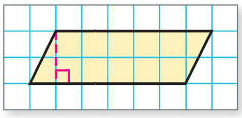

Find the area of the parallelogram in square inches.
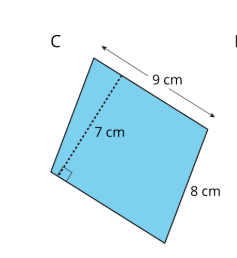
What is the area of the parallelogram in square centimeters?
Remember that height comes at a right angle! Look for the right angle FIRST, and then decide the base and height.

Which of the following is the correct formula to find the area of a triangle?
A=bh
A=2bh
A=31bh
A=2bh or A=21bh

Which expression below will find the Area of this triangle?
2(6 ×8)
2(6 ×10)
2(8×14)
2(6 ×14)

True or False? Any side of a triangle can be the base side.
True--it doesn't have to be the bottom side in the orientation of the triangle. You can turn the triangle until the base is the bottom if you want.
False--the base can only be the side on the bottom.
To find the area of a triangle, you need to know the _________ and ________.
sides and sides
base and height
bottom and top
length and width

A triangle height has to be ______ to its base.
parallel (lines that would never intersect)
criss crossed
perpendicular (meeting at a right angle)
curved

We know we can use ANY triangle side as the base, so long as we have a height marked perpendicular (at a right angle) to it.
Which side would be the best to use as the base of the triangle, because it's connected to the height by a right angle?
18 cm
14 cm
8 cm
6 cm

What is the area of this triangle?
Remember that base and height come at a right angle, and the base does NOT need to be at the bottom.
You can always turn the triangle if it helps to see the base at the bottom.
14 units2
24 units2
48 units2
20 units2

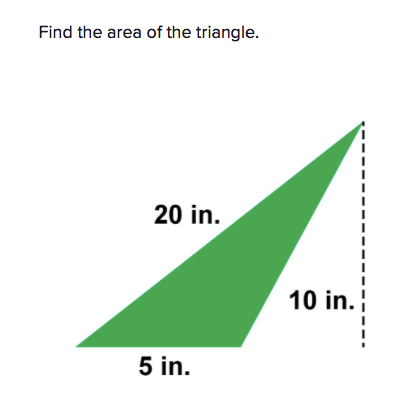
Find the area of the triangle.
Remember that the height is the measurement from the base line to the tip of the triangle. The height can be counted outside of the triangle and must be counted outside for this triangle.
11.5 square units
21 square units
28 square units
14 square units

What is the Area of this Triangle?
60 units2
20 units2
30 units2
65 units
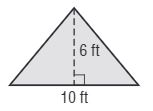
Find the area of the figure.
Note that the ten feet base is the measurement across the entire base side. The dotted line for height does not affect the base measurement.
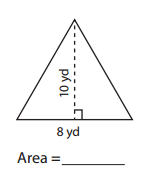
Find the area of the triangle in square yards.
Type only the numerical answer with no units.
(a)
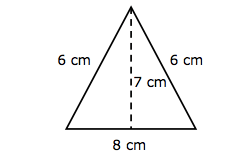
Find the area of the triangle.
20 cm2
56 cm2
28 cm2
27 cm2

Find the area of the triangle in square inches.
Type only the numerical answer. Do not use any units.
(a)

What is the area?
30 m2
11 m2
25 m
15 m2
Find the area
Watch the video regarding how to visually find the area of a trapezoid. Order the steps according to the video.
Duplicate the trapezoid so you have two congruent trapezoids.
Flip one trapezoid. Now arrange the two into a single, long parallelogram.
Find the measurement of the parallelogram base by adding up the two different original trapezoid bases.
Find the area of the parallelogram you created.
To find the area of the trapezoid, half the parallelogram area.

In a trapezoid, the bases are always_________.
congruent (same lengths)
parallel (would never intersect if the lines continued)
perpendicular (meet at a right angle)
The top and bottom of the trapezoid.
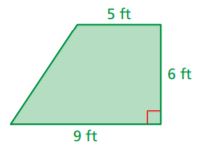
Correctly fill in the area formula for the green trapezoid.
A=2(b1+b2)⋅h
A=2(5+9)⋅6
A=2(6+9)⋅5
A=2(5+6)⋅9
The correct use of the formula for the area of this trapezoid is shown.
A=2(b1+b2)⋅h
A=2(5+9)⋅6
What is the area of this trapezoid in square feet? Type only the numerical answer with no units.
(a)

Find the area of the figure using the trapezoid formula.
A=2(b1+b2)⋅h

Find the Area.

