

wayground logo

Free Printable Worksheets

Font size

S
M
L
XL
Worksheets

Atoms & Periodic Table Practice Test

Total questions: 51

Worksheet time: 1hrs 8mins
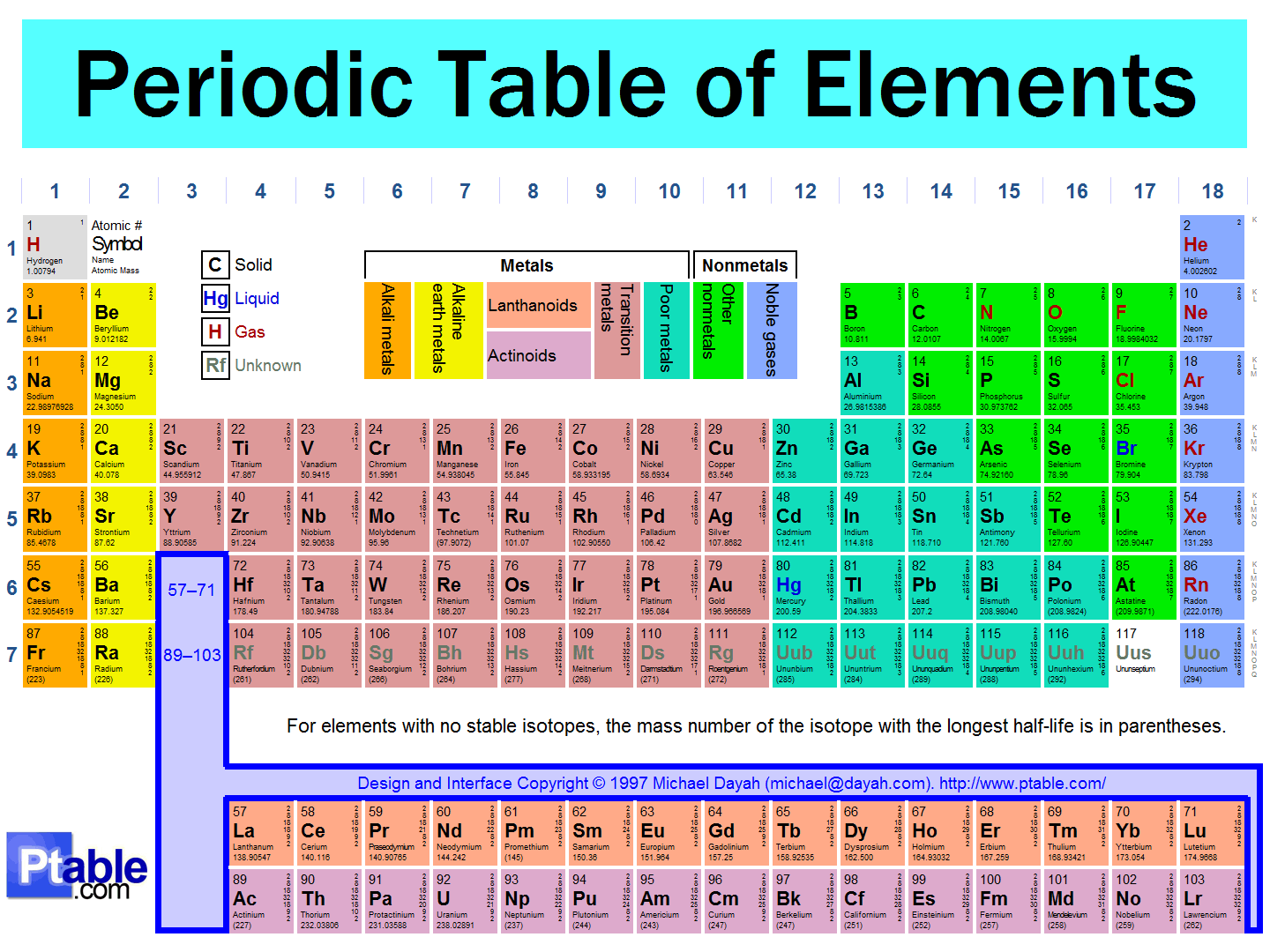
Name
Class
Date
1.

The vertical (up and down) columns in the Periodic Table are called

a)

groups

b)

towers

c)

periods

d)

atomic numbers

2.
Elements in a ..................have similar chemical properties.  
a)
period
b)
group
c)
row
3.

What period is this element located in?

a)

1

b)

2

c)

3

d)

4

4.

What group is this element located in?

a)

5

b)

6

c)

7

d)

8

5.

What period is this element located in?

a)

1

b)

2

c)

3

d)

4

6.

How many valence electrons does this element have?

a)

20

b)

2

c)

4

d)

1

7.

The horizontal (left to right) rows on the periodic table are known as

a)

periods.

b)

atoms.

c)

groups or families.

d)

valence electrons.

8.
These are found on the Periodic Table.
a)
Compounds
b)
Elements
c)
Mixtures
9.
The Modern Periodic Table of Elements is arranged by
a)
atomic mass
b)
atomic number
c)
valence electrons
d)
number of isotopes
10.
What does the 1.00794 stand for?
a)
Hydrogen
b)
atomic number
c)
atomic mass
d)
atomic explosion
11.
Each column in the periodic table is called a 
a)
period
b)
group
c)
cluster
d)
unit
12.
How many protons are in this element?
a)
79
b)
196
c)
117
d)
Cannot be determined
13.
What's a valence electron?
a)
electrons in the second energy level
b)
electrons in the outermost energy level
c)
the atomic number
d)
electrons in the first level
14.

one or two letters that represent the name of an element

a)

element name

b)

element symbol

c)

atomic number

d)

atomic mass

15.
What does the 1.00794 stand for?
a)
Hydrogen
b)
atomic number
c)
atomic mass
d)
atomic explosion
16.

a unique number for each element that equals the number of protons in an atom of that element

a)

element name

b)

element symbol

c)

atomic number

d)

atomic mass

17.
Which of the following atomic symbols for bromine is written correctly?
a)
bR
b)
BR
c)
Br
d)
br
18.

What does the C represent?

a)

atomic mass

b)

atomic number

c)

element name

d)

chemical symbol

19.

What does the 6 represent?

a)

atomic mass

b)

atomic number

c)

element name

d)

chemical symbol

20.

What does 12.011 represent?

a)

atomic mass

b)

atomic number

c)

element name

d)

chemical symbol

21.

The Atomic number is known as the _______

a)

Number of electrons in an atom

b)

Number of Protons in an atom

c)

Number of neutrons in an atom

d)

Number of Protons and electrons in an atom

22.

What is Atomic Mass Number ?

a)

Number of Protons

b)

Number of Neutrons

c)

Number of Protons and Neutrons

d)

Number of Protons and Electrons

23.

The number of electrons in an atom is equal to the...

a)

Atomic number

b)

Protons

c)

Atomic Mass

d)

Neutrons

24.

The formula used to calculate the number of neutrons is:

a)

Mass Number - Atomic Number

b)

Protons + Electrons

c)

Atomic Number - Mass Number

d)

Protons x2

25.

Elements in the same group have : (2 correct answers)

a)

Similar chemical properties

b)

Similar names

c)

Same number of outer (valence) electrons)

d)

The same number of protons

26.
Something that takes up space and has mass.
a)
volume
b)
matter
c)
mass
d)
density
27.
The amount of space something takes up
a)
density
b)
volume
c)
mass
d)
matter
28.
__________ are the building blocks of life.
a)
solids
b)
gases
c)
atoms
d)
nutrients
29.
The positive particles of an atom are 
a)
electrons 
b)
positrons 
c)
neutrons 
d)
protons 
30.
the central region of an atom where its neutrons and protons are is its 
a)
nucleus 
b)
electron cloud
c)
core 
d)
center 
31.
Particles in an atom that are neutral and have no charge are 
a)
negatrons 
b)
electrons 
c)
neutrons 
d)
protons 
32.

What does the atomic number tell you?

a)

The number of neutrons

b)

The number of protons

c)

The number of protons + neutrons

33.

What does the atomic mass tell you?

a)

The number of neutrons + protons

b)

The number of electrons

c)

The number of electrons + protons

34.

What is the atomic mass of Oxygen?

a)

8

b)

16

c)

0

35.

Cobalt has 27 protons, 32 neutrons, and 27 electrons. What is the atomic number?

a)

32

b)

59

c)

27

d)

5

36.

What is b?

a)

Neutron

b)

Proton

c)

Electron

37.
These have a negative electric charge and move around outside the nucleus.
a)
electron
b)
proton
c)
neutron
38.

The subatomic particles that make up an atom.

a)

solid, liquid, gas

b)

electrons, protons, nucleus

c)

energy, protons, nucleus

d)

electrons, protons, neutrons

39.

What particles are in the nucleus?

a)

Protons

b)

Neutrons

c)

Electrons

d)

Nucleus

40.

Which particle is outside the nucleus?

a)

Protons

b)

Neutrons

c)

Electrons

d)

Nucleus

41.

Which two particles have mass?

a)

Protons

b)

Neutrons

c)

Electrons

d)

Nucleus

42.

The cloud-like space that electrons travel around:

a)

nucleus

b)

shell

c)

neutrons

d)

Oort cloud

43.
Which of the following is NOT a characteristic of most metals?
a)
Brittle
b)
Good conductor
c)
Ductile
d)
Malleable
44.
Most __________ conduct electricity very well.
a)
types of glass
b)
plastics
c)
metals
d)
types of rubber
45.
Having the ability to be drawn into a wire describes which property?
a)
Malleable
b)
Ductile
c)
Brittle
d)
Nonconductor
46.

Which words best describe NON-METALS?

a)

ductile, shiny, brittle

b)

malleable, dull, brittle, ductile

c)

brittle, dull, insulators

47.

What does "malleable" mean?

a)

Can be made into a shape.

b)

Brittle

c)

Ductile

d)

Shiny

48.

Iron is a good conductor, malleable and magnetic. What type of element is Iron?

a)

Metal

b)

Non Metal

c)

Metalloid

d)

Pretty

49.
Which of the following is a property of a non-metal?
a)
Conducts electricity and heats well
b)
Can be hammered into thin sheets
c)
Is brittle and breaks easily
d)
Has a shiny, metallic luster
50.
Metalloids _____________
a)
have no properties of metals.
b)
have no properties of nonmetals.
c)
have some properties of both metals and nonmetals.
d)
none of the above
51.
Where are metalloids located on the periodic table?
a)
to the right of nonmetals
b)
along the zig-zag line
c)
to the left of the zig-zag line
d)
to the right of the zig-zag line
