
 Worksheets
Gas laws
Total questions: 31
Worksheet time: 1hrs 3mins
Name
Class
Date
1.
When the temperature of matter increases the particles...
a)
speed up and move closer
b)
speed up and move farther apart
c)
slow down and move closer together
d)
slow down and move farther apart
2.
How do gas molecules move?
a)
in an orderly fashion
b)
constantly and randomly
c)
in straight line paths
d)
in a circular motion
3.
True or False: Gases can be compressed.
a)
True
b)
False
4.
When Pressure increases then the Volume must...
a)
Increase
b)
decrease
5.
When Volume increases then Pressure must...
a)
Increase
b)
Decrease
6.
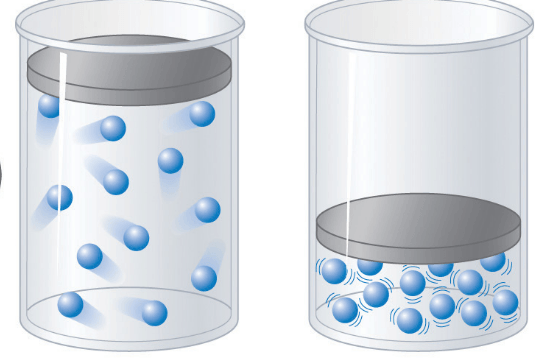
Which container will have a lower pressure?
a)
left
b)
right
c)
they both have the same pressure
d)
I don't know
7.
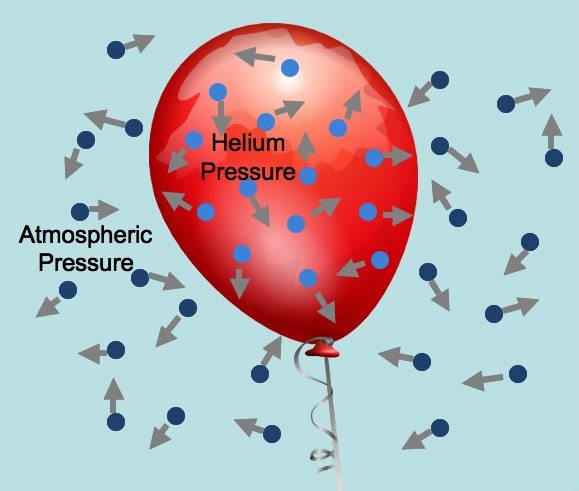
What causes pressure?
a)
The walls of the container
b)
The vacuum in the container
c)
The collisions of the particles
d)
Atmospheric pressure acting on the outside walls
8.
According to Boyle's law of PV, at constant temperature, as the pressure of a given sample of gas is increased, the volume will –
a)
Increase
b)
Decrease
c)
Remains the same
9.
Boyle's PV law : When _______ is held constant, the pressure and volume of a gas are ________ proportional
a)
temperature, equally
b)
mass, inversely
c)
temperature, inversely
d)
mass, equally
10.

If a balloon is cooled what will happen to the volume?
a)
Volume will increase
b)
Volume will decrease
c)
Volume will not change
11.
Which of the following would increase the (gas) pressure of a system?
a)
Increase the Temperature
b)
Pump in more gas
c)
Decrease the volume
d)
All of these
12.
The word inverse means.......
a)
the same
b)
opposite
13.
Gas Laws involve what three terms?
a)
Solid Liquid Gas
b)
Speed Velocity Acceleration
c)
Elements Compounds Mixtures
d)
Pressure Temperature Volume
14.
Temperature describes the ______________ of particles.
a)
volume
b)
mass
c)
motion
d)
conductivity
15.
What is the formula for Boyle's Law?
a)
P1V1=P2V2
b)
P1V1/P2V2
c)
P1V2=P2V1
d)
P1/V1=P2/V2
16.
What is the formula Charles' Law?
a)
V = T
b)
VT = VT
c)
T1 / V1 = T2 / V2
d)
V1 / T1 = V2 / T2
17.
What is 50 C in Kelvin?
a)
223
b)
323
c)
100
d)
50
18.
atm, kPa, and mmHg are units for
a)
Pressure
b)
Volume
c)
Temperature
d)
Mass
19.
mL and L are units for
a)
Pressure
b)
Volume
c)
Temperature
d)
Mass
20.

This graph demonstrates which gas law?
a)
Boyle's Law
b)
Charles' Law
c)
Combined Gas Law
d)
Ideal Gas Law
21.

This graph demonstrates which gas law?
a)
Ideal Gas Law
b)
Boyle' Law
c)
Dalton's Law
d)
Charles' Law
22.
A hydrogen balloon has an inital pressure of 1.50 atm and is inflated from 2L to 6L. What is the final pressure of this ballon after it is inflated?
a)
2.0 atm
b)
8.0 atm
c)
0.5 atm
d)
10.5 atm
23.
What is the variable for this number 22.4 L
a)
P
b)
T
c)
n
d)
V
24.
What is the variable for this number 32oC
a)
P
b)
T
c)
n
d)
V
25.
What is the variable for this number 9.10 atm
a)
P
b)
T
c)
n
d)
V
26.
What is the variable for this number 122 K
a)
P
b)
T
c)
n
d)
V
27.
What is the variable for this number 1.5 mol
a)
P
b)
T
c)
n
d)
V
28.
PV=nRT
a)
Charles Law
b)
Boyle's Law
c)
Combined Gas Law
d)
Ideal Gas Law
29.
Calculate the volume that a 0.323-mol sample of a gas will occupy at 265 K and a pressure of 0.900 atm.
a)
7.18 L
b)
7.81 L
c)
4.63 L
d)
4.36 L
30.
Determine the Kelvin temperature required for 0.0470 mol of gas to fill a balloon to 1.20 L under .998 atm pressure.
a)
0 K
b)
107 K
c)
207 K
d)
307 K
31.

Which of the following graphs represents pressure versus volume (V) for a real gas at a constant temperature
a)
A
b)
B
c)
C
d)
D
100 %

