wayground logo

Free Printable Worksheets

Font size

S
M
L
XL
Worksheets

AB Quarter 1 Exam Review

Total questions: 130

Worksheet time: 6hrs 54mins

Name
Class
Date
1.
What is the limit of the function as x approaches -4 from the left?
a)
2
b)
-4
c)
DNE
d)
-2
2.

 Find  limx2 f(x)\lim_{x\rightarrow2^-\ }f\left(x\right)  

a)

-1

b)

5

c)

0

d)

DNE

3.

 Find  limx2+ f(x)\lim_{x\rightarrow2^+\ }f\left(x\right)  

a)

-1

b)

5

c)

0

d)

DNE

4.

 Find  limx2 f(x)\lim_{x\rightarrow2\ }f\left(x\right)  

a)

-1

b)

5

c)

0

d)

DNE

5.

 Find  f(2)f\left(2\right)  

a)

-1

b)

5

c)

0

d)

undefined

6.

 Find  limx1 f(x)\lim_{x\rightarrow-1^-\ }f\left(x\right)  

a)

4

b)

0

c)

-1

d)

DNE

7.

 Find  limx1+ f(x)\lim_{x\rightarrow-1^+\ }f\left(x\right)  

a)

4

b)

0

c)

-1

d)

DNE

8.

 Find  limx1 f(x)\lim_{x\rightarrow-1\ }f\left(x\right)  

a)

4

b)

0

c)

-1

d)

DNE

9.

 Find  f(1)f\left(-1\right)  

a)

4

b)

0

c)

-1

d)

undefined

10.

 Find  limx4 f(x)\lim_{x\rightarrow-4^-\ }f\left(x\right)  

a)

-2

b)

3

c)

-4

d)

DNE

11.

 Find  limx4+ f(x)\lim_{x\rightarrow-4^+\ }f\left(x\right)  

a)

-2

b)

3

c)

-4

d)

DNE

12.

 Find  limx4 f(x)\lim_{x\rightarrow-4\ }f\left(x\right)  

a)

-2

b)

3

c)

-4

d)

DNE

13.

 Find  f(4)f\left(-4\right)  

a)

-2

b)

3

c)

-4

d)

undefined

14.
a)

0

b)
DNE
c)
3
d)
1
15.
a)
-1
b)
-4
c)
8
d)
5
16.
a)
DNE
b)
-10
c)
-3
d)
-4
17.
a)

DNE

b)
-2
c)
3
d)
0
18.
a)
13
b)
7
c)
6
d)
-3
19.

What technique would you use to find this limit?

a)

Direct Substitution only

b)

Factor & Cancel

c)

Conjugate Multiplication

d)

Rewrite with a Trig Identity

20.
a)
0
b)
3
c)
4
d)
DNE
21.
a)
Does not exist
b)
2
c)
0
d)
1
22.
a)

DNE

b)

1

c)

2.9

d)

3

23.

 Find  limx2+ f(x)\lim_{x\rightarrow2^+\ }f\left(x\right)  

a)

-1

b)

5

c)

0

d)

DNE

24.
a)

1

b)

10

c)

7

d)

DNE

25.

Find limx01+x1x\lim_{x\rightarrow0}\frac{\sqrt{1+x}-1}{\text{x}}

a)

12\frac{1}{2}  

b)

14\frac{1}{4}  

c)

DNE

d)

0

26.

Evaluate the limit

a)

-1

b)

0

c)

d)

-∞

e)

DNE

27.

Evaluate the limit

a)

-1

b)

0

c)

2

d)

4

e)

DNE

28.

The graph of the function, f(x) is shown in the graph. What is limx1f(f(x))?\lim_{x\rightarrow-1}f\left(f\left(x\right)\right)?  

a)

1

b)

2

c)

5

d)

dne

29.

The graph of the function, f(x) is shown in the graph. What is limx2f(f(x))?\lim_{x\rightarrow-2}f\left(f\left(x\right)\right)?  

a)

1

b)

2

c)

5

d)

dne

30.

The graph of the function, f(x) is shown. What is f(2)?f\left(2\right)?  

a)

1

b)

3

c)

4

d)

dne

31.

Let limx2f(x)=16\lim_{x\rightarrow-2}f\left(x\right)=16  . Find  limx2f(x)\lim_{x\rightarrow-2}\sqrt{f\left(x\right)}  

a)

4

b)

-2

c)

2

d)

16

32.

Let limx8f(x)=3 and limx8g(x)=10.\lim_{x\rightarrow8}f\left(x\right)=3\ and\ \lim_{x\rightarrow8}g\left(x\right)=10.  Find  limx8f(x)g(x).\lim_{x\rightarrow8}\frac{f\left(x\right)}{\text{g(x)}}.  

a)

8

b)

10/3

c)

-7

d)

3/10

33.

Find limx4x2+3x28x4\lim_{x\rightarrow4}\frac{x^2+3x-28}{x-4}

a)

11

b)

0

c)

DNE

d)

3

34.

Find limx2xx+22x+4\lim_{x\rightarrow2}\frac{\text{}\frac{x}{x+2}-2}{x+4}

a)

4

b)

-4

c)

14\frac{1}{4}  

d)

14-\frac{1}{4}  

35.

Find limx21x12x2\lim_{x\rightarrow2}\frac{\frac{1}{x}-\frac{1}{2}}{x-2}

a)

DNE

b)

14\frac{1}{4}  

c)

12\frac{1}{2}  

d)

14-\frac{1}{4}  

36.
a)
DNE
b)
-10
c)
-3
d)
-4
37.

Which of the following best describes the continuity at x = 1?

a)

Continuous

b)

Removable Discontinuity

c)

Infinite Discontinuity

d)

Jump Discontinuity

38.

limx1(ln(x)3x)\lim_{x\rightarrow1}\left(\frac{\ln\left(x\right)}{3x}\right)  

a)

0

b)

3/e

c)

e

d)

3

39.

limx0  4sinxcosxsinxx2\lim_{x\rightarrow0}\ \ 4\frac{\sin x\cos x-\sin x}{x^2}  

a)

2

b)

40/3

c)

infinity

d)

0

40.

limxa x22ax+a2xa\lim_{x\rightarrow a}\ \frac{x^2-2ax+a^2}{x-a}  

a)

- infinity

b)

a

c)

0

d)

infinity

41.
a)

I only

b)

II only

c)

I and II only

d)

I, II, and III

42.

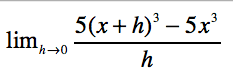
limh0 52(x+h)(52x)h\lim_{h\rightarrow0}\ \frac{5-2\left(x+h\right)-\left(5-2x\right)}{h}  

a)

2

b)

DNE

c)

0

d)

-2

43.

limx15 (6)\lim_{x\rightarrow15}\ \left(6\right)  

a)

DNE

b)

15

c)

6

d)

0

44.

limx0 sin2x5x\lim_{x\rightarrow0}\ \frac{\sin2x}{5x}  

a)

1/10

b)

2/5

c)

0

d)

1/5

45.

limx0 tan3x4x\lim_{x\rightarrow0}\ \frac{\tan3x}{4x}  

a)

3/4

b)

1/4

c)

0

d)

DNE

46.

limx0 1cos3x10x\lim_{x\rightarrow0}\ \frac{1-\cos3x}{10x}  

a)

1/10

b)

3/10

c)

DNE

d)

0

47.

limx0 sin2(6x)9x2\lim_{x\rightarrow0}\ \frac{\sin^2\left(6x\right)}{9x^2}  

a)

0

b)

4

c)

2/3

d)

4/9

48.
Name the discontinuity at x=2. 
a)
Infinite Discontinuity
b)
Removable Discontinuity
c)
Jump Discontinuity
d)
Continuous at x=2
49.
Name the discontinuity at x=2. 
a)
Infinite Discontinuity
b)
Removable Discontinuity
c)
Jump Discontinuity
d)
Continuous at x=2
50.
Name the discontinuity at x=2. 
a)
Infinite Discontinuity
b)
Removable Discontinuity
c)
Jump Discontinuity
d)
Continuous at x=2
51.
Name the discontinuity at x=2. 
a)
Infinite Discontinuity
b)
Removable Discontinuity
c)
Jump Discontinuity
d)
Continuous at x=2
52.
What is the Vertical Asymptotes? 
a)
x= -5
b)
x= 5
c)
x= 6
d)
x= -6
53.

Where are the discontinuities?

a)

holes: x=-1

asymptotes: x=5/3

b)

holes: x=-1

asymptotes: x=2/3

c)

holes: x=1

asymptotes: x=5/3

d)

holes: x=1

asymptotes: x=2/3

54.

Which of the following graphs presents an infinite discontinuity at x = 1?

a)
b)
c)
d)
55.

What is the removable discontinuity?

a)

x= 4

b)

x= -4

c)

x= 5

d)

x= -5

56.

In interval notation, positive and negative ∞ are always closed in by ______.

a)

( ) Parentheses

b)

[ ] Square Brackets

c)

{ } Curly Brackets

57.

Find the domain: 13+x\frac{1}{3+x}  

a)

(−∞,∞)

b)

(−∞,−3)

c)

(−∞,−3)∪(−3,∞)

d)

(−3,∞)

58.

Find the domain: x5\frac{\sqrt[]{x}}{5}  

a)

(−∞,∞)

b)

[0,∞)

c)

(0,∞)

d)

(−∞,0)∪(0,∞)

59.

Find the domain: 1x216\frac{1}{x^2-16}  

a)

(−∞,4)∪(4,∞)

b)

(−∞,−4)∪(−4,∞)

c)

(−∞,−4)∪(−4,4)∪(4,∞)

d)

(−∞,−4)∪(4,∞)

60.

Find the domain of f(x)=x+1x3f\left(x\right)=\frac{x+1}{x-3}  

a)

(∞,3)∪(3,∞)

b)

(−∞,−1)∪(−1,∞)

c)

(3,∞)

d)

(−∞, −1)∪(−1,3)∪(3,∞)

61.

Find the domain f(x)=x+1xf\left(x\right)=\frac{x+1}{\sqrt[]{x}}  

a)

(0,∞)

b)

(−∞,∞)

c)

[0,∞)

d)

(−∞,0)∪(0,∞)

62.
Which of the following best describes the continuity at x = 5?
a)
Continuous
b)
Removable Point Discontinuity
c)
Non-removable Infinite Discontinuity
d)
Non-removable Jump Discontinuity
63.
The following function is not continuous at x = 3 because...
a)
f(3) does not exist
b)
limit from left of 3 does not equal limit from right of 3
c)
3 is not a lucky number
64.

A function f(x)f\left(x\right)  has to be continuous at x=ax=a  if the limxa f(x)\lim_{x\rightarrow a}\ f\left(x\right)  exists.

a)

True

b)

False

c)

cannot be determined

65.
Find the value that makes the function continuous
a)
c=1/3
b)
c=3
c)
c=-3
d)
c=-1/3
66.

Let f be the function defined above where c is a constant. For what value of c, if any is f continuous at x=c ?

a)

6

b)

8

c)

10

d)

There is no such value c

67.
What is the horizontal asymptote?
a)
y = -4
b)
y = 1
c)
x = 1
d)
y = -6
68.

limx sin xx+4\lim_{x\rightarrow\infty}\ \frac{\sin\ x}{x}+4  

a)

1

b)

0

c)

DNE

d)

4

69.

limx x+74x2+3x=...\lim_{x\rightarrow\infty}\ \frac{x+7}{\sqrt{4x^2+3x}}=...  


a)

-\infty  

b)

\infty  

c)

12\frac{1}{2}  

d)

0

e)

12-\frac{1}{2}

70.

Does this function have any vertical asymptotes? If so, what are their equations? y=(x+3)(x4)(x+7)(x4)y=\frac{\left(x+3\right)\left(x-4\right)\left(x+7\right)}{\left(x-4\right)}  

a)

No vertical asymptotes.

b)

One vertical asymptote: x = 4

c)

Two vertical asymptotes: x = -3 and x = -7

d)

Three vertical asymptotes:  x = -3, x = 4, and x = -7

71.

f(x)=(x+7)(x3)(x+1)(x3)(x5)f\left(x\right)=\frac{\left(x+7\right)\left(x-3\right)\left(x+1\right)}{\left(x-3\right)\left(x-5\right)}  

Select all of the true statements.

a)

A hole occurs where x=3

b)

vertical asymptote at x=3

c)

vertical asymptote at x=5

d)

A hole occurs where x=5

72.

Suppose h is a continuous function containing the ordered pairs shown in the table. On which interval must h have a zero?

a)

(12.163, 12.164)

b)

(12.164, 12.165)

c)

(12.165, 12.166)

d)

(12.166, 12.168)

73.

Consider the function

f(x)=1x35f\left(x\right)=\frac{1}{x-3}-5  .  Can you conclude that there must be a zero between f(2) and f(3.1)?

a)

Yes, because f(2) is negative and f(3.1) is positive.

b)

No, because f(2) is negative and f(3.1) is also negative.

c)

Yes, because f(2) is positive and f(3.1) is negative.

d)

No, because there is a discontinuity at x = 3.

e)

No, because f(2) is positive and f(3.1) is also positive.

74.

Let f be a continuous function for which f(-2)=1 and f(5)=-3. The Intermediate Value Theorem guarantees that

a)

f(c)=2 for at least one c between -3 and 1

b)

f(c)=0 for at least one c between -2 and 5

c)

f(c)=0 for at least one c between -3 and 1

d)

f(c)=2 for at least one c between -2 and 5

75.

To justify that a function is continuous you must show... 

a)

f(c) is defined

b)

limxc\lim_{x\rightarrow c}  exists

c)

f(c) = limxcf(x)f\left(c\right)\ =\ \lim_{x\rightarrow c}f\left(x\right)  

d)

All of these

76.

Which of the following is a continuous function at all real numbers?

a)

f(x)=x1f\left(x\right)=\sqrt[]{x-1}  

b)

f(x)=x2+2x+1x+1f\left(x\right)=\frac{x^2+2x+1}{x+1}

c)

f(x)=x1f\left(x\right)=x-1

d)

f(x)=1xf\left(x\right)=\frac{1}{x}

77.

limx5   x+52 = ....\lim_{x\rightarrow-5}\ \ \ \frac{x+5}{2}\ =\ ....  

a)

0

b)

5

c)

\infty  

d)

52\frac{5}{2}  

e)

25\frac{2}{5}  

78.

Find the  limx2 f(x)×g(x)\lim_{x\rightarrow2}\ f\left(x\right)\times g\left(x\right)  if  f(x) = x2+3; g(x)= 2f\left(x\right)\ =\ x^2+3;\ g\left(x\right)=\ 2  

a)

2

b)

14

c)

11

d)

12

79.
Derivative means the same thing as
a)
slope of the tangent line
b)
slope of the normal line
c)
exponent
d)
potato
80.
The derivative of a function is its
a)
Slope
b)
Maximum/Minimum
c)
Instantaneous rate of change
d)
Common Denominator
81.
a)

15x2

b)

(5/4)x4

c)

indeterminate

d)

82.

f'(x)=

a)

limh0(f(x+h)f(x)h)\lim_{h\rightarrow0}\left(\frac{f\left(x+h\right)-f\left(x\right)}{h}\right)

b)

limxc(f(x)f(c)xc)\lim_{x\rightarrow c}\left(\frac{f\left(x\right)-f\left(c\right)}{x-c}\right)

c)

dydx\frac{\text{d}y}{\text{d}x}

d)

an equation for the slope of the tangent line

83.

limxx2+3x5\lim_{x\rightarrow\infty}x^2+3x-5  

a)

-\infty  

b)

2

c)

0

d)

\infty  

84.

limx(x2+x3x4x3+1)\lim_{x\rightarrow\infty}\left(\frac{x^2+x-3}{x^4-x^3+1}\right)  

a)

-\infty  

b)

0

c)

1

d)

\infty  

85.
a)
b)
c)
d)
86.
a)
b)
c)
d)
87.
a)
b)
c)
d)
88.
a)
b)
c)
d)
89.
a)
b)
c)
d)
90.
a)
b)
c)
d)
91.
a)

f'(x) = -sin x

b)

f'(x)= sinx

c)

f'(x)= cos x

d)

f'(x) = - cos x

92.
a)

f'(x)= sin x

b)

f'(x) = - sin x

c)

f'(x) = cos x

d)

f'(x) = - cos x

93.
a)
b)
c)
d)
94.
a)
b)
c)
d)
95.
a)
b)
c)
d)
96.
a)
b)
c)
d)
97.
a)
b)
c)
d)
98.
a)
b)
c)
d)
99.
a)

the instantaneous rate of change of a function

b)

the average rate of change

c)

a rule you do to find a new equation

100.
a)
b)
c)
d)
101.

The derivative of position is...

a)

velocity

b)

acceleration

c)

position

d)

speed

102.

The derivative of velocity is...

a)

velocity

b)

acceleration

c)

position

d)

speed

103.

What rule should be used in deriving f(x) = x5

a)

Constant rule

b)

Sum rule

c)

Power rule

d)

Difference rule

104.

What is the derivative of f(x) = 2x3 - 4x + 5?

a)

f'(x) = 6x2 - 4x

b)

f'(x) = 2/3x2 - 4x

c)

f'(x) = 3x2 - 4

d)

f'(x) = 6x2 - 4

105.

Which function has the derivative of g'(x) = 4x3 + 2x - 1

a)

g(x) = 2x4 + 2x2 - 1

b)

g(x) = x4 + x2 - x

c)

g(x) = 2x3 + x3 - 2x

d)

g(x) = x5 + x2 - x

106.

At which point(s) will the slopes of the tangent line are zero?

a)

at C only

b)

at points A, C and E only

c)

at point B and D only

d)

at points A and E only

107.

Let y = (x - 1)(x + 2). Find dy/dx.

a)

2x + 1

b)

2x - 1

c)

4x - 1

d)

2x2 + x - 1

108.

Let f(x) = (x - 1)(x + 2). Find f'(0)

a)

0

b)

1

c)

2

d)

3

109.

Given f(x) = ax2 + 2bx. What are a and b if f'(x) = 8x + 6?

a)

a = 2 and b = 3

b)

a = 3 and b = 2

c)

a = 3 and b = 4

d)

a = 4 and b = 3

110.

At what point will the slope of y = -x2 + 4 is zero?

a)

(0, 4)

b)

(1, 4)

c)

(4, 0)

d)

(1, 0)

111.

What is the slope of the line normal to the curve y = x2 + x at x = 1?

a)

-1

b)

-1/2

c)

-1/3

d)

-1/4

112.

What is the equation of the line tangent to the curve y = x2 at x = 1?

a)

y = 2x + 1

b)

y = 2x - 1

c)

y = -2x + 1

d)

y = x - 1

113.

What is the derivative of f?

a)

1/(x - 1)-1

b)

-1/(x - 1)-2

c)

-1/(x - 1)

d)

-1/(x - 1)2

114.

Let y = x3 - 3x. At what value of x will the rate of change is zero? Choose the best answer.

a)

at x = 0 only

b)

at x = -1 only

c)

at x = 1 only

d)

at x = -1 or x = 1 only

115.

What is the equation of the line tangent to the curve y = -x2 + 3 at (1, 2)?

a)

y = 2x - 4

b)

y = -2x - 4

c)

y = -2x + 4

d)

y = 2x + 4

116.

What is the derivative of y = 2π?

a)

0

b)

2

c)

-2

d)

None of the above

117.

What is the rate of change of f(t) = 2t3 - 4t + 1 when t = 2s and f is in meter (m)?

a)

16 m/s

b)

20 m/s

c)

24 m/s

d)

30 m/s

118.
What is the derivative of xn?
a)
(n-1)xn
b)
nxn+1
c)
(n+1)xn-1
d)
nxn-1
119.
Find the derivative of the given equation
f(x) = 7
a)
7
b)
0
c)
7x
d)
14
120.
find 
a)
y = 2 x-1
b)
y=2 x-2
c)
y= −2x-2
d)
y= −2 x-1
121.

Which of the following is the quotient rule for derivatives?

a)

h'(x)=((g(x)f'(x) + f(x)g'(x)) / (g(x))2

b)

h'(x)=((g'(x)f'(x) - f(x)g(x)) / (g(x))

c)

h'(x)=((g(x)f'(x) - f(x)g'(x)) / (g(x))2

d)

h'(x)=((g'(x)f'(x) + f(x)g(x)) / (g(x))

122.

Which of the following is the product rule for derivatives utilizing the original function h(x) = f(x)g(x) ?

a)

h'(x)= f'(x)g'(x)

b)

h'(x)=f'(x)g'(x) + f(x)g(x)

c)

h'(x)=f'(x)g(x) - f(x)g'(x)

d)

h'(x)=f'(x)g(x) + f(x)g'(x)

123.
a)
8x4 -60x2
b)
16x4
c)
(8x4 -60x2)/(2x2-5)2
d)
3x
124.
Find the derivative.
y = x/ (3x-1)
a)
y' = 9x- 12
y' = (3x-1) / (3x-1)2
b)
y' = (3x2 - 2x) / (3x-1)2
c)
y' = (6x+1)/ 3
125.
a)

12x4 +3x2

b)

20x4 +3x2 +16x

c)

3x5 +32x3 +6x2 +8x

d)

24x3

126.
Find the derivative of y = 2x2 (3x - 4)
a)
6x3 - 8x2
b)
18x2 - 16x
c)
15x- 6x
d)
6x - 4
127.
Find the derivative: y=-1/x
a)
-1
b)
0
c)
1/x2
d)
x
128.
Find the slope of the tangent line to f(x) = -3x2-6x at x = 1.
a)
m = 0
b)
f'(x) = -6x - 6
c)
f'(x) = 6x
d)
m = -12
129.
Given f (x) = 5sinx + 3x3cosx, f '(x) =
a)
-5cosx − 3x3sinx + 9x2cosx
b)
5sinx − 3x3sinx + 9x2cosx
c)
5cosx − 3x3sinx + 9x2cosx
d)
5cosx + 3x3sinx + 9x2cosx
130.
Find the derivative of g(x)=(3x-2)/(x2+2)
a)
3/(2x)
b)
(-3x2-4x +6)/(x2+2)2
c)
(-3x2+4x +6)/(x2+2)2
d)
(-3x2+10)/(x2+2)2