
 Worksheets
work energy power
Total questions: 122
Worksheet time: 2hrs 52mins
The unit of work is
watt
hertz
joule
pascal
What is the unit for power?
what
watt
joule
Jewel-Osco
Which requires more WORK – a person WALKING up stairs OR a person RUNNING up stairs?
walking
running
they require equal work
no work is required for either because the movement is vertical
Which requires more POWER – a person WALKING up stairs OR a person RUNNING up stairs?
walking
running
they require equal power output
no power is required at all
P = F/t
P = W * t
P = F * t
Which does not illustrate kinetic energy?
It is expressed in Joule.
It depends upon the objects’ mass and speed.
It is the energy an object possesses due to its motion.
It depends upon the objects’ mass and objects’ height.
As speed increases, kinetic energy
Increases
Decreases
Stays the same
Increase then decrease
If a 4 kg cat is running at 3 m/s what is its kinetic energy?
18 J
18
12
12 J

The kid at the top of the roller coaster car pictured here has
100% Potential Energy
0% Kinetic Energy
75% Potential Energy
25% Kinetic Energy
50% Potential Energy
50% Kinetic Energy
0% Potential Energy
100% Kinetic Energy
Elastic Potential
Gravitational Potential
At halfway down the track

C
D
E

When you compress a spring, you are storing __________ energy.
sound
elastic
kinetic
chemical
Chemical
The formula for gravitational potential energy (GPE) in an object is U = mgh.
Which object will have the largest value for its GPE?
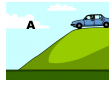
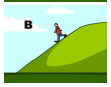
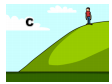
If these are all moving at the SAME SPEED, which vehicle has the greatest Kinetic Energy?
(Think about their sizes)


Which type of energy causes the arrow to shoot from the bow?
hooke's law

The diagram shows the same spring being stretched at different lengths using different masses. At which length does the spring have the MOST potential energy?
length A
length B
length C
length D
Which requires more WORK – a person WALKING up stairs OR a person RUNNING up stairs?
walking
running
they require equal work
no work is required for either because the movement is vertical
Which requires more POWER – a person WALKING up stairs OR a person RUNNING up stairs?
walking
running
they require equal power output
no power is required at all
Which does not illustrate kinetic energy?
It is expressed in Joule.
It depends upon the objects’ mass and speed.
It is the energy an object possesses due to its motion.
It depends upon the objects’ mass and objects’ height.
As speed increases, kinetic energy
Increases
Decreases
Stays the same
Increase then decrease
If a 4 kg cat is running at 3 m/s what is its kinetic energy?
18 J
18
12
12 J
The kid at the top of the roller coaster car pictured here has
100% Potential Energy
0% Kinetic Energy
75% Potential Energy
25% Kinetic Energy
50% Potential Energy
50% Kinetic Energy
0% Potential Energy
100% Kinetic Energy
Elastic Potential
Gravitational Potential
At halfway down the track
C
D
E
The formula for gravitational potential energy (GPE) in an object is U = mgh.
Which object will have the largest value for its GPE?
Work causes a change in
Sweat
Energy
Calories
Force

Where is kinetic energy at its maximum?
a
b
c
d
A force F of strength 20 N acts on an object of mass 3 kg as it moves a distance of 4 m. If F is perpendicular to the 4 m displacement, the work it does is equal to
0 J
60 J
80 J
600 J
Under the influence of a force, an object of mass 4 kg accelerates from 3 m/s to 6 m/s in 8 s. How much work was done on the object during this time?
27 J
54 J
72 J
96 J
A box of mass m slides down a frictionless inclined plane of length L and vertical height of h. What is the change in its gravitational potential energy?
mgL
mgh
hmgL
Lmgh
While a person lifts a book of mass 2 kg from the floor to a tabletop, 1.5 m above the floor, how much work does the gravitational force do on the book?
-30 J
-15 J
0 J
15 J
A satellite is currently orbiting Earth in a circular orbit of radius R; its kinetic energy is K1 . If the satellite is moved and enters a new circular orbit of radius 2R, what will be its kinetic energy?
4K1
2K1
2K1
4K1
An object of mass m is traveling at constant speed v in a circular path of radius r. How much work is done by the centripetal force during one-half of a revolution?
πmv2
0
πmv2r
2πmv2r
A block of mass m slides from rest down an inclined plane of length s and height h. If F is the magnitude of the force of kinetic friction acting on the block as it slides, then the kinetic energy of the block when it reaches the bottom of the incline will be equal to
mgh
mgs - Fh
mgh - Fs
mgh - Fs
As a rock of mass 4 kg drops from the edge of a 40-meter high cliff, it experiences air resistance, whose average strength during the descent is 20 N. At what speed will the rock hit the ground?
10 m/s
12 m/s
16 m/s
20 m/s
An astronaut drops a rock from the op of a crater on the Moon. When the rock is halfway down to the bottom of the crater, its speed is what fraction of its final impact speed?
41
2 21
21
21
A force of 200 N is required to keep an object sliding at a constant speed of 2 m/s across a rough floor. How much power is being expended to maintain this motion?
50 W
100 W
200 W
400 W
When a force acts upon an object to cause a displacement of the object, it is said that work was done upon the object.
True
False
There are three key ingredients to work. What are they? **there is more than one answer **
force
time
displacement
mass
cause
When the work is done upon the object, that object gains _____.
Mass
Energy
Power
Time
The energy acquired by the objects upon which work is done is known as _______ ___________.
(a)
Mechanical energy can be either _____ or _______. **there is more than one answer**
Power Energy
Kinetic Energy
Work Energy
Potential Energy
Which energy is referred to also as "Energy of Motion"?
(a)
Which energy is referred to also as "stored energy of position"?
(a)
One ______ is equivalent to one Newton of force causing a displacement of one meter.
Watt
Joule
Meter
Newton
______ is the unit of work.
Mass
Newton
Force
Joule
Watt
An object that possesses mechanical energy is able to do work.
True
False
mechanical energy is often defined as the ability to do work
True
False
_______ ______ is the stored energy of position possessed by an object.
Kinetic Energy
Gravitational Energy
Potential Energy
Force Energy
There are two forms of Potential Energy, what are they? **there is more than one answer*
gravitational potential energy
force potential energy
mass potential energy
elastic potential energy
_____ potential energy is the energy stored in an object as the result of its vertical position or height.
Elastic
Gravitational
_____ potential energy is the energy stored in elastic materials as the result of their stretching or compressing.
Elastic
Gravitational
_____ is the rate at which work is done.
Force
Power
Work
Energy
The standard metric unit of power is the (a) .
____ is equivalent to a Joule/second
Force
Newton
Watt
Kilogram
Joule
A particle is in motion along a straight line under the action of force F which varies with velocity v as per law F=vA where A is a constant. The work done by the force in time t is
At
At2
A/t
A/t2
A loco engine of mass 40 ton moves on a track having μ = 0.01 . When its speed is 72 kmh-1 , power developed by engine is 880 kW. Its acceleration at that instant is (in ms-2)
0.1
1
0.2
2
Power of a force acting on a particle of mass 2 kg varies with time as per P = 32t3 where P is in watt and t is in second. At t=0 the particle is at rest. its velocity at t=3 ms-1 is
2
6
22
4
if the kinetic energy increases by 800% then momentum increases by
400 %
200 %
141 %
100 %

A 1kg stone is dropped down from a height of 2m on a vertically fixed spring of spring constant k = 200 Nm-1. The maximum energy stored in the spring subsequently is ( in Joules )
20.05
25
26.2
28
Work of W is performed to compress a spring and then an additional 2W is performed to elongate it. The ratio of elongation to compression is
0
1
2
3
A body of mass M moving with the same kinetic energy K collides elastically with a mass m at rest and kinetic energy of M after collision is K/4 and it moves in the same direction. Then the ratio M/m is
2
3
3.5
4.2
After an elastic collision between a particle of speed v and a particle at rest, the lighter particle moves at v/2. The ratio of their masses is (heavier: lighter)
3/2
2
3
4
In elastic collisions
momentum is conserved
KE is conserved
Both momentum and KE are conserved
Momentum not conserved but KE is conserved
A stationary bomb explodes in to two parts, 4kg and 8kg. The velocity of the 8kg mass is 6m/s. The KE of the other body is
48J
24J
288J
16J
The formula "Force x Distance" is used to solve for (a) .
The formula "Force x Distance x Cos(angle)" is used to find (a) .
Work = if force and displacement are the same direction then work is (a) .
Work = if the force and displacement are opposite direction then the work is (a) .
This formula " TimeWork " is used to solve for (a) >
This formula " TimeForce x Displacement " is used to solve for (a) .
This formula "Mass x Velocity" is used to solve for (a) .
This formula " 21 x Mass x Velocity2 " is used to solve for (a) .
This formula " TimeMass x Velocity " is used to solve for (a) .
This formula " TimeMass x (Vf−Vi) " is used to solve for (a) .
If the numbers from both equations, "Force x Time" and "Mass x Velocity" equals the same number. Then this is referred to as (a) .
Potential Energy has two types. Which are they? **there can be more than one answer**
Elastic Potential Energy
Height Energy
Gravitational Potential Energy
Small Energy
Big Energy
The formula "Mass x Gravity x Height" is used to solve for (a) .
The formula " 21 ×K ×X2 " is used to solve for (a) .
In the Formula " PEe = 21× K × X2 " what does the K represent?
(a)
In the Formula " PEe = 21× K × X2 " what must be done if you are given two distances for X2 ?
(a)
What are the units for force?
(a)
What are the units for Power?
(a)
What are the units for Work?
(a)
For every 1kg of Mass there are how many Units of Force?
(a)
Two factors that determine work are...
Force
Mass
Velocity
Distance
Units of force are...
Newtons
Grams
Joules
Meters
Units of work are...
Newtons
Grams
Joules
Meters
If you push a cart with a force of 60 N for 2 m... how much work have you done?
120 J
30 J
120 N
30 N
Work is
having a job
movement
energy transfer
energy transfer to an object
The ( ) the force the ( ) work is done
less, more
smaller, more
bigger, more
bigger, less
If the object does not move then what is happening
work
power
no work is being done on the object
What is the unit for power?
what
watt
joule
Jewel-Osco
A basketball that is dropped bounces back up to its original height. Pick the correct energy transformation from the point when it was dropped until it returns to the original height.
KE --> PE --> Elastic
PE --> KE --> Elastic --> KE --> PE
KE --> PE --> Elastic --> PE --> KE
Elastic --> PE --> KE --> Elastic
How much power is required to raise a 200-kg crate a vertical distance of 2 m in a time of 4 s?
400 W
1000 W
1600 W
4000 W

A pendulum bob swings from potential C to D as indicated in the diagram. There is no friction or air resistance. Which of the following is not true?
Kinetic Energy decreases from C to D
Potential Energy decreases from C to D
The Total Energy stays constant from C to D.
The bob is fastest at point C.

A skier slides down an incline as shown. The work done by friction is:
Positive
Negative
Zero
All of the above
Work done by friction ____________ of the body.
(a) increases kinetic energy
(b) decreases kinetic energy
(c) increases potential energy
(d) decreases potential energy
How much power do you have if you pushed a box with a force of 10 N across the floor a distance of 5 m over a period of 5 seconds?
50 W
10 W
250 W
20 W
A 1000kg car is moving at 5m/s, what is the Kinetic Energy of the car?
6250000 J
25000 J
12500 J
2500 J
A 7.14 kg object has 700 J of stored gravitational potential energy. How high above the ground is the object?
0.9m
7.14m
10m
20m
A 2kg ball rolls with a KE of 36 J - what is the speed of the ball?
6m/s
7.4m/s
18m/s
None of these
A 50 kg object sits on the roof of a 25 m building. If we neglect friction, at what velocity will it hit the ground if it falls freely?
22.14 m/s
45 km/h
29.56 m/s
None of the above

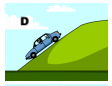
Where is the car moving fastest?
A
B
C
D

Which number shows kinetic energy at its maximum?
three
two
four
five
Stored energy or energy due to its position is called
mechanical energy
potential energy
kinetic energy
thermal energy
Which of the following statements about a skier skiing down a steep slope is true?
His kinetic energy decreases and his potential energy increases
His potential energy decreases and his kinetic energy increases
His chemical energy increases
Both his potential and kinetic energy increases
Energy in motion is called
kinetic energy
potential energy
nuclear energy
transfer energy
Kinetic energy depends on_________ and _________.
speed and mass
speed and height
height and mass
energy and height

What numbers show maximum potential energy on this pendulum?
1 and 5
1 and 4
2 and 3
3 and 4
At which point(s) on the roller coaster is the gravitational potential energy at its maximum?
A
B
C
D
The Law of Conservation of Energy states:
Energy can created or destroyed but not transformed
Energy cannot be created or destroyed, it can only transformed
Energy can't be created, destroyed or transformed
Energy cannot be created or destroyed.

What happens when the ball goes from the highest position to the lowest position
PE and KE increases and decreases together
Impossible to know without knowing the mass of the object
the PE decreases while KE increases

