Wayground logo

Free Printable Worksheets

Font size

S
M
L
XL
Worksheets

Newton's 3 Laws of Motion and Law of Universal Gravitation

Total questions: 123

Worksheet time: 2hrs 25mins

Name
Class
Date
1.
The Law of Inertia
a)
Newton's
1st
Law of Motion
b)
Newton's
2nd
Law of Motion
c)
Newton's
3rd
Law of Motion
2.
F=ma
a)
Newton's
1st
Law of Motion
b)
Newton's
2nd
Law of Motion
c)
Newton's
3rd
Law of Motion
3.
For every action, there is an equal and opposite reaction.
a)
Newton's
1st
Law of Motion
b)
Newton's
2nd
Law of Motion
c)
Newton's
3rd
Law of Motion
4.
An automobile you are riding in suddenly stops, but you continue to go forward.
a)
Newton's
1st
Law of Motion
b)
Newton's
2nd
Law of Motion
c)
Newton's
3rd
Law of Motion
5.
When the force on a car is doubled, the acceleration is doubled.
a)
Newton's
1st
Law of Motion
b)
Newton's
2nd
Law of Motion
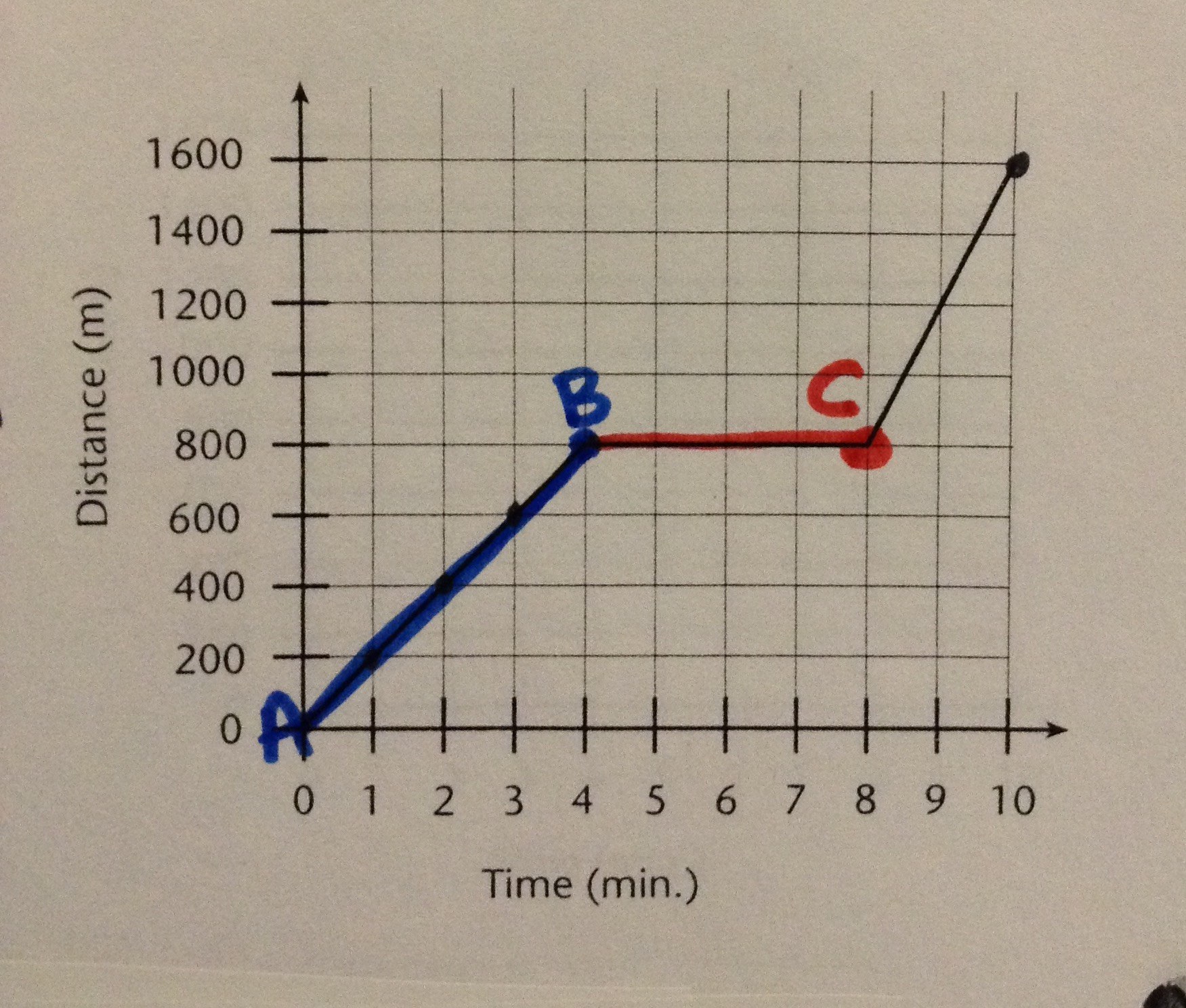
c)
Newton's
3rd
Law of Motion
6.
A stationary bumper car is set in motion by the outside force of another bumper car colliding with it.
a)
Newton's
1st
Law of Motion
b)
Newton's
2nd
Law of Motion
c)
Newton's
3rd
Law of Motion
7.
A rocket in outer space continues to move.
a)
Newton's
1st
Law of Motion
b)
Newton's
2nd
Law of Motion
c)
Newton's
3rd
Law of Motion
8.
A skater pushes another skater forward, but the one pushing moves backwards.
a)
Newton's
1st
Law of Motion
b)
Newton's
2nd
Law of Motion
c)
Newton's
3rd
Law of Motion
9.
The harder you hit a baseball, the faster it accelerates.
a)
Newton's
1st
Law of Motion
b)
Newton's
2nd
Law of Motion
c)
Newton's
3rd
Law of Motion
10.
You push against a wall and the wall is pushing back on you.
a)
Newton's
1st
Law of Motion
b)
Newton's
2nd
Law of Motion
c)
Newton's
3rd
Law of Motion
11.
The acceleration of a 4 kg bowling ball will be greater than the acceleration of a 6 kg bowling ball if the same force is applied to both.
a)
Newton's
1st
Law of Motion
b)
Newton's
2nd
Law of Motion
c)
Newton's
3rd
Law of Motion
12.
As the fuel in a rocket ignites, the force of gas expansion and explosion pushes out the back of the rocket and pushes the rocket forward.
a)
Newton's
1st
Law of Motion
b)
Newton's
2nd
Law of Motion
c)
Newton's
3rd
Law of Motion
13.
You step from a boat to a dock.  The boat moves backwards as you move forwards and you fall in the water.
a)
Newton's
1st
Law of Motion
b)
Newton's
2nd
Law of Motion
c)
Newton's
3rd
Law of Motion
14.
You push against the floor when you walk and the floor pushes back on you.
a)
Newton's
1st
Law of Motion
b)
Newton's
2nd
Law of Motion
c)
Newton's
3rd
Law of Motion
15.
You slide towards the window when a car makes a sudden turn.
a)
Newton's
1st
Law of Motion
b)
Newton's
2nd
Law of Motion
c)
Newton's
3rd
Law of Motion
16.
A swimmer pushes water back with her arms but her body moves forward.
a)
Newton's
1st
Law of Motion
b)
Newton's
2nd
Law of Motion
c)
Newton's
3rd
Law of Motion
17.
When you paddle a kayak, you push the paddle backwards in the water and the kayak goes forward.
a)
Newton's
1st
Law of Motion
b)
Newton's
2nd
Law of Motion
c)
Newton's
3rd
Law of Motion
18.

What is Newtons 1st law of motion?

a)

Force= Mass x acceleration

b)

An object at rest stays at rest unless acted on an unbalanced force.

c)

For every action there is a equal and opposite re-action.

d)

Law of gravity

19.

What is Newtons 2nd law of motion?

a)

Force= Mass x acceleration

b)

An object at rest stays at rest unless acted on an unbalanced force.

c)

For every action there is a equal and opposite re-action.

d)

Law of gravity

20.
What is Newtons 3rd law of motion?
a)
Force= Mass multiplied by acceleration
b)
An object at rest stays at rest unless acted on an unbalanced force.
c)
For every action there is a equal and opposite  reaction.
d)
Law of gravity 
21.

Determine the accelerations that result when a 12-N net force is applied to a 3-kg object.

a)

3 m/s2

b)

4 ft/s2

c)

13 m/s2

d)

4 m/s2

22.
Mass is a measure of an object's inertia. Objects with greater mass have a greater inertia; objects with less mass have less inertia.
a)
true 
b)
false 
23.

Newton's First Law is also known as the Law of ______.

a)

Inertia

b)

Speed

c)

Acceleration

d)

Mass

24.

What is the acceleration of a jogger, if his force is 18 N and his mass is 15 kg?

a)

0.833 m/s2

b)

270 m/s2

c)

1.2 m/s2

d)

3.2 m/s2

25.

If a person pushes a cart with a force of 60 N and its mass is 20 kg, what is the acceleration of the cart?

a)

3 m/s2

b)

0.33 m/s2

c)

120 m/s2

d)

4.33 m/s2

26.

A person uses a force of 50 N to move a 30kg boulder. What is the acceleration the person moves the boulder?

a)

0.60 m/s2

b)

150 m/s2

c)

3.34 m/s2

d)

1.67 m/s2

27.

A person uses a force of 30 N to pedal a bike. If the person weighs 50 kg, what is his acceleration on bike?

a)

1.2 m/s2

b)

0.6 m/s2

c)

150 m/s2

d)

65 m/s2

28.

A person uses a force of 50 N to move a desk from one classroom to the next. If the desk weighs 5kg, what is the acceleration the person moves the desk?

a)

0.10 m/s2

b)

250 m/s2

c)

10 m/s2

d)

2.50 m/s2

29.

Look at the diagram below:

___N <-----M-----> 35 N

How much net force, F, is needed to keep the object at rest and at which direction?

a)

35 N to the left (west)

b)

35 N to the right (east)

c)

0 N to the right (east)

d)

0 N to the left (west)

30.

Look at the diagram below:

15 N <-----M-----> 25 N

What is the net force, F, and at which direction?

a)

10 N to Left (west)

b)

10 N to the Right (east)

c)

40 N to the Left (west)

d)

40 N to the Right (east)

31.

Look at the diagram below:

55 N <------ M ------>___ N

How much net force, F, is needed to keep the object at rest and at which direction?

a)

0 N to the Right (East)

b)

0 N to the Left (west)

c)

55 N to the Left (West)

d)

55 N to the Right (East)

32.

Look at the diagram below:

105 N <------- M ------> ___ N

How much net force, F, is needed to keep the object at rest and at which direction?

a)

0 N to the Right (East)

b)

105 N to the Left (West)

c)

105 N to the Right (East)

d)

0 N to the Left (West)

33.

Look at the diagram below:

85 N <--- M ---> 95 N

What is the net force and at which direction is it going at?

a)

10 N to the Left (West)

b)

10 N to the Right (East)

c)

0 N to the Left (West)

d)

0 N to the Right (East)

34.

Look at the diagram below:

75 N <---- M -----> 35 N

What is the net force and at which direction is it going at?

a)

40 N to the Left (west)

b)

40 N to the Right (East)

c)

0 N to the Right (East)

d)

0 N to the Left (West)

35.

What is Newton's First law is also known as

a)

Law of Inertia

b)

Law of Mass

c)

Law of Acceleration

d)

Law of Velocity

36.

"For every action there is an equal and opposite reaction." Represents which Law of Motion?

a)

1st Law of Motion

b)

2nd Law of Motion

c)

3rd Law of Motion

d)

Law of Velocity

37.
Determine the accelerations that result when a 12-N net force is applied to a 3-kg object. 
a)
3 m/s
b)
4 ft/s 
c)
13 m/s
d)
4 m/s 
38.
What is Newtons 2nd law of motion?
a)
Force= Mass multiplied by acceleration
b)
An object at rest stays at rest unless acted on an unbalanced force.
c)
For every action there is a equal and opposite  re-action.
d)
Law of gravity 
39.
What is Newtons 1st law of motion?
a)
Force= Mass multiplied by acceleration 
b)
An object at rest stays at rest unless acted on an unbalanced force.
c)
For every action there is a equal and opposite  re-action.
d)
Law of gravity 
40.
When you paddle a kayak, you push the paddle backwards in the water and the kayak goes forward.
a)
Newton's
1st
Law of Motion
b)
Newton's
2nd
Law of Motion
c)
Newton's
3rd
Law of Motion
41.
A second grader is pulling her sled behind her in the snow.  She is crying because when she stopped to tie on her hat, the sled kept sliding and hit her in the back of her legs.
a)
Newton's
1st
Law of Motion
b)
Newton's
2nd
Law of Motion
c)
Newton's
3rd
Law of Motion
42.
A swimmer pushes water back with her arms but her body moves forward.
a)
Newton's
1st
Law of Motion
b)
Newton's
2nd
Law of Motion
c)
Newton's
3rd
Law of Motion
43.
You slide towards the window when a car makes a sudden turn.
a)
Newton's
1st
Law of Motion
b)
Newton's
2nd
Law of Motion
c)
Newton's
3rd
Law of Motion
44.
You are carrying a lunch tray when you bump into the edge of a table.  Although the tray did not tip, your milk falls off of the front of the tray.
a)
Newton's
1st
Law of Motion
b)
Newton's
2nd
Law of Motion
c)
Newton's
3rd
Law of Motion
45.
You push against the floor when you walk and the floor pushes back on you.
a)
Newton's
1st
Law of Motion
b)
Newton's
2nd
Law of Motion
c)
Newton's
3rd
Law of Motion
46.
You step from a boat to a dock.  The boat moves backwards as you move forwards and you fall in the water.
a)
Newton's
1st
Law of Motion
b)
Newton's
2nd
Law of Motion
c)
Newton's
3rd
Law of Motion
47.
As the fuel in a rocket ignites, the force of gas expansion and explosion pushes out the back of the rocket and pushes the rocket forward.
a)
Newton's
1st
Law of Motion
b)
Newton's
2nd
Law of Motion
c)
Newton's
3rd
Law of Motion
48.
The acceleration of a 4 kg bowling ball will be greater than the acceleration of a 6 kg bowling ball if the same force is applied to both.
a)
Newton's
1st
Law of Motion
b)
Newton's
2nd
Law of Motion
c)
Newton's
3rd
Law of Motion
49.
The harder you hit a baseball, the faster it accelerates.
a)
Newton's
1st
Law of Motion
b)
Newton's
2nd
Law of Motion
c)
Newton's
3rd
Law of Motion
50.
You push against a wall and the wall is pushing back on you.
a)
Newton's
1st
Law of Motion
b)
Newton's
2nd
Law of Motion
c)
Newton's
3rd
Law of Motion
51.
A skater pushes another skater forward, but the one pushing moves backwards.
a)
Newton's
1st
Law of Motion
b)
Newton's
2nd
Law of Motion
c)
Newton's
3rd
Law of Motion
52.
A magician pulls a table cloth from under a table of dishes.
a)
Newton's
1st
Law of Motion
b)
Newton's
2nd
Law of Motion
c)
Newton's
3rd
Law of Motion
53.
A rocket in outer space continues to move.
a)
Newton's
1st
Law of Motion
b)
Newton's
2nd
Law of Motion
c)
Newton's
3rd
Law of Motion
54.
A stationary bumper car is set in motion by the outside force of another bumper car colliding with it.
a)
Newton's
1st
Law of Motion
b)
Newton's
2nd
Law of Motion
c)
Newton's
3rd
Law of Motion
55.
When the force on a car is doubled, the acceleration is doubled.
a)
Newton's
1st
Law of Motion
b)
Newton's
2nd
Law of Motion
c)
Newton's
3rd
Law of Motion
56.
An automobile you are riding in suddenly stops, but you continue to go forward.
a)
Newton's
1st
Law of Motion
b)
Newton's
2nd
Law of Motion
c)
Newton's
3rd
Law of Motion
57.
For every action, there is an equal and opposite reaction.
a)
Newton's
1st
Law of Motion
b)
Newton's
2nd
Law of Motion
c)
Newton's
3rd
Law of Motion
58.
F=ma
a)
Newton's
1st
Law of Motion
b)
Newton's
2nd
Law of Motion
c)
Newton's
3rd
Law of Motion
59.
The Law of Inertia
a)
Newton's
1st
Law of Motion
b)
Newton's
2nd
Law of Motion
c)
Newton's
3rd
Law of Motion
60.
Which force produces a change in motion?
a)
unbalanced force
b)
balanced force
c)
gravitational force
d)
frictional force
61.
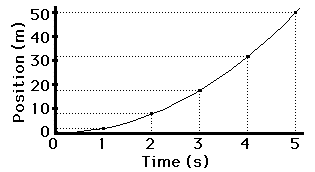
The picture of the position vs. time graph shows an object that is...
a)
accelerating/speeding up
b)
moving at a constant speed 
c)
not moving 
d)
accelerating/slowing down. 
62.
What is the standard unit force is measured in?
a)
Newtons
b)
pounds
c)
grams
d)
meters
63.
What is Newton's First Law known as? The Law of
a)
Friction
b)
Mass
c)
Inertia
d)
Gravity
64.
Which has more Inertia? (so need more force to move) 
a)
Truck
b)
Ant
c)
A cat
d)
A skateboard
65.
What is the formula for force?
a)
F=M/A
b)
F=MA
c)
F=AX
d)
what is force?
66.
What is Newton's Third Law?
a)
Object in motion stays in motion and an object at rest stays at rest unless acted on by a outside force
b)
Force = mass x acceleration
c)
For every action there is an equal and opposite reaction
67.
According to Newton's second law, if you increase the force applied to an object :
a)
it accelerates more
b)
it doesn't move
c)
you get more inertia
d)
it decelerates
68.
Who is the scientist who came up with the Laws of Motion?
a)
Sir Issac Newton
b)
The Greeks
c)
John Dalton
d)
Sir John Newt
69.
What is Newtons 2nd law of motion?
a)
Pancakes 
b)
Force= Mass multiplied by acceleration
c)
For every action there is a equal and opposite  re-action.
d)
Law of gravity 
70.
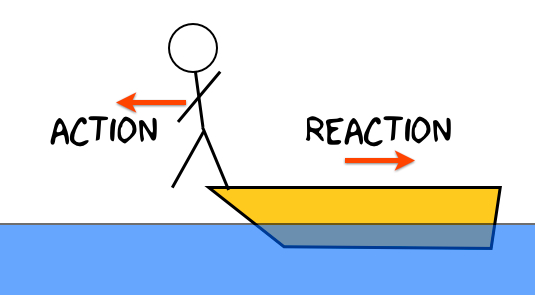
What law of motion does this picture represent?
a)
Newtons 1st law
b)
Newtons 4th law 
c)
Newtons 3rd law 
d)
Newtons 2nd law
71.
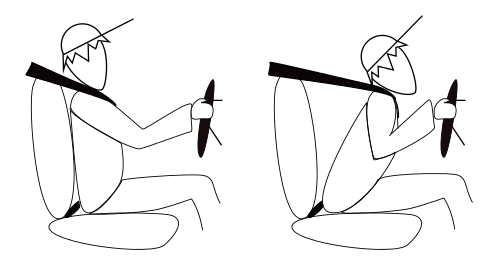
What Newtons law does this picture represent
a)
Newtons 2nd law 
b)
Law of gravity 
c)
Newtons 1st law
d)
Newtons 5th law
72.
What law of motion does this picture represent?
a)
Newtons 3rd law
b)
Newtons 4th law
c)
Newtons 1st law
d)
Newtons 2nd law 
73.
A distance vs. time graph shows an object's
a)
frame of reference
b)
speed
c)
acceleration
d)
favorite food
74.
Speed =
a)
distance / time
b)
time / distance
c)
distance * time
75.
On a distance-versus-time graph, a straight line ALWAYS indicates that an object’s speed is _____.
a)
constant
b)
zero
c)
increasing
d)
decreasing
76.
Change in speed over a given period of time is
a)
velocity
b)
motion
c)
speed
d)
acceleration
77.
On a distance vs. time graph, the steeper the slope _____
a)
the slower the speed
b)
the faster the speed
c)
less acceleration
d)
greater acceleration
78.
When something has speed in a certain direction it is called ___________.
a)
motion
b)
position
c)
velocity
d)
speed
79.
Acceleration of an object happens when things ________
a)
slow down
b)
go faster
c)
change direction (turn)
d)
All of the above
80.
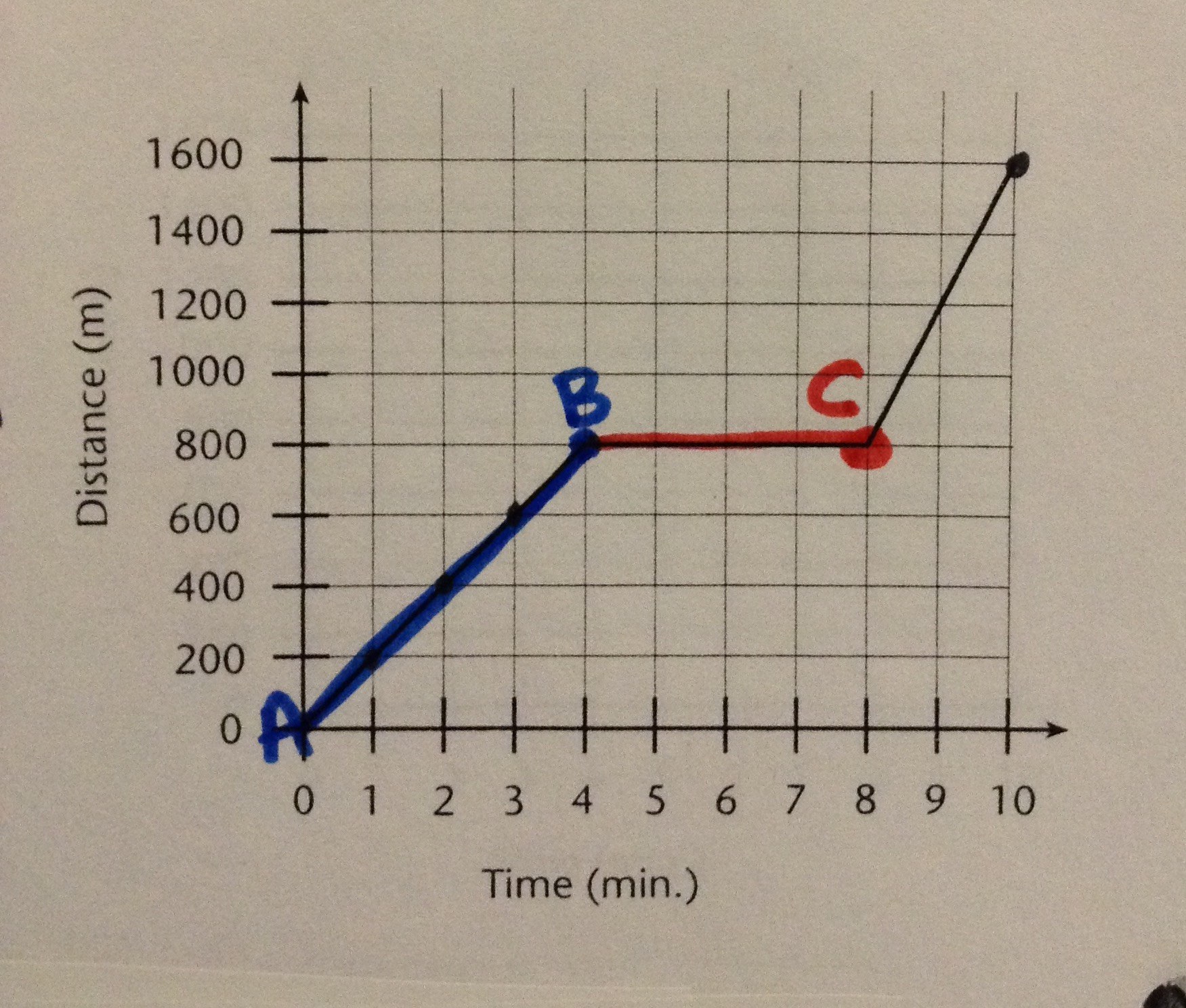
LT4: The graph shows Ashley riding her bike to Maria's house. 
What is occurring from point A to point B?
a)
they are traveling at a constant speed
b)
they are decreasing in speed
c)
they stopped to take a break
81.
LT4: The graph shows Ashley riding her bike to Maria's house. 
What was occurring from point B to point C?
a)
She was increasing her speed.
b)
She stopped for 4 minutes
c)
She was decreasing in speed
82.
LT5: What is velocity?
a)
Time + Distance
b)
Speed in a given direction
c)
A fast dinosaur
d)
The direction a storm is moving
83.
LT5: The rate at which velocity CHANGES is: 
a)
acceleration
b)
speed
c)
direction
d)
physics
84.
The graph represents
a)
no motion
b)
Constant velocity
c)
Acceleration
d)
negative acceleration
85.
The graph represents
a)
no motion
b)
constant velocity
c)
acceleration
d)
negative acceleration
86.
The graph respresents
a)
No motion
b)
Constant Velocity
c)
Acceleration
d)
Deceleration
87.
Forces always act in equal and opposite pairs.
a)
Newton's 1st Law
b)
Newton's 3rd Law
c)
Newton's second law
88.
An empty truck and a fully loaded truck are next to each other at a traffic light. When the light turns green, the lighter truck increases speed more quickly. Which of these best explains this situations
a)
Newton's first law
b)
Newton's second law
c)
Newton's third law
d)
Conservation of momentum
89.
Newton's first law of motion states that __________.
a)
when a force is applied on an object, there is an equal force applied by the object in the opposite direction
b)
hen a force acts on an object, its acceleration is in the same direction as the force
c)
an object will remain at rest or keep moving with a constant velocity unless a force acts on it
d)
cceleration is calculated by dividing the force exerted on an object by the mass of the object
90.
When a heavy football player and a light one run into each other, who exerts more force?
a)
The heavy one
b)
The light one
c)
They are equal
d)
there is no such thing as force
91.
What is Newton's First Law
a)
F=ma
b)
Every action has an equal and opposite reaction
c)
An object at rest stays at rest, an object in motion stays in motion. 
d)
Friction 
92.
What is Newton's First Law
a)
F=ma
b)
Every action has an equal and opposite reaction
c)
An object at rest stays at rest, an object in motion stays in motion. 
d)
Friction 
93.
What is the speed of an object that travels 20 meters in 4 seconds?
a)
80 m/s
b)
0.2 m/s
c)
5 m/s
d)
24 m/s
94.
What pulls a ball back to earth?
a)
Gas
b)
Gravity
c)
Friction
d)
Molecules
95.
Which law best describes- A satellite orbiting the earth.
a)
Law of Inertia
b)
Law of Mass and Acceleration
c)
Law of Action Reaction
96.
If a 10 kilogram object accelerates suddenly at 15 m/s2, how much force was applied to the object?
a)
150 Newtons
b)
15 Newtons
c)
150 kilograms
d)
100 kilograms
97.
When a large truck pushes a small car with a given force, the small car is applying an equal and opposite force on the truck.
a)
True
b)
False
98.
When you step on a Lego. You push on the Lego and the Lego pushes back on you.
a)
Newton's 1st Law
b)
Newton's 2nd Law
c)
Newton's 3rd Law
99.
"For every action, there is an equal and opposite reaction."
a)
Newton's 1st Law
b)
Newton's 2nd Law
c)
Newton's 3rd Law
d)
Newton's 4th Law
100.
Force = Mass x Acceleration
a)
Newton's 1st Law
b)
Newton's 2nd Law
c)
Newton's 3rd Law
d)
Newton's 4th Law
101.
"An object in motion (or at rest) will to stay in motion (or at rest) until an outside force acts upon it."
a)
Newton's 1st Law
b)
Newton's 2nd Law
c)
Newton's 3rd Law
d)
Newton's 4th Law
102.
The tendency of an object to resist changes in its motion is...
a)
inertia
b)
force
c)
acceleration
d)
velocity
103.
A Newton is a unit of...
a)
force
b)
inertia
c)
acceleration
d)
velocity
104.
The combination of all the forces acting on an object is the...
a)
net force
b)
action force
c)
reaction force
d)
balance force
105.
A cannonball with a mass of 0.5 kg is flying at an acceleration of 10 m/sec/sec. What is it's force?
a)
50 Newtons
b)
5 Newtons
c)
20 Newtons
d)
9.5 Newtons
106.
You push on a tree with 20 N of force. If the tree doesn't move, the tree is pushing back on you with _____of force.
a)
20N 
b)
40N 
c)
10N 
d)
70N
107.
Which has more Inertia? (so need more force to move) 
a)
Truck
b)
Ant
c)
A cat
d)
A skateboard
108.
What is the definition of "weight"?
a)
the force in which gravity pulls on an object
b)
the time it takes to get on a ride 
c)
the amount of matter in an object
d)
the size of an object
109.
What is the net force?
a)
10 N
b)
0 N
c)
25 N
d)
1 N
110.
Balanced or Unbalanced?
a)
Balanced 
b)
Unbalanced
111.
What is the net force?
a)
400 N Up
b)
400 N Down
c)
- 400 N Down
d)
800 N Down
112.
If you exert a net force of 8 N on a 2-kg object, what will its acceleration be?
a)
2 m/s2
b)
4 m/s2
c)
16 m/s2
d)
10 m/s2
113.
A book weighs 4 N. When held at rest in your hands, the net force on the book is
 
a)
0 N.
b)
 0.4 N.
c)
 4 N.
d)
 39 N.
114.
unit of weight is
a)
Kg
b)
N
c)
metre/sec
d)
Kgm/s
115.
If the distance between the two objects doubles, how does this affect the force of gravity between them?
a)
The force of gravity will increase. 
b)
The force of gravity decreases. 
c)
The force of gravity remains the same. 
116.
What does r2 represent in the Gravity equation? 
a)
Distance between the 2 objects. 
b)
The mass of the 2 interacting objects. 
c)
Gravitational constant. 
d)
Force of Gravity
117.
If I double the distance between two objects, what happens to their gravitational Force?
a)
4x bigger
b)
4x smaller
c)
2x bigger
d)
2x smaller
118.
Find the force of gravity (Fg) for two objects with:
m1 = 100 kg
m2 = 1000 kg
d = 500 m
a)
2.67 * 10-11 N
b)
0.4 N
c)
6.67 * 10-11 N
d)
1.3 * 10-8 N
119.
Find the force of gravity (Fg) for two objects with:
m1 = 6.0 * 1024 kg
m2 = 1000 kg
d = 6.4 * 106 m
a)
1.46 * 1014 N
b)
9770 N
c)
6.25 * 1010 N
d)
1.64 * 1031 N
120.
How much will the force of an object change if you triple one mass and double the distance?
a)
3x as strong
b)
3/4 of what it was
c)
1/4 of what it was
d)
2x as strong
121.
The units of acceleration are
a)
kg
b)
m/s2
c)
m/s
d)
N
122.
The units of velocity are
a)
kg
b)
m
c)
m/s
d)
N
123.
If a feather and a hammer are dropped at the same time on the moon, where there is no atmosphere, which one will hit the ground first?
a)
Neither, there is no gravity on the moon.
b)
hammer because it has more mass
c)
feather because it has less mass
d)
both will hit at the same time