wayground logo

Free Printable Worksheets

Font size

S
M
L
XL
Worksheets

PhyEd 102 Quiz 2

Total questions: 30

Worksheet time: 15mins

Name
Class
Date
1.

the largest artery in human is _______.

a)

Vena cava

b)

pulmonary artery

c)

aorta

d)

Pulmonary vein

2.

One of the main functions or jobs of the cardiovascular system is...

a)

Deliver nutrient molecules to the body's cells

b)

Deliver oxygen molecules to the body's cells

c)

Remove cell waste from the body's cells

d)

All of these

3.

What part of the heart is #3?

a)

Right atrium

b)

Left atrium

c)

right ventricle

d)

left ventricle

4.

Which part of the heart is indicated by #8?

a)

Right ventricle

b)

Right atrium

c)

Left ventricle

d)

Left atrium

5.

Which part of the heart is indicated by #5 and #9?

a)

right atrium, left atrium

b)

right ventricle, left ventricle

c)

right septum, left septum

6.

(a)   carry blood TO the heart.

7.

(a)   carry blood AWAY from the heart.

8.

___are tiny, thin blood vessels that drop off nutrient and oxygen molecules to the cells and pick up waste molecules such as carbon dioxide from the cells.

a)

Veins

b)

Arteries

c)

Capillaries

9.

On average, the heart pumps ___________ times per day.

a)

100

b)

1000

c)

10,000

d)

100,000

10.

What is a stroke?

a)

When the heart beats too fast

b)

When the heart stops because it does not get enough oxygen

c)

When the brain stops does not get enough oxygen

d)

None of the above

11.
When you breathe, your lungs take in ___ and remove ___. 
a)
air/oxygen
b)
oxygen/carbon dioxide 
c)
carbon dioxide/waste 
d)
waste/air 
12.
What is the main function of the respiratory system?
a)
to provide oxygen and remove carbon dioxide from the body
b)
to bring oxygen to the body
c)
to break down food and absorb nutrients
d)
to remove oxygen from the body and deliver carbon dioxide
13.
The left lung has three lobes and the right lung has two. 
a)
True
b)
False
14.

The only externally visible part of the respiratory system

a)

Eyes

b)

Nose

c)

Pharynx

d)

Larynx

15.

Which lung has 2 lobes?

a)

Right

b)

Left

16.
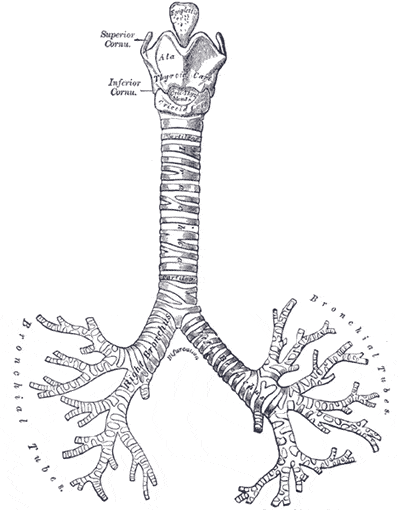
The two main branches from the trachea (one to each lung)
a)
bronchi
b)
alveoli
c)
capillaries
d)
bronchioles
17.
What does the Larynx hold ?
a)
The larynx holds the whole sub system 
b)
The larynx is part of the plant cells. 
c)
The larynx holds the vocal chords. 
d)
The larynx is part of animal tissues. 
18.

Which of the following happens when you exhale?

a)

chest cavity expands

b)

your lumgs become smaller

c)

your chest cavity becomes smaller

d)

your lungs take in and give off oxygen

19.
What is another name for the windpipe?
a)
Lungs
b)
Trachea
c)
Larynx
d)
Esophagus
20.

Which of the following shows what happens to the chest cavity when air rushes into the lungs?

a)

decrease in volume

b)

deflates

c)

expands

d)

relaxes

21.
What is the definition for elimination?
a)
Breaking down food into smaller nutrients
b)
Getting rid of waste products
c)
Getting food into our bodies
d)
Getting nutrients into our bloodstream, so that our cells can use them
22.
What is the definition for absorption?
a)
Breaking down food into smaller nutrients
b)
Getting rid of waste products
c)
Getting food into our bodies
d)
Getting nutrients into our bloodstream, so that our cells can use them
23.
Where does the digestion of starch begin?
a)
esophagus
b)
small intestine
c)
stomach
d)
mouth
24.
The organ where food is mashed and then broken down by acids?
a)
esophagus
b)
small intestine
c)
stomach
d)
mouth
25.
Where are nutrients absorbed into the blood?
a)
esophagus
b)
small intestine
c)
stomach
d)
mouth
26.
Where extra water and minerals are absorbed through the cells of this organ ...
a)
liver
b)
small intestine
c)
stomach
d)
large intestine
27.
What is the correct order in which food passes through the digestive system?
a)
mouth>stomach>large intestine>small intestine
b)
esophagus>sm intestine>stomach>lg intestine
c)
stomach>sm intestine>esophagus>mouth
d)
mouth>esophagus>stomach>sm intestine>lg intestine
28.

What are the rhythmic muscular contractions of your esophagus called to help food move along?

a)

swallowing

b)

peristalsis

c)

inertia contractions

d)

paralysis

29.
Produces insulin and enzymes to help digest food
a)
liver
b)
pancreas
c)
gallbladder
d)
esophagus
30.

What is the squeezing motion called that moves food down the esophagus?

a)

peristalsis

b)

absorption

c)

sneezing

d)

suffocation