
 Worksheets
Chemistry Unit Test
Total questions: 60
Worksheet time: 39mins

The positively charged particle in an atom.
Proton
Neutron
Electron
Nucleus
Identifies the number of protons in an atoms nucleus.
Electron Cloud
Atomic Theory
Atomic Number
Mass Number

The negatively charged particles in an atom
Proton
Electron
Neutron
Electron Cloud
A charged atom
Ion
Isotope
Proton
Electron
Atoms of the same element that have different numbers of neutrons
Ion
Isotope
Proton
Electron
The total number of protons and neutrons in the nucleus of an atom
Atomic Number
Mass Number
Atomic Theory
Electron Cloud
The small, dense, positively charged center of an atom
Neutron
Proton
Nucleus
Electron
The center of an atom where its neutrons and protons are is called the _____________.
nucleus
electron cloud
center

USE THE PERIODIC TABLE
How many valence electrons does Phosphorus have?
31
5
15
4

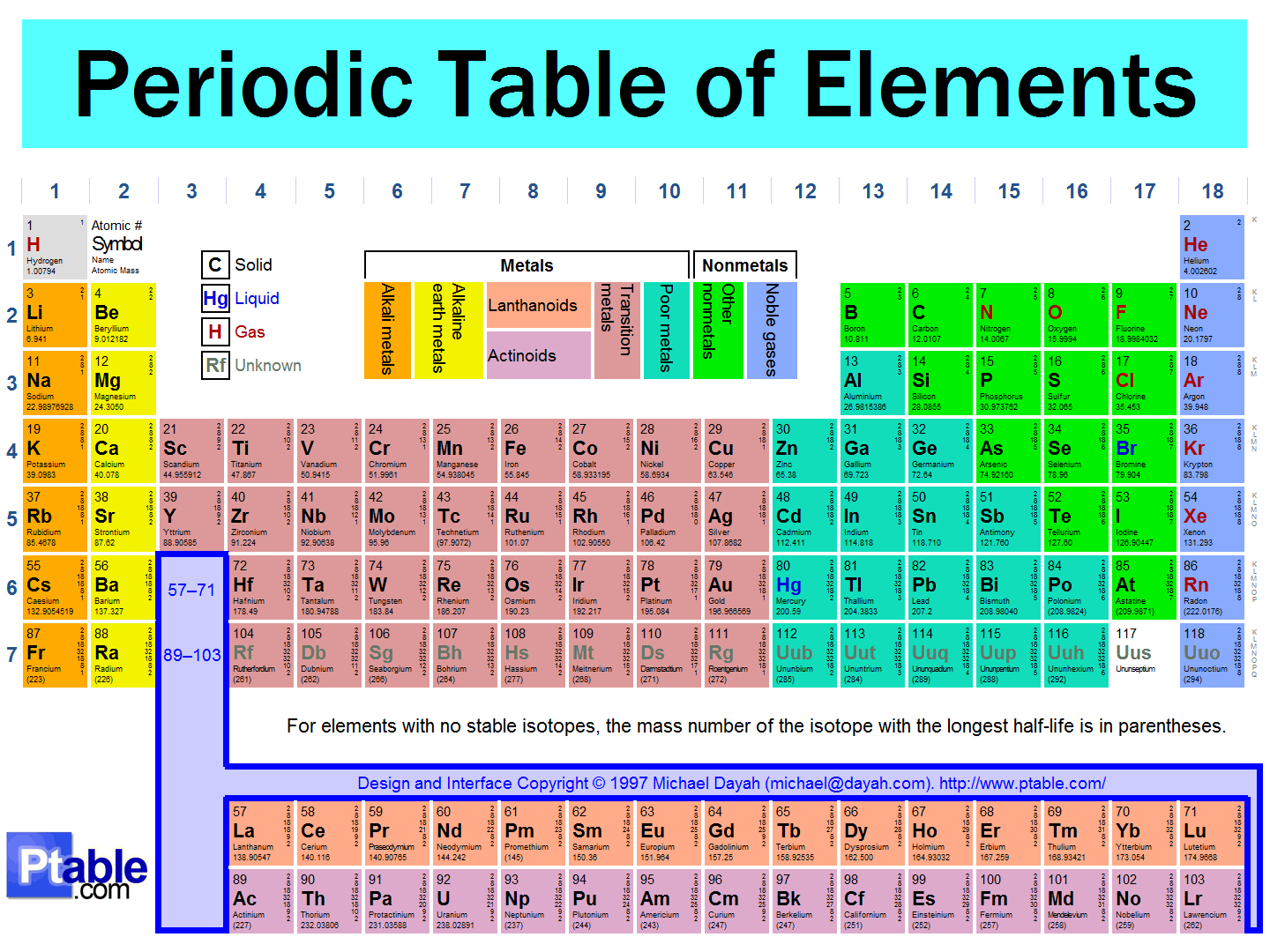
Metals are found on the ______________ side of the periodic table.
nonmetals
left
right
metals
This group of elements have properties that are opposite those of metals. ______________________
luster
nonmetals
metalloids
metals

The Atomic number is known as the _______
Number of electrons in an atom
Number of Protons in an atom
Number of neutrons in an atom
Number of Protons and electrons in an atom
The formula used to calculate the number of neutrons is:
Mass Number - Atomic Number
Protons + Electrons
Atomic Number - Mass Number
Protons x2
How many periods are on the periodic table?
5
6
7
8
Elements in the same group have : (2 correct answers)
Similar chemical properties
Similar names
Same number of outer (valence) electrons)
The same number of protons

What does the 6 represent?
atomic mass
atomic number
element name
chemical symbol

What does 12.011 represent?
atomic mass
atomic number
element name
chemical symbol
Which is an alkali metal?
Magnesium
Iron
Sodium
Europium
Which is a halogen?
Helium
Chlorine
Oxygen
Neptune
Name this group: These metals are the second most reactive.


Name this group: These metals are the most reactive.
I am a nonmetal
I am in period 2
I am in group 16/6A
Ba
Si
O
S
I am a metal
I am in group 2
I am in period 6
I am…
Mo
Re
S
Ba
These two elements have similar chemical properties to Barium (Ba).
Ca and Ra, because they are in the same group.
Cs and La, because they are in the same period number.
Ca and Y, because they are 90 degree angle.
How many atoms of Hydrogen are in H2O
1
2
3
more than 3
How many different elements are present in H2COCH2
5
4
3
2
Calculate the number of Oxygen atoms in Al(OH)3
1
2
3
4
How many Magnesium atoms are in 10MgCl2?
10
5
20
How many Sodium atoms are in 6NaCl?
1
12
6
How many atoms are there TOTAL in H2SO4 ?
6
5
7
3

How many total POTASSIUM atoms are in this formula?
8
2
4
12
What determines the reactivity of an element?
protons
neutrons
electrons
valence electrons

Ions are formed when atoms gain or lose ___.
electrons
protons
neutrons
atomic mass
The common charge on an atom in group 17 would be....
+1
+7
-7
-1
17

What family is highlighted in the picture?
Alkali Metals
Alkaline Earth Metals
Halogens
Noble Gases

What family is highlighted in the picture?
Alkali Metals
Alkaline Earth Metals
Halogens
Noble Gases

What family is yellow in the picture?
Boron Group
Carbon Group
Transition Metals
Noble Gases
What family is dark purple in the picture?
Boron Group
Halogens
Transition Metals
Noble Gases

What family is highlighted in the picture?
Boron Group
Halogens
Transition Metals
Noble Gases
What group of metals is the MOST reactive?
Transition Metals
Metalloids
Alkaline Earth Metals
Alkali Metals
What group of nonmetals is the MOST reactive?
Noble Gases
Nitrogen Group
Halogens
Lanthanides

What type of elements are red in the picture?
Nonmetals
Metals
Metalloids
What type of elements are green in the picture?
Nonmetals
Metals
Metalloids
What type of elements are blue in the picture?
Nonmetals
Metals
Metalloids



