wayground logo

Free Printable Worksheets

NEW

Font size

S
M
L
XL
Worksheets

Introduction to Science

Total questions: 72

Worksheet time: 2hrs 40mins

Name
Class
Date
1.

Read the statement and decide if it's an observation or inference:

The man is wearing a striped tie.

a)

Observation

b)

Inference

2.

Read the statement and decide if it's an observation or inference:

The car seems to be a VW Buggy

a)

Observation

b)

Inference

3.

Read the statement and decide if it's an observation or inference:

The man's tongue is sticking out.

a)

Observation

b)

Inference

4.

Read the statement and decide if it's an observation or inference:

The dog is smarter than the human.

a)

Observation

b)

Inference

5.

Read the statement and decide if it's an observation or inference:

In this world, dog's rule and human's drool!

a)

Observation

b)

Inference

6.

Read the statement and decide if it's an observation or inference:

The dog has long ears.

a)

Observation

b)

Inference

7.

Read the statement and decide if it's an observation or inference:

The car is on the right side of the road.

a)

Observation

b)

Inference

8.

Read the statement and decide if it's an observation or inference:

The car seems to be moving very fast.

a)

Observation

b)

Inference

9.

Read the statement and decide if it's an observation or inference:

The man has a long nose.

a)

Observation

b)

Inference

10.

Read the statement and decide if it's an observation or inference:

The dog is annoyed by the human.

a)

Observation

b)

Inference

11.

I use rulers, scales and calculators to make these observations.

a)

Qualitative data

b)

Quantitative data

12.

The mass of the chocolate cake is 250 g.

a)

Qualitative

b)

Quantitative

13.

There were 17 boys and 12 girls on the yellow school bus.

a)

Quantitative

b)

Qualitative

c)

Both

d)

Neither

14.

What are observations made using our five senses called?

a)

Qualitative data

b)

Quantitative data

15.

The ocean water looked bluish green.

a)

Qualitative

b)

Quantitative

16.

It makes a loud crackling sound.

a)

Qualitative

b)

Quantitative

17.

The flower is 8 cm tall.

a)

Qualitative data

b)

Quantitative data

18.

The bearded iris smells sweet.

a)

Qualitative data

b)

Quantitative data

19.

"A distinctive attribute or character " describes which method of observation?

a)

Sight and Touch

b)

Hearing and Taste

c)

Smell

d)

All the above

20.

It feels smooth.

a)

Qualitative

b)

Quantitative

21.
Your teacher has asked you to explain the difference between quantitative and qualitative observations. Which statement is correct?
a)
Quantitative observations use numbers, qualitative uses the senses.
b)
Quantitative observations use the senses, qualitative uses numbers.
c)
Quantitative observations use measurement, qualitative uses numbers.
d)
Quantitative observations use colors, qualitative uses the senses.
22.

The chimp identified 12 pictures correctly.

a)

Qualitative

b)

Quantitative

23.
Qualitative or Quantitative:
The butterfly is on a pink flower. 
a)
Qualitative
b)
Quantitative
24.
If your teacher asked you to make qualitative observations about the class’s pet hamster, which group of words might be used?
a)
A  mass of 3 kg, 11 cm long, age of 16 months
b)
A  mass of 3 kg, 11 cm long, cute
c)
A  long hair, white and brown colored, soft
d)
A  temperature, length, weight
25.

Feelings, attitudes, opinions and thoughts of human being

a)

QUALITATIVE RESEARCH

b)

QUANTITATIVE RESEARCH

26.
What two types of measurements make up DENSITY
a)
Mass and Volume
b)
Temperature and Mass
c)
Grams and Centimeters
d)
Volume and Weight
27.
Look at this image.  Which object has the LOWEST density in water? How
a)
The Ping Pong Ball because it floats to the top 
b)
The bolt because it has sunk to the bottom
c)
The soda cap because it is not just full of air like the Ping Pong ball
28.
Jack has a rock. The rock has a mass of 14g and a volume of 2cm3. What is the density of the rock?
a)
7 mL
b)
7 g/cm3
c)
28 g/cm3
d)
1/7 g/cm3
29.
If an object has a density of .6 g/mL and you put it into water, will it sink or float?  
a)
sink
b)
float
30.
If an object has a density of 3.6 g/mL and you put it into water, will it sink or float?  
a)
sink
b)
float
31.
Frank has an eraser. It has a mass of 4g, and a volume of 2cm3. What is its density?
a)
8 g/cm3
b)
2 g/cm3
c)
1/2 g/cm3
d)
24 g/cm3
32.
What units are used to measure mass?
a)
g
b)
cm3
c)
g/cm3
d)
cm3/g
33.
What is the formula for density?
a)
density = mass x volume
b)
density = mass / volume
c)
density = mass + volume
d)
density = mass - volume
34.
Calculate the density of the cube.
a)
2 g/cm3
b)
4 g/cm3
c)
6 g/cm3
d)
8 g/cm3
35.
What is this tool to get mass?
a)
triple beam balance
b)
ruler
c)
thermometer
d)
graduate cylinder
36.
Which units of measurement are used for volume?
a)
grams
b)
centimeters
c)
grams/milliliter
d)
milliliter
37.
What units are used to measure Density?
a)
cm3/g
b)
g
c)
g/cm3
d)
cm3
38.
What is this tool to get volume?
a)
triple beam balance
b)
ruler
c)
thermometer
d)
graduate cylinder
39.
a)

15 cm3

b)

50 cm3

c)

150 cm3

d)

180 cm3

40.
a)

303.4 g

b)

370.4 g

c)

373.0 g

d)

373.4 g

41.

When you put an object in a graduated cylinder of water and measure how much the water level changed what is this process called?

a)

Relative Density

b)

Displacement

c)

Density

42.
What is the volume of Object X?
a)

10.0 ml

b)

15.0 ml

c)

20.0 ml

d)

25.0 ml

43.
What is the volume of the fish?
a)

18.0 ml

b)

6.0 ml

c)

38.0 ml

44.
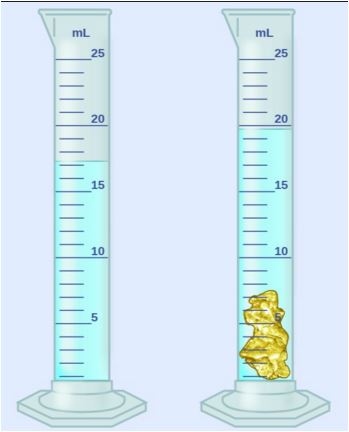
An irregularly shaped piece of gold was lowered into a graduated cylinder holding a volume of water equal to 17 ml. The height of the water rose to 20 ml. If the mass of the gold was 27 g, what was its density?
a)
9 g/mL
b)
10.5 g/mL
c)
6.5 g/mL
d)
8 g/mL
45.
How much water has been displaced in the image shown?
a)
40 mL
b)
65 mL
c)
20 mL
d)
25 mL
46.
Change from standard form to scientific notation: 12,000,000
a)
12.0  x  107
b)
0.12  x  107
c)
1.2  x  106
d)
1.2  x  107
47.
Change from standard form to scientific notation:  450,000
a)
4.5  x  105
b)
45  x  105
c)
4.5  x  104
d)
4.5  x  106
48.
Change from standard form to scientific notation:  0.000398
a)
39.8  x  10-5
b)
3.98  x  10-5
c)
3.98  x  10-4
d)
39.8  x  10-6
49.
Change from standard form to scientific notation: 0.004078
a)
4.078  x  10-3
b)
4.078  x  103
c)
40.78  x  10-4
d)
.4078  x  10-2
50.
Which number is correctly written in scientific notation?
a)
5.67 x 10⁵
b)
56.7 x 10³
c)
0.567 x 10⁶
51.

Consider Scientific Notation...

5 Which is the correct coefficient of 147,000 when it is written in scientific notation

a)

147

b)

14.7

c)

1.47

d)

0.147

52.
Which number is correctly written in scientific notation?
a)
8.2 x 10²
b)
82 x 107
c)
3.45 x 94
53.
How would you write 0.0005 in scientific notation?
a)
50 x 105
b)
5 x 10⁴
c)
5 x 10³
d)
.5 x 103
54.
How would you write -5.6 x 10⁻³ in standard form?
a)
0.0056
b)
-5,600
c)
0.00056
d)
-0.0056
55.
The rule of scientific notation is to write all exponents with a base of ____.
a)
50
b)
5
c)
100
d)
10
56.
Which of the following in the LARGEST number?
a)
9 x 10⁶
b)
8 x 10¹⁰
c)
1.3 x 10¹²
d)
5.3 x 10³
57.
Which one of these is in scientific notation?
a)
8.987000
b)
8.98 x 10⁶
c)
80.987 x 10
d)
8.986
58.
Write 9.8 x 10⁻⁵ in standard form
a)
0.00098
b)
0.000098
c)
.098
d)
98,000
59.
Write 0.000972 in scientific notation.
a)
9.72 x 10⁻⁴
b)
9.72 x 10⁻³
c)
972 x 10-4
d)
9.72 x 10⁴
60.

Which is the correct coefficient of 23,400,000 when it is written in scientific notation?

a)

0.234

b)

2.34

c)

234.

d)

23.4

61.
125,678,000: Change to scientific notation
a)
1.25678  x  1012
b)
.125678  x  10-9
c)
12.5678  x  108
d)
1.25678  x  108
62.
Try to change the number back to standard form:  6.79  x  104
a)
679,000
b)
6,790
c)
67,900
d)
6,790,000
63.
Try to change the number back to standard form: 3.97  x  10-2
a)
0.000397
b)
0.0397
c)
0.0000397
d)
0.397
64.
Write 2.08 x 10²  in standard form.
a)
208
b)
0.0208
c)
20,800
d)
0.208
65.
How do you write
1001
in scientific notation?
a)
1.0001 x 10⁴
b)
1.01 x 10⁵
c)
1.001 x 10³
d)
10.1 x 10³
66.

Based on the image of the scientist, decide if the statement is an OBSERVATION or INFERENCE:

"The scientist is looking through a microscope."

a)

Observation

b)

Inference

67.

Based on the image of the scientist, decide if the statement is an OBSERVATION or INFERENCE:

"There are test tubes on the table."

a)

Observation

b)

Inference

68.

Based on the image of the scientist, decide if the statement is an OBSERVATION or INFERENCE:

"The scientist is observing cells under the microscope."

a)

Observation

b)

Inference

69.

Based on the image of the scientist, decide if the statement is an OBSERVATION or INFERENCE:

"The scientist is a biologist."

a)

Observation

b)

Inference

70.
Observation or Inference?
I believe he must have hit a pothole in the road
a)
observation
b)
inference
71.
Observation or Inference?
It is a hot summer day
a)
observation
b)
inference
72.
Observation or Inference?
The girl has hurt her knee
a)
observation
b)
inference