
 Worksheets
economics 1st 9 weeks review
Total questions: 126
Worksheet time: 1hrs 8mins
things such as food, clothing and shelter that are necessary for survival
Needs
Goods
Services
Wants
the situation that exists where there are not enough resources to meet human wants
limitations
scarcity
rations
coupons
the benefit or satisfaction we gain from the use of the good or service
utility
opportunity cost
incentives
TINSTAAFL
things such as food, clothing and shelter that are necessary for survival
Needs
Goods
Services
Wants
the situation that exists where there are not enough resources to meet human wants
limitations
scarcity
rations
coupons
the benefit or satisfaction we gain from the use of the good or service
utility
opportunity cost
incentives
TINSTAAFL
Scarcity affects whom? (best answer)
Individuals
Businesses
Governments
Everyone
physical objects that can be purchased
Needs
Goods
Services
Wants
people who buy goods and services for personal use
consumers
officials
investors
producers
work that one person performs for another for payment
Needs
Goods
Services
Wants
desires that can be satisfied by consuming a good or service
Needs
Goods
Services
Wants
people who make goods or provide services
consumers
officials
investors
producers
Which is NOT an economic question that needs to be answered?
What will be produced?
How will it be produced?
Where will it be produced?
For whom will it be produced?
all of the natural resources found on or under the ground that are used to produce goods and services
Land
Entrepreneurship
Capital
Labor
the study of how people choose to use scarce resources to satisfy their wants
freakonomics
psychology
economics
consumer sciences
the willingness to take risks that are needed to create and run a new business
Land
Entrepreneurship
Capital
Labor
benefits offered to encourage people to act in certain ways
utility
opportunity cost
incentives
TINSTAAFL
all of the resources made and used by people to produce and distribute goods and services
Land
Entrepreneurship
Capital
Labor
the concept that everything has some form of cost
utility
opportunity cost
incentives
TINSTAAFL
The alternative that you give up when you make an economic choice
utility
trade off
incentives
TINSTAAFL
simplified representations of complex economic activities, systems or problems
economic models
efficiencies
economized
resources
numerical data or information that showcase patterns of behavior
microeconomics
competition
macroeconomics
statistics
all the human time, effort, and talent that goes into making products
Land
Entrepreneurship
Capital
Labor
the study of the behavior of individuals in an economy
microeconomics
competition
macroeconomics
statistics
the study of the behavior of the economy as a whole
microeconomics
competition
macroeconomics
statistics
a way of describing economics as it is, not as it should be
microeconomics
positive economics
macroeconomics
normative economics
a way of describing or explaining what economic behavior should be, not what it actually is
microeconomics
positive economics
macroeconomics
normative economics
considered the father of the modern study of economics
Alexis de Tocqueville
Sam Adams
Adam Smith
Mr. Long
The person who starts, organizes and manages a business is called
an entrepreneur
a consumer
a producer
The study of resources such as money, materials, and labor
economics
services
producers
Factors of production are grouped into four categories:
land, labor, capital, entrepreneurship
land, labor, capital, money

Natural Resources
Capital Resources
Human Resources
The most comprehensive measure of a nation’s wealth is provided by its
gross domestic product
scarcity


Consumer decisions are influenced by:
price of a good or service
the price of alternatives
the consumer’s income
all of the above
A measure of economic output in terms of a worker’s input
Productivity
Inflation
Interest Rate
Division of Labor
The higher the price of a product the higher the supply will be for that product
Law of Supply
Law of Demand
Inflation Rate
Macroeconomics
The study of large-scale economic factors that indicate the condition of the economy
Microeconomics
Market Structure
Macroeconomics
Monetary Policy
A market structure where a small number of businesses have control of a market
(i.e. Cell Phone services)
Perfect Competition
Monopolistic Competition
Oligopoly
Monopoly
The market structure where a single business has exclusive control of a market.
(i.e. Microsoft)
Perfect Competition
Oligopoly
Monopolistic Competition
Monopoly
(a) is an economic system where generational customs and learned behaviors determine what is produced and for whom.
______ is an economic system that is heavily influenced by the law of ______.
Capitalism; Sustainable Development
Communism; Class Warfare
Capitalism; Supply & Demand
Socialism; Safety-Net Programs
Capitalism; Distribution
Country 2: “In my country, all key decisions are made by our central planners. They hold complete power over all politics and economics in our nation. Our government directly owns the land, natural resources, and factories for the good of the people.”
Which economic system is most likely being described in Country 2?
(a)
In a _________ economy, a government works with corporations to meet the basic needs of all citizens in order to _________.
Capitalist; maximize profits
Communist; eliminate social classes
Capitalist; ensure worker safety
Socialist; eliminate poverty
Socialist; create dependence on the government
Country 3: “In my nation, all people are free to produce whatever they wish and to consume whatever they can afford. People seek to make or sell goods and services so they can earn a profit.”
What economy is more than likely described in Country 3?
(a)
Select all that apply.
The features of a communist economy more than likely will include-
Private ownership of businesses
Government planning on all major decisions
Provide public services to meet basic needs
Equal wage distribution
Limited government intervention
Canada is often labeled as an example of (a) because of its high tax rate, social programs that are funded by the government, and universal health care plan.
In a ______ economy, the government will focus on equal wages in order to _________.
Communist; maximize profits
Communist; eliminate social classes
Socialist; provide health care
Socialist; allow some private ownership
Capitalist; provide a basic income
Select all that apply.
A traditional economy will more than likely feature-
Trade or exchange of handmade goods
Rising prices when demand is high
Public-funded health care and education
Small profits from surplus goods, if any
Equal Wage Distribution
The extreme rise in the price of the EpiPen is an example of what can happen in a (a) economy.
Select all that apply. What are the three basic economic questions?
What should be produced?
How should it be produced?
Why should it be produced?
Who gets to consume it?
Select all that apply. What are the three basic economic questions?
What should be produced?
How should it be produced?
Why should it be produced?
Who gets to consume it?
It is when individuals dictate the economy
Command economy
Traditional economy
Mixed economy
Market economy
It is when customs dictate the economy
Mixed economy
Market economy
Command economy
Traditional economy
It is when the government dictate the economy
Traditional economy
Command economy
Market economy
Mixed economy
It is when individuals in the market dictate the economy
Market economy
Command economy
Mixed economy
Traditional economy
One of the advantages of a traditional economy
poverty
innovative
promotes strong social bonds
creates national projects
One advantage of command economy
little technology
planning does not match reality
innovative
create large national projects
Select all that apply. Disadvantages of a command economy
planning does not match reality
innovative
little technology
does not meet people's needs
Select all that apply. advantages of market economy
markets lead to equilibrium
poverty
innovative
high quality
role of government in mixed economy
regulate the market
own the market
reject the market
in a mixed economy, ______ are determined in the market
cost of products
incentives
prices
profit
differentiate socialist, communist, capitalist and fascist
What type of economic system did Adam Smith support?
a free market system
mixed economic system
planned economic system
A philosophy that calls for very little or no government involvement in the economy.
Industrial Capitalist
Economics
Supply and Demand
Laissez-Faire
Laissez-faire capitalism as attributed to Adam Smith called for
heavy taxation of manufacturers
strict government control of the economy
minimal government involvement in the economy
government investments in major industries
What does PPC show? Select Multiple options.
Describes the production of only two products in economy.
It explains the production when there is full and efficient utilisation all resources in economy
It explains the consumption pattern in economy
It is the combination of all possible output points of two goods given that technology and resources are fixed.

If a point lies on the curve this means the company/country/individual is being efficient. If a point lies inside the curve, what does that tell?
They are being over efficient
They are being inefficient
It is not impossible with the given resources
They are still efficient, just at another point
Some advantages of a communism are:
low unemployment
less income inequality
lots of competition
little corruption
The concept that society's goals will be met as individuals seek their own self-interest.
The Invisible Hand
The Incredible Hulk
The Scarcity Rule
The Floating Hand
Fixed Costs are only fixed in the
Long run
Short run
Period where there is neither a profit or a loss
none of the above
A firm in the long run will make
Losses
Economic Profit
Profits greater than MC
none of the above
Which of the following is an example of a perfectly competitive firm?
Farmer's market stand
Fast food restaurant
Cell phone service provider
Local internet service provider
A perfect competitive firm charges a price that is ____________.
different to other firms
higher than other firms
lower than other firms
similar to other firms

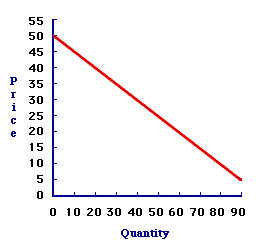

This graph represents...?
Changes in quantity demanded
Changes in quantity supplied
Changes in demand
Changes in supply

If Tom Brady unretires and wins a Super Bowl, what will happen to the demand curve for Tom Brady jerseys (in theory)?
It will shift to the right
It will shift to the left
It won't shift
The price will go down

Which statement expresses a central idea of how the laws of supply and demand work?
The government sets the prices for goods and services.
Prices are determined by the interaction of producers and consumers.
Consumers alone determine the prices for goods and services.
Technology dictates the prices charged for goods and services.

According to the Supply & Demand model, a price ceiling will lead to a....
Surplus
Shortage
Extra cost of producing one additional unit of production
Fixed cost
marginal cost
variable cost
production costs that vary as output changes
fixed cost
variable cost
marginal cost
costs of production that do not change when output changes
fixed cost
variable cost
marginal cost
stage of production where output increases at a decreasing rate as more units of variable input are added
marginal product
stages of production
diminishing returns

When quantity demand smaller than quantity supply the price will usually?
increase
decrease
remain the same
equilibrium

Supply is
how much consumers are willing to buy.
how much a producer (a business) is able and willing to make for sale to consumers.
the goods that are left over after a sale.
All of the above
The law of demand shows the relationship between
consumers' income and demand.
population and demand.
demand and supply.
price and quantity demanded.
A movement along a demand curve can be influenced by
tastes.
population.
the product's price.
consumers' income.
What is a producer?
a person that makes goods or services
someone that eats
a person that buys or uses a good or service
A hurricane wipes out an orange crop in Florida, sharply affecting the supply of oranges. Which chart demonstrates this concept?


When the gov't pays money to businesses, usually to encourage them to produce a certain product..
taxes
regulations
competition
subsidies

What is a: SERVICE?
work that one person does for another
things that people make or grow and then sell.
When people spend money to buy
things they need or want
A person who makes a product or provides a service.
What is a: CONSUMER?
work that one person does for another
things that people make or grow and then sell.
When people spend money to buy
things they need or want
A person who makes a product or provides a service.

