wayground logo

Free Printable Worksheets

NEW

Font size

S
M
L
XL
Worksheets

Chemistry Revision y10 test 1

Total questions: 47

Worksheet time: 40mins

Name
Class
Date
1.

TRUE or FALSE: In order to change the state of matter, you need increase or decrease the energy (heat).

a)

TRUE

b)

FALSE

2.

TRUE or FALSE: Liquids have a fixed volume but not a fixed shape.

a)

TRUE

b)

FALSE

3.

TRUE or FALSE: Gases have the least kinetic energy out all 3 states of matter.

a)

TRUE

b)

FALSE

4.

Phase change from solid to gas is called:

a)

Freezing

b)

Condensation

c)

Vaporization

d)

Sublimation

5.

Phase change from liquid to solid is called:

a)

Melting

b)

Freezing

c)

Deposition

d)

Condensation

6.

Phase change from gas to liquid is called:

a)

Melting

b)

Freezing

c)

Deposition

d)

Condensation

7.

Phase change from gas to solid is called:

a)

Sublimation

b)

Freezing

c)

Deposition

d)

Vaporization

8.

When changing a substance from liquid to solid, the energy has to...

a)

INCREASE

b)

DECREASE

9.

When changing a substance from gas to liquid, the energy has to...

a)

INCREASE

b)

DECREASE

10.

Which of the following statements about the particle theory of matter is incorrect?

a)

All matter is made up of tiny particles.

b)

All substances are made of the same particles.

c)

The particles can move when they are heated.

d)

Particles are held together by strong electrical forces.

11.
How many neutrons does the isotope of lithium have?
a)
8
b)
3
c)
5
12.
If a hydrogen atom has 1 proton, 1 electron, and 1 neutron, its atomic number is:
a)
1
b)
2
c)
3
13.
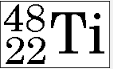
How many protons does this isotope of titanium have?
a)
48
b)
22
c)
26
14.
If a sulfur atom has 16 protons, 16 electrons, and 16 neutrons, its atomic mass is:
a)
16
b)
32
c)
48
15.

Which of the following are isotopes?

a) 14 7X b) 14 6X c) 15 7X d) 15 8X

a)

a) and b)

b)

a) and c)

c)

c) and d)

d)

a) and d)

16.
If X is the symbol for an element, which of the following two symbols represent    isotopes of the same element?     I. 7735X  II. 7733X  III. 8137X  IV. 8135 X
a)
I and II
b)
III and IV
c)
I and IV
d)
I and III
17.
How is carbon-12 different from carbon-14?
a)
They have a different number of protons
b)
they have a different number of electrons
c)
they have a different number of neutrons
18.

Using the picture from a periodic table, how many NEUTRONS are in Iron?

a)

26

b)

30

c)

55.845

d)

56

19.

When two atoms of the same element have different masses, they are called ______, and have a different number of ______.

a)

Neutrons; Isotopes

b)

Atoms; Isotopes

c)

Isotopes; Protons

d)

Isotopes; Neutrons

20.
Most of the elements on the periodic table are classified as _____.
a)
Metals
b)
Nonmetals
c)
Metalloids
d)
Periods
21.
These are found on the Periodic Table.
a)
Compounds
b)
Elements
c)
Mixtures
22.
a)
Element
b)
Compound
c)
Mixture
23.
a)
Element
b)
Compound
c)
Mixture
24.
a)
Element
b)
Compound
c)
Mixture
25.
a)
Element
b)
Compound
c)
Mixture
26.

A(n) ______________ is formed when two or more elements chemically combine.

a)

Compound

b)

Element

c)

Mixture

27.

A ___________ is a combination of many different elements not chemically combined.

a)

Element

b)

Compound

c)

Mixture

28.
Which of the following is NOT a pure substance?
a)
milk
b)
oxygen
c)
water
d)
carbon dioxide
29.
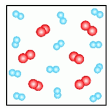
This diagram represents a _____.
a)
pure substance that is a compound
b)
mixture of elements
c)
pure substance that is an element
d)
mixture of compounds
30.
Carbon Dioxide is a ______ 
a)
compound 
b)
element 
c)
mixtures 
d)
Battle of Bunker Hill 
31.
Contains only one kind of atom.
a)
Element
b)
Compund
c)
Mixture
32.

What is a solvent

a)

A liquid that will dissolve a solid solute

b)

Another word for solution

c)

A thing that make drinks change colour

d)

Usually the solid about to be dissolved

33.

The ___ is the thing being dissolved.

a)

solute

b)

solvent

c)

mixture

d)

solution

34.
Solutions are composed of __________ .
a)
salts and solutes
b)
solvents and salts
c)
solutes and alloys
d)
solutes and solvents
35.

If I dissolve salt in water, what is the solvent?

a)

salt

b)

water

c)

salt & water

d)

none of the above

36.

Define the term soluble.

a)

Can dissolve in water

b)

Cannot dissolve in water

c)

Partially dissolves in water

37.

Define the term insoluble.

a)

Can dissolve in water.

b)

Cannot dissolve in water.

c)

Partially dissolves in water.

38.

______ refers to the ability of a substance to combine and form a solution

a)

solvent

b)

solute

c)

solution

d)

solubility

39.
At approximately what temperature does the solubility of sodium chloride, NaCl, match the solubility of potassium dichromate, K2Cr2O7?
a)
60 ºC
b)
30 ºC
c)
50 ºC
d)
83 ºC
40.
How many grams of K2Cr2O7, are soluble in 100 g of water at 95 ºC?
a)
83 grams
b)
75 grams
c)
40 grams
d)
12 grams
41.
Which substance is MOST soluble at 0 ºC?
a)
KI
b)
NaNO3
c)
NaCl
d)
Ce2(SO4)3
42.
When 20 grams of potassium chlorate, KClO3, is dissolved in 100 grams of water at 80 ºC, the solution can be correctly described as:
a)
supersaturated
b)
saturated
c)
unsaturated
43.
When 50 grams of KCl is dissolved in 100 grams of water at 50 ºC, the solution can be correctly described as:
a)
supersaturated
b)
unsaturated
c)
saturated
44.

At what temperature does the solubility of NaCl, match the solubility of K2Cr2O7?

a)

60

b)

30

c)

83

d)

50

45.

Which solute does not increase in solubility as the temurature increases?

a)

NaCl

b)

SO2

c)

KClO3

d)

KNO3

46.

What is the maximum temperature where at least 60 g of HCl can dissolve?

a)

35 ⁰C

b)

45 ⁰C

c)

55 ⁰C

d)

65 ⁰C

47.

Which salt is LEAST soluble at 0 ºC?

a)

KNO3

b)

Ce2(SO4)3

c)

K2Cr2O7

d)

KClO3