
 Worksheets
Nuclear Test Review
Total questions: 57
Worksheet time: 14hrs 15mins
Rank the four fundamental forces of nature in order from strongest to weakest:
Strong Nuclear
Electromagnetism
Weak Nuclear
Gravity
the pull between any two objects with mass.
Which fundamental force that binds protons and neutrons together to create the nucleus of an atom?
Which is the only fundamental force that attracts and repels and is responsible for all electricity and magnetism?
Gravitational
Strong Nuclear
Electromagnetic
Weak Nuclear
Which fundamental force binds 3 quarks together to create protons and neutrons?
Gravitational
Strong Nuclear
Electromagnetic
Weak Nuclear
What is the primary factor that affects the strength of all of the fundamental forces?
Electromagnetic force has a range that is _________.
Limited
Infinite
Constantly changing
Small
For an atom to become radioactive and unstable, which force must be overcome to allow it to break apart or decay?
Gravity
Electromagnetism
Weak Nuclear
Strong Nuclear

What is the mass number of this isotope?
131
53
184
78
What is the atomic number of this isotope?
131
53
184
78
How many protons does this isotope have?
131
53
184
78
How many neutrons does this isotope have?
131
53
184
78
What is the name of this isotope?
Iodine-131
Iodine-53
Iodine-184
Iodine-78
An alpha particle is made up of
2 protons and 4 neutrons
1 proton and 1 neutron
2 protons and 2 neutrons
4 protons and 2 neutrons
Which type of nuclear radiation can be stopped by a sheet of paper?
Alpha
Beta
Gamma
Which type of nuclear radiation can be stopped by lead?
Alpha
Beta
Gamma
When a substance undergoes beta decay
A neutron is changed to a proton causing the atomic number to increase by 1 and an electron is released.
A proton is changed to a neutron causing the atomic number to decrease by 1 and an electron is released.
A neutron is changed to a proton, the atomic number stays the same, and an electron is released.

Which type of nuclear decay did Radon-198 go through?
α decay
β decay
γ decay

What will the values of x and y be?
x=194, y =83
x=194, y =84
x=194, y =85
I don't know. I should probably study this stuff more before the test.
A sample of Radium-228 decays from 100g to 12.5g. How many half lives took place?
1
2
3
4

α decay
β decay
γ decay

α decay
β decay
γ decay
The three types of nuclear radiation in increasing order of energy and penetrating power are
β
α
γ
Identify the type of nuclear decay shown here
21483Bi → 0-1e + 21484Po
α
β
γ
What is an isotope
An atom with the same number of neutrons different number of protons
An atom that has lost or gained an electron
An atom with the same number of protons, different number of neutrons
An atom with the same number of electrons and different neutrons
Radiation therapy can be used to treat what condition?
acne
cancer
indigestion

What particle is released when an unstable isotope undergoes α decay?
When nuclei decay, massive amounts of __________ is released.
energy
electrons
protons
neutrons
The most energetic and thus, dangerous type of radiation is the ____.
α particle
γ ray
β particle
Which process takes two small nuclei and combines them into a larger nucleus
In which process does a heavy nucleus split into two lighter nuclei?
freezing
condensation
fission
fusion
What occurs in both fusion and fission reactions?
Small amounts of energy are converted into large amounts of matter.
Small amounts of matter are converted into large amounts of energy.
Heavy nuclei are split into lighter nuclei.
Light nuclei are combined into heavier nuclei.
Which phrase describes a risk associated with producing energy in a nuclear power plant?
depletion of atmospheric hydrogen
depletion of atmospheric carbon dioxide
production of wastes needing long-term storage
production of wastes that cool surrounding water supplies
Which reaction represents fusion?




Which reaction represents fission?




Radioactive decay
Catching fish without a license
Nuclear energy uses _____ to turn turbines which spins magnets inside a wire coil to generate an electric current.
liquid water
the sun
True or False: Control rods are used to slow down the reaction in the reactor core when the core becomes too hot.
True
False
There are positive and negative consequences to producing energy using different methods. Which of the following is a reasonable argument for the use of nuclear power plants?
Nuclear power is derived from renewable resources.
Nuclear power has no byproducts associated with it.
Nuclear power provides electricity at the lowest cost.
Nuclear power does not impact the environment.
The use of nuclear energy can have both positive and negative consequences. Which of the following is a positive consequence of using nuclear energy?
Nuclear energy uses nonrenewable resources.
Nuclear energy produces little air pollution.
Uranium ore used for nuclear power plants must be mined and processed.
Nuclear energy has no environmental impact.
Which risk is associated with using nuclear fission to produce energy in a power plant?
depletion of hydrocarbons
depletion of atmospheric oxygen
exposure of workers to radiation
exposure of workers to sulfur dioxide
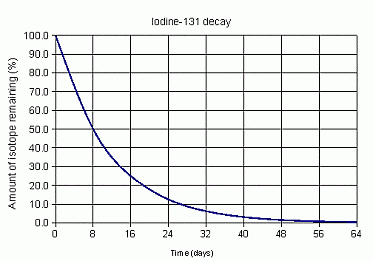
What % mass of the parent isotope remains after 1 Half Life?
50%
25%
12.5%
6.25%
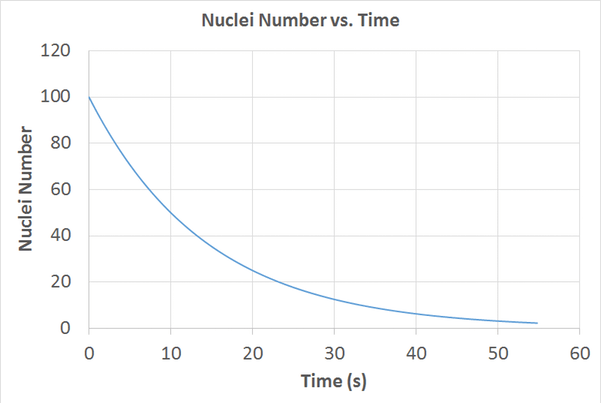
What is the Half life of this isotope?
5 seconds
10 seconds
15 seconds
20 seconds
You have 100 grams of radioactive C-14. The half life of C-14 is 5730 years.
How many grams are left after 2 half lives?
100 grams
25 grams
50 grams
14 grams
A certain radioactive sample has a half life of 2 years. After 6 years, how much of the sample is left?
1/2
1/3
1/16
1/8
A 50.0 g sample of a radioactive element has a half-life of 40 years. How much mass will be left after 80 years?
50
25
12.5
6.25
How long would it take for an element with a half-life of 100 years to reach 5 half-lives?
50
500
5000
5

In an isotope with 60 protons and 70 neutrons would you expect it to undergo radioactive decay? If so, which type?
α
β
γ
None
In an isotope with 38 protons and 60 neutrons would you expect it to undergo radioactive decay? If so, which type?
α
β
γ
None
In an isotope with 90 protons and 130 neutrons would you expect it to undergo radioactive decay? If so, which type?
α
β
γ
None
In an isotope with 22 protons and 28 neutrons would you expect it to undergo radioactive decay? If so, which type?
α
β
γ
None

