
 Worksheets
Unit 3 Test Review
Total questions: 190
Worksheet time: 48hrs 30mins


If lines are parallel with a transversal, then these two angles are...
Supplementary Angles
Corresponding Angles
Alternate Exterior Angles
Parallel Angles
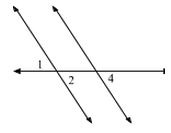
Find the measure of angle 4
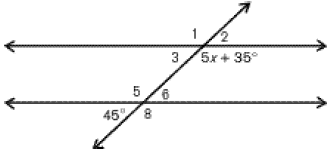

Which could be used to prove the lines are parallel?
Converse of Alternate Interior Angles Theorem
Converse of Same-Side Interior Angles Theorem
Converse of Corresponding Angles Postulate
Cannot be proved parallel
Select the figure that makes lines r and t parallel.


No
Yes, Corresponding angles are congruent
Yes, Alternate Interior angles are congruent
Yes, Alternate Exterior angles are congruent

No
Yes, Corresponding angles are congruent
Yes, Alternate Interior angles are congruent
Yes, Alternate Exterior angles are congruent

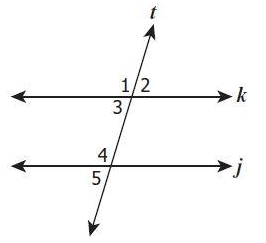




are vertical angles
are vertical angles
are vertical angles
are vertical angles

are corresponding angles
are corresponding angles
are corresponding angles
are corresponding angles



Find the measure of <Q.
60
120
110
70

Find the measure of angle AGE
50
130
120
60

Solve for x.
60
20
30
120

Find x.
130
150
120
Huh?!

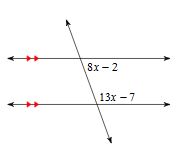
Find x.
69
23
38.5
28

Find y.
69
23
28
111

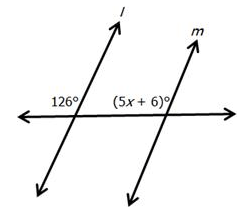
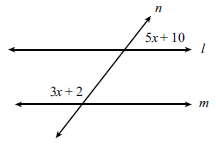
Lines L and M are parallel. Find x. Enter a number only.
(a)

Lines L and M are parallel. Find x. Enter a number only.
(a)

Lines L and M are parallel. Find x. Enter a number only.
(a)

Lines L and M are parallel. Find x. Enter a number only.
(a)

Lines L and M are parallel. Find x. Enter a number only.
(a)

Lines L and M are parallel. Find x. Enter a number only.
(a)

Lines L and M are parallel. Find x. Enter a number only.
(a)

Lines L and M are parallel. Find x. Enter a number only.
(a)

Lines L and M are parallel. Find x. Enter a number only.
(a)

Lines L and M are parallel. Find x. Enter a number only.
(a)
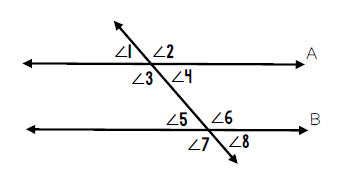
Angle 3 and Angle 6 are examples of which type of angle pair?
Alternate exterior angles
Alternate interior angles
Vertical angles
Corresponding angles
Angle 1 and Angle 5 are examples of which type of angle pair?
Alternate exterior angles
Alternate interior angles
Vertical angles
Corresponding angles
Angle 6 and Angle 7 are examples of which type of angle pair?
Alternate exterior angles
Alternate interior angles
Vertical angles
Corresponding angles
Which of the following angles would NOT be congruent to the measure of ∠7 ?
∠2
∠3
∠6
∠8
Which of the following is NOT an example of supplementary angles?
∠7 and ∠8
∠2 and ∠3
∠1 and ∠7
∠6 and ∠4
Find the value of x if the m∠3 = −4x+5° and the m∠5 = −13x+39° .
-3.8
3.8
-8
8
Find the value of x if the m∠1 = 12x+19° and the m∠2 = 22x−9° .
-2.8
2.8
-5
5
Find the value of x if the m∠1 = 11x − 9° and the m∠5 = 7x +9° .
-4.5
4.5
1
0
If the m∠5 = 63°, find the measure of ∠3.
63°
117°
180°
Cannot be determined
If the m∠7 = 115°, find the measure of ∠2.
115°
65°
180°
Cannot be determined

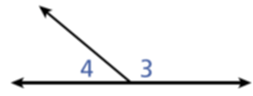
What type of angles are these? (select 2)
Adjacent Angles
Linear Pair
Complementary Angles
Supplementary Angles
Vertical Angles
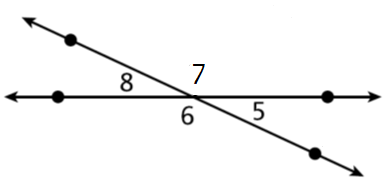
Which angles are vertical angles?
∠8 & ∠7
∠8 & ∠6
∠8 & ∠5
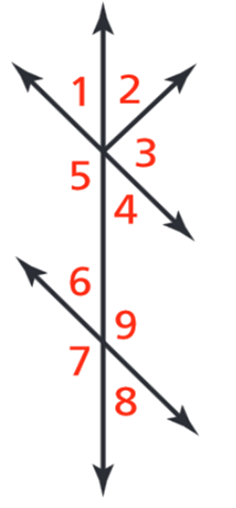
Which angle is a linear pair with ∠1 ?
∠2
∠3
∠4
∠5
∠6
Which angle is a vertical angle to with ∠7 ?
∠1
∠5
∠3
∠6
∠9


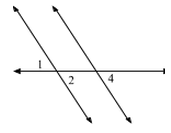
Find the measure of angle 4


Which lines are parallel, and why?
m || n because corresponding angles are congruent
m || n because alternate interior angles are congruent
p || q because corresponding angles are congruent
p || q because alternate interior angles are congruent

Which lines are parallel, and why?
m || n because corresponding angles are congruent
m || n because alternate interior angles are congruent
p || q because corresponding angles are congruent
p || q because alternate interior angles are congruent

Which lines are parallel, and why?
m || n because corresponding angles are congruent
m || n because alternate interior angles are congruent
p || q because corresponding angles are congruent
p || q because alternate interior angles are congruent

Which condition would prove s || t?
Angle 1 is 108 degrees.
Angle 2 is 108 degrees.
Angle 3 is 72 degrees.
Angle 1 is 72 degrees.
Angle 2 is 72 degrees.
Which condition would prove u || v?
Angle 1 is 108 degrees.
Angle 2 is 108 degrees.
Angle 3 is 72 degrees.
Angle 1 is 72 degrees.
Angle 2 is 72 degrees.

Which condition would prove a || b ?
Angle 1 is 60 degrees.
Angle 2 is 120 degrees.
Angle 3 is 120 degrees.
Angle 1 is 120 degrees.
Angle 3 is 60 degrees.
Which condition would prove g || h ?
Angle 1 is 60 degrees.
Angle 2 is 120 degrees.
Angle 3 is 120 degrees.
Angle 1 is 120 degrees.
Angle 3 is 60 degrees.

Which line is parallel to c ?
a
b
d
none

According to the angle measurements given, which lines are parallel?
e || f
e || g
e || h
f || g
f || h
What are vertical angles? #37
Angles that are adjacent to each other
Angles that add up to 180°
Angles that are opposite of each other when lines intersect
Angles that add up to 90°

Which conditional correctly states the Vertical Angles Theorem? #27
If <1 and <2 are vertical angles, then m < 1 = m < 2
If m < 1 = m < 2, then <1 and <2 are vertical angles
If <1 and <2 are vertical angles, then <1 and <2 form a linear pair
If <1 and <2 are vertical angles, then <1 is adjacent to < 2

What is the measure of each vertical angle? #30
****HINT: SOLVE FOR X BY SETTING ANGLE 1 =ANGLE 2, AND THEN PLUG X=? BACK INTO EACH ANGLE****
6 degrees, 6 degrees
6 degrees, 174 degrees
12 degrees, 12 degrees
12 degrees, 168 degrees

Find the value of x. #40
What is this? "If two angles are vertical, then they have equal measures". #21
Vertical Angle Postulate
Definition of Vertical Angles
Parallel Postulate
Vertical Angle Theorem

What is Reason #2? #13
Definition of a Linear Pair
Definition of Congruent Angles
Angle Addition Postulate
Definition of a Right Angle
What are Reasons #3 and #4? #14
Definition of a Linear Pair
Definition of Congruent Angles
Angle Addition Postulate
Definition of a Right Angle

The definition of a linear pair includes:
(select all that apply) #23
Two angles share a vertex
Two angles make a straight angle
The sum of the measures of a linear pair are 180*
Two angles that are complementary angles
What is a linear pair?
two angles that are non-adjacent and whose non-common sides form a straight line.
two angles that are adjacent and whose non-common sides form a straight line.
two angles that are non-adjacent and whose common sides form a straight line.
What is the reason if ∠1 and ∠2 are a linear pair, then ∠1 and ∠2 are supplementary? #24
Definition of Complementary Angles
Definition of Supplementary Angles
Definition of Vertical Angles
Linear Pair Postulate
∠1 and ∠2 form a linear pair.
If m∠1 = (5x + 9)° and m∠2 = (3x + 11)°, find the measure of each angle. #22
m∠1 = 110° and m∠2 = 70°
m∠1 = 109° and m∠2 = 71°
m∠1 = 70° and m∠2 = 110°
m∠1 = 71° and m∠2 = 109°

Solve for x. #36
20
25
120
180

Find the value of x. #33
88
78
84
74

In the given proof, what are the reasons for steps 1 and 2? #31
Angles that form a linear pair are supplementary.
Substitution
Reflexive Property of Congruence
Angles of equal measure are congruent.


Select the figure that makes lines r and t parallel.

Find the Value of x that will make the line PT and line CW parallel.
9
2
12
8

In the triangular prism, select the lines that are skew to line AE. (Select all that apply)
BD
AB
BC
DF
EF

Which of these statements is enough to prove that lines m and n are parallel?

What is the measure of ∠8 if the lines are parallel?
55
155
135
45

Angle 1 = 27o
Find the measure of angle 4 that makes the lines parallel
27o
153o
63o
90o

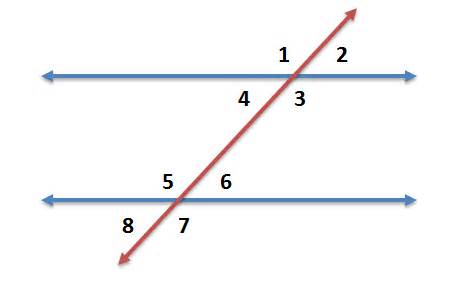

Which pair of angles must be supplementary so that r is parallel to s?
∠2 and ∠3
∠5 and ∠6
∠4 and ∠10
∠6 and ∠14


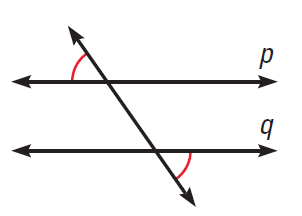
Which reason explains why the two lines are parallel?
Corresponding Angles Converse
Alt. Interior Angles Converse
Alt. Exterior Angles Converse
Consecutive Int. Angles Converse
Not Enough Information to Prove Parallel

Which reason explains why the two lines are parallel?
Corresponding Angles Converse
Alt. Interior Angles Converse
Alt. Exterior Angles Converse
Not Enough Information to Prove Parallel
Vertical Angles Theorem
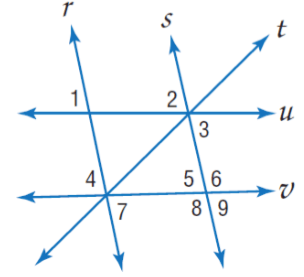
If ∠5 ≌∠7, which of the following can be concluded?
r is parallel to s by converse of Alternate Interior Angles Thm.
u is parallel to v by Converse of Corresponding Angles Thm
s is ⊥ u by Converse of Alternate Interior Angles Thm
v ⊥ r by Converse of Alternate Exterior Angles Thm

Supply the second reason.
Linear Pair Postulate
Alternate Interior Angles Theorem
Vertical Angles Theorem
Corresponding Angles Postulate

Supply the third reason.
Vertical Angle Theorem
Corresponding Angles Postulate
Alternate Interior Angles Postulate
Same Side Interior Angles Theorem

13) What is the reason for Statement 4?
Substitution
Converse of Alternate Exterior Angles Theorem
Converse of Corresponding Angles Postulate
Converse of Same-side Interior Angles Theorem

Find the vaule of y
19
27
39
15
y = 3x - 3
These lines are...
y = 3/2x + 9
These lines are...
m = 4
m = 5/8


m = 5/8
y = -6x + 2
These lines are...
Write the equation of a line PERPENDICULAR to the line y = 3x + 2 that passes through the point (9, -2)
y = -1/3x - 5
y = 3x-29
y = 1/3x -5
y = -1/3x +1
Write the equation of the line PARALLEL to the line y = 4x - 9 that passes through the point (-2, 4)
y = 4x + 12
y = -4x -4
y = -1/4x + 5/2
From the equation: y = -2x +6 what is the slope of the line?
y
6
x
-2
From the equation: y = -2x+6 what is the y-intercept of the line?
y
6
x
-2
Which of the following graphs has a POSITIVE SLOPE?


Which of the following graphs has a NEGATIVE SLOPE?
Which of the following equations has a POSITIVE SLOPE?
y=43x−5
y=−4x+1
y=−13
x=10
Which of the following equations has a NEGATIVE SLOPE?
y=43x−5
y=−4x+1
y=−13
x=10

Identify the slope of the function described in the graph.
m=−31
m=31
m=-3
m=3

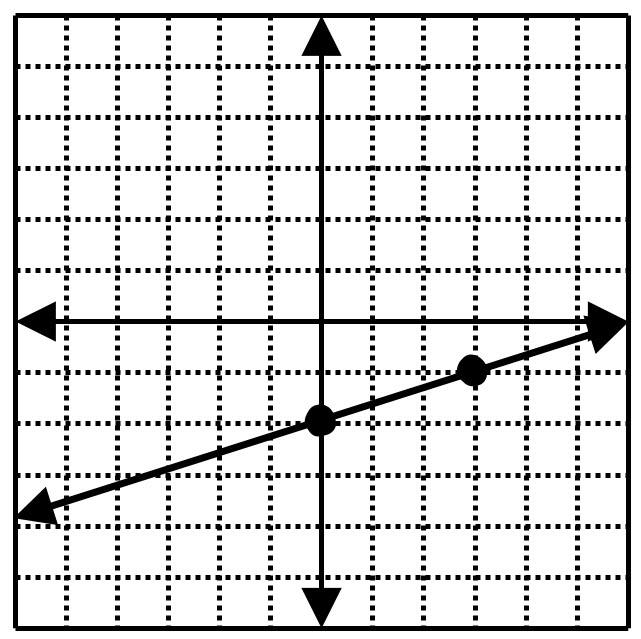


What is the initial value (y-intercept) ?
50 tiles to start
200 tiles to start
250 tiles to start


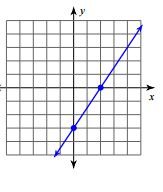


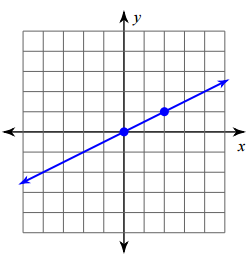

Identify the slope of the following graph.
Positive
Negative
Zero
Undefined

What is the equation for this graph?
y = 3
x = 3
0
undefined
(-2, -1); m= -3
y - 3 = 2(x + 4),
what is the ordered pair?
y - 4 = -1/3(x - 7),
what are the coordinates for the point?
What is the equation of the line that goes through the points ( 3, - 1 ) and ( 2, - 4 )?
y = 3x - 4
y = - 3x + 8
y = 3x - 1
y = 3x - 10
Write the equation of the line that passes through the points ( 0, - 5 ) and ( 4, 3 )
y = 2x - 5
y = 1/2x - 5
y = 2x + 5
y = 1/2x + 5
( 1, 2 ) and ( - 2, 5 )
y = x + 3
y = - x + 3
y = - x + 1
y = 3x + 3
Write the slope-intercept form of the equation with the given point and slope.
Through ( - 1,4 ) and m = - 3
y = x - 3
y = - 3x + 1
y = x + 2
y= - 3x + 4
What does "m" represent in y - y1 = m(x - x1)?
y-intercept
slope
macaroni
nothing
Write an equation
m = - 1/2 through ( -2, 4 )
y = - 3/2x + 3
y = 3/2x + 3
y = - 1/2x + 3
y = 3x - 3/2
Write the slope-intercept form of the equation with the given point and slope.
m = 5 through ( - 1, - 3 )
y = 5x + 2
y = - 5x - 5
y = - 5x + 2
y = 2x - 5
What is the equation of the line that passes through the points ( 3, - 1 ) and ( 2, - 4 )?
y = 3x - 4
y = - 3x + 8
y = 3x - 1
y = 3x - 10
Which of the following is the equation of the line that has a slope of 3 and passes through the point ( - 1, 9 )?
y = - 3x + 12
y = 3x + 3
y = 3x + 12
y = 3x - 3
Write the slope-intercept form of the equation with the given point and slope.
Through ( 2, 5 ) and m= 1/2
y = 1/2x + 4
y = - 1/2x - 4
y = 4x - 1/2
Write the slope-intercept form of the equation with the given point and slope.
Through ( 1, 5 ) and m = 3
y = 3x + 2
y = 3x - 2
y = 2x + 3
(0,3) and (2,-1)
y = -5x + 3 through (-5, -4)
Which of the following lines is PARALLEL to the graph of y = -6x + 3 and goes through the point (-1,4)?
y=1/6x +25/6
y = 1/6x + 4
y = -6x - 2
y = -6x + 4
Which of the following represents the equation of the line passing through (-4, 5) PERPENDICULAR to the line y = -1/2x + 5/2?
y = 2x + 13
y = 2x + 5
y = -1/2x + 3
y = -1/4x + 11/2
Determine the equation of the line that is PERPENDICULAR to the line 3x + 12y = 1 and contains the point (-2, 6).
y = 4x + 6
y = 4x + 14
y = 3x + 12
y = -1/4x + 11/2
Which equation describes a line that is perpendicular to the line y = -2/7x + 4/7 and contains the point (-6, 5)?
y = 7/2x + 26
y = 7/2x - 16
y = 7/2x - 26
y = 7/2x + 16
Determine the equation of a line perpendicular to y=-3x-2 and going through the point (9, 2), in slope-intercept form.
y=31x−3
y=−31x−9
y=31x−1
y=−3x−9
y = -2x + 4
and runs through the point (-3, 2 )
Which of the following lines is PARALLEL to the graph of y = -6x + 3 and goes through the point (-1,4)?
y=1/6x +25/6
y = 1/6x + 4
y = -6x - 2
y = -6x + 4
Which equation describes a line that is perpendicular to the line y = -2/7x + 4/7 and contains the point (-6, 5)?
y = 7/2x + 26
y = 7/2x - 16
y = 7/2x - 26
y = 7/2x + 16
Which of the following lines goes through the point (-3, 4) and is perpendicular to y = 3/2x + 6?
y = 3/2x - 6
y = 2/3x + 3
y = -2/3x - 2
y = -2/3x + 2
Which of the following lines is PARALLEL to the graph of y = -6x + 3 and goes through the point (-1,4)?
y=1/6x +25/6
y = 1/6x + 4
y = -6x - 2
y = -6x + 4

