
 Worksheets
Heredity
Total questions: 27
Worksheet time: 29mins
A
G
T
F
a
g
t
f
AA
GG
FF
EE
Aa
Gg
Ff
Ee
aa
gg
ff
ee
All organisms have DNA
True
False
A(n) (a) is a variation of a gene.
One gene codes for a single___________.
Genotype
Protein
Feature
DNA
A skin cell and an bone cell have _______DNA
The Same
Different
An offspring gets its DNA from________.
Mom & Dad
(50:50)
Mom & Dad
(60:40)
Mom & Dad
(40:60)
Only Mom
In people, the Dominant allele (W) codes for a Widow's Peak. The recessive allele (w) codes for no Widow's Peak. What combination of alleles could produce a person without a Widow's Peak?
WW
Ww
ww
In people, the Dominant allele (W) codes for a Widow's Peak. The recessive allele (w) codes for no Widow's Peak. Which phenotype would you expect to be more common? Why?
Widow's Peak- it is the recessive trait.
Widow's Peak-
It is Dominant, so it could be both WW or Ww
Widow's Peak-
It is recessive, so it could be both ww or Ww
No Widow's Peak-
It is Dominant, so it could be both WW or Ww
In Larkeys, the allele (E) is dominant for red eyes and the allele (e) is recessive for grey eyes. What would be the possible genotype (s) for red eyes?
EE
Ee or ee
EE or Ee
ee

When studying guinea pigs, what are the possible genotype(s) for short hair?
CHOOSE ALL THAT APPLY
When studying guinea pigs, what are the possible genotype(s) for long hair?
CHOOSE ALL THAT APPLY
When studying guinea pigs, what are the possible genotype(s) for rough hair texture?
CHOOSE ALL THAT APPLY!
When studying guinea pigs, what are the possible genotype(s) for smooth hair texture? CHOOSE ALL THAT APPLY!
In Larkeys, the allele (E) is dominant for red eyes and the allele (e) is recessive for grey eyes. What would be the possible genotype (s) for grey eyes?
EE
Ee or ee
EE or Ee
ee
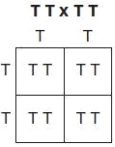
What is ratio of the offspring from the cross shown will be homozygous recessive for the trait of tallness? T = tall t = short
0 in 4
1 in 4
2 in 4
4 in 4


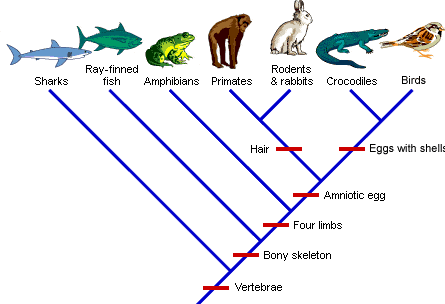


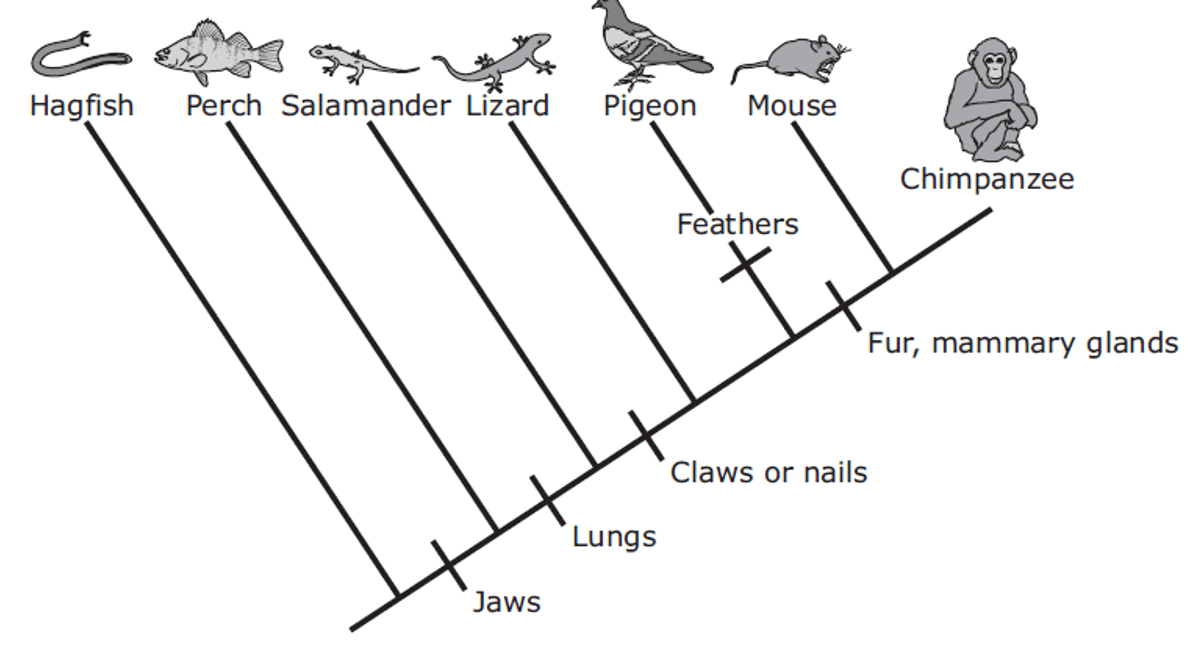

The circles on this cladogram represent_____.
Ancestors
Common Ancestors
Most Recent Common Ancestor
Descendants

Which letter represents the most recent common ancestor of a Chimp and a Salamander
A
B
C
D
E
Why is knowing information about an organism's embryo helpful when placing the organism on a cladogram?
The embryo looks like the adult organism
The embryo does not show all the traits of the adult organism
Sometimes the trait you need to classify the organism is only seen in the embryo
All embryos look alike.
What information did the dolphin embryo show us that helped us place the dolphin with humans and mammals on the cladogram?
The embryo had a tail.
The embryo had gills like a fish.
The embryo had four limbs like the tetrapods
The embryo was in a amniotic egg.
Which explanations support the claim that sexual reproduction leads to variation in a population? CHOOSE ALL THAT APPLY!
Offspring receive genetic information from both parents.
A combination of alleles codes for the different traits of the offspring.
Over generations, the variation in individuals leads to variation in the population.
Mutations are more likely to occur in organisms that undergo sexual reproduction

