
Font size
 Worksheets
Weather Intro
Total questions: 40
Worksheet time: 21mins
Which device is used to measure humidity?
anemometer
thermometer
hygrometer
barometer
Which of the following symbols represents a warm front?


Where do meteors burn up?
Troposphere
Stratosphere
Mesosphere
Thermosphere
Exosphere
What percentage of our atmosphere is nitrogen?
2%
15%
21%
78%
90%
What is a barometer used to measure?
Wind Direction
Temperature
Wind Speed
Air Pressure

Where is the International Space Station?
Troposphere
Stratosphere
Mesosphere
Thermosphere
Exosphere
A front is
where warm air is cooling at earth's surface
a line where hot and cold air are separating
a line where two different air masses meet
where cold air is rising and forming rain clouds
What percentage of our atmosphere is oxygen?
2%
15%
21%
78%
90%
Where does the vast majority of our weather occur?
Troposphere
Stratosphere
Mesosphere
Thermosphere
Exosphere
Which layer has the lowest temperatures?
Troposphere
Stratosphere
Mesosphere
Thermosphere
Exosphere
Where is the Hubble Telescope?
Troposphere
Stratosphere
Mesosphere
Thermosphere
Exosphere
Where are the auroras?
Troposphere
Stratosphere
Mesosphere
Thermosphere
Exosphere
Which layer has the highest temperatures?
Troposphere
Stratosphere
Mesosphere
Thermosphere
Exosphere
Which of the following symbols represents an occluded front?
Where is most of the water vapor in our atmosphere?
Troposphere
Stratosphere
Mesosphere
Thermosphere
Exosphere
Low pressure areas tend to have what kind of weather? Select two answers.
rain
overcast
clear skies
windy
no wind
Where is the ozone layer?
Troposphere
Stratosphere
Mesosphere
Thermosphere
Exosphere
Where do passenger planes fly during long flights?
Troposphere
Stratosphere
Mesosphere
Thermosphere
Exosphere
Which of the following symbols represents a stationary front?
Which layers have decreasing temperature with increasing altitude?
Troposphere
Stratosphere
Mesosphere
Thermosphere
Exosphere
When Naomi the rascally kitten gets warmed up by lying in her heated cat bed, this transfer of heat is called
conduction
convection
radiation
Which layers have increasing temperature with increasing altitude?
Troposphere
Stratosphere
Mesosphere
Thermosphere
Exosphere
What layer can weather balloons reach?
Troposphere
Stratosphere
Mesosphere
Thermosphere
Exosphere

What is this called?
barometer
thermometer
anemometer
hygrometer
When heat is transferred via warm matter rising and cold matter sinking in a continuous cycle, this is called
conduction
insolation
convection
radiation
If an air mass is sinking, it must be
cold and less dense
cold and more dense
warm and more dense
warm and less dense
Air masses are different in many ways. Which of these is NOT different?
moisture contents
ratio of oxygen/nitrogen
density
temperature
If I blew up a balloon in a 72°F classroom and then took it outside where it is 100°F, what would happen to the volume of air in the balloon?
It would shrink.
It wouldn't change size.
It would expand.
Which of the following symbols represents a cold front?
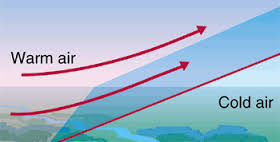
When a cold front or a warm front stays in place for several days without invading another front, it becomes a/n ______.
stationary front
cold front
occluded front
warm front

Winds are caused by differences in
precipitation
humidity
air pressure
turbulance
High pressure areas tend to have what kind of weather? Select two answers.
rain
overcast
clear skies
windy
no wind
Cyclonic winds in the Northern Hemisphere blow
clockwise
counterclockwise
north to south
west to east
Warm fronts tend to bring what kind of precipitation?
prolonged, light rain
short bursts of hard rain
In the Northern hemisphere, cold fronts typically move
north to south
east to west
south to north
west to east
Wind blows from where to where?
high pressure to low pressure
low pressure to high pressure

