
 Worksheets
Material Cycles revision
Total questions: 30
Worksheet time: 1hrs 1mins
Identify the type of organisms that can take up carbon dioxide and convert it into organic compounds
Consumers
Detritivores
Saprotrophs
Autotrophs
State the type of rock that consists mainly of calcium carbonate
(a)
What deposits form due to the partially decomposed plant matter in acidic and anaerobic conditions?
Peat
Limestone
Coral reefs
Oil
Identify the gas released through the breakdown of organic matter in anaerobic conditions by a group of prokaryotic archaeans
Nitrogen
Methane
Carbon monoxide
Sulphur dioxide
Identify the process carried out by both heterotrophs and autotrophs that returns carbon dioxide to the atmosphere
Fossilization
Respiration
Partial decomposition
Photosynthesis
State the term that describes a method of carbon storage in an ecosystem
(a)
Identify the acid that forms when carbon dioxide reacts with water
Hydrochloric acid
Sulphuric acid
Carbonic acid
Nitric acid
Identify the process that is causing a large and increasing quantity of carbon dioxide into the atmosphere
Combustion
Photosynthesis
Fossilization
Methanogenesis

Which cycle is shown in this diagram?
Nitrogen
Carbon
Phosphorus
Water
Oxygen
Types of organisms that serve to break down inorganic waste and deposit into the soil.
Diffusion
Decomposers
Detrivores
Fossil fuels
Denitrification
Which process is a significant part of the carbon cycle?
erosion
evaporation
transpiration
photosynthesis
Why does matter travel in cycles throughout the environment?
There is a limited amount of matter so it must be recycled or life can’t sustain itself
it’s how we organize environments
The world must be in cycles for order to be brought to this world
Gex 3
Which of the following is correct?
There is as much carbon on earth as when it was formed
Carbon is being created whenever it is recycled
Carbon is lost every time it is recycled
Carbon changes to different forms and is never recovered
Which is an example of a carbon sink?


The conversion of atmospheric nitrogen into ammonia, a form of nitrogen plants can readily use, is called -
denitrification.
ammonification.
nitrogen fixation.
nitrification.
To obtain the nitrogen they need, animals depend on many different microscopic ____________________ to convert nitrogen at all stages of the nitrogen cycle.
protozoa
bacteria
worms
insects
Denitrifying, anaerobic bacteria convert nitrate into nitrogen gas that returns to the atmosphere. What does anaerobic refer to?
Oxygen is present.
Oxygen is not present.
There is little or no light available.
There are several species of bacteria.
The atmosphere is made up of mostly nitrogen. The percentage of nitrogen in the atmosphere is approximately _____.
60%
78%
83%
51%
Decomposers make ammonium in the soil during the process of -
nitridication.
nitrogen fixation.
denitrification.
ammonification.
(a) converts ammonia and ammonium into nitrite and nitrate.
Select all answers below that are stages of the nitrogen cycle.
Nitrogen fixation
Diffusion
Ammonification
Nitrification
The relationship between some plants and nitrogen-fixing bacteria is -
predator-prey.
parasitic.
mutualistic.
commensal.
The nitrogen cycle converts _________________ nitrogen into a useful form that living organisms can use to build proteins and nucleic acids within their cells.
cellular
atnospheric
soil-based
anaerobic
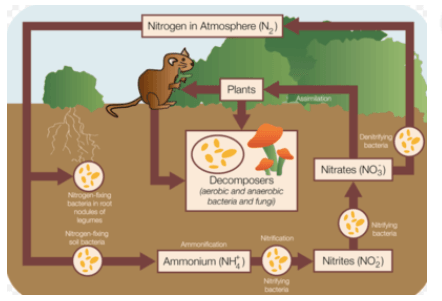
A correct path that nitrogen could take would be
air -> animals -> plants -> bacteria
animals -> air -> bacteria -> plants
bacteria -> air -> plants -> animals
air -> bacteria -> plants -> animals
This can transform nitrogen in the atmosphere into a usable form of nitrogen
rain
ice
lightning
sun


