
 Worksheets
Unit 2 Solutions Review
Total questions: 38
Worksheet time: 22mins
Liquid to Gas
melting
vaporization/evaporation
condensation
sublimation

Freezing
F
C
A
D
Melting
increases heat energy of a substance.
decreases heat energy of a substance.
Gas to liquid
vaporization
melting
condensation
sublimation

Sublimation
A
B
C
F
Condensation
increases heat energy of a substance.
decreases heat energy of a substance.
Solid to liquid
freezing
melting
sublimation
condensation

Vaporization
B
E
D
F
Freezing
increases heat energy of a substance.
decreases heat energy of a substance.

Deposition
A
C
B
F
Change of a solid directly into a gas
Deposition
Melting
Sublimation
Freezing
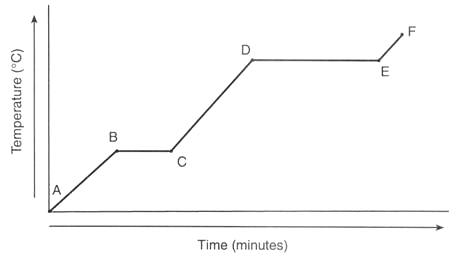
Are the particles moving faster or slower as time goes on?
Faster
Slower

The melting point of the sample is
-60 ºC
-100 ºC
60 ºC
100 ºC

Given the heating curve of a solid being heated at a constant rate, what is the boiling point of this substance?
20°C
50°C
110°C
170°C

What term goes on the y-axis? (A)
Heat(Energy)
Temperature
Phase
Type of Matter
What phase of matter exists in part C of the graph?
Gas
Liquid
Solid
Plasma
What phase change occurs when you start at D and end at C?
Freezing
Melting
Condensing
Vaporization
On which parts of the graph does the temperature remain the same?
Between C and D
Between D and E
At C, D, or E
On both flat sections

Which box has a higher concentration?
gas
liquid
solid
pressure
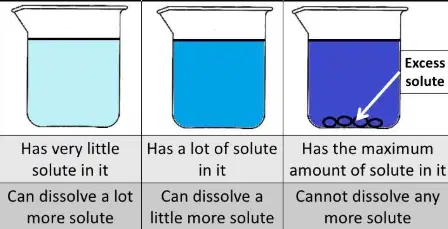
Of these solutions, the solution on the left would be considered ____. (lightest blue, more solvent than solute).
Unsaturated
Saturated
Super Saturated
Of these solutions, the solution on the right would be considered ____. (overloaded with too much solute).
Unsaturated
Saturated
Super Saturated
Of these solutions, the middle solution would be considered ____. (has the "just right" amount of solute).
Unsaturated
Saturated
Super Saturated
Which solution is more concentrated?
50 grams of sugar in 100 ml water
75 grams of sugar in 100 ml water
25 grams of sugar in 100 ml water
60 grams of sugar in 100 ml water
What would you do to make a solution more concentrated?
add more solvent
add more solute
add more solvent and solute
pour some of the solution out
Which statement is true about a solution of saltwater?
the water is the solvent
the salt and water are solutes
the salt is the solvent
the water is the solute
To make a Kool-Aid solution less concentrated, which would you do?
add more solute
add more solvent
pour out some of the Kool-Aid
add more solvent AND solute
Which is NOT a factor in the rate at which a solute dissolves?
the temperature of the solvent
the size of the particles of the solute
the size of the container the solution is in
whether or not the mixture is stirred
Which is true about the rate of a solute dissolving?
solutes dissolve slower in a hot solvent
solutes dissolve faster when not stirred
smaller particles dissolve faster
larger particles in cold solvent dissolve faster
If a solution is SATURATED, what does that mean?
No more solute can be dissolved
More solute must be added
The solvent can no longer evaporate
The solution cannot be stirred

Which of the solutions above is the most concentrated?
A
C
E
They are all the same concentration
What are the two parts of a solution?
solubility and mixture
solvent and solute
solvent and solving
saturation and solute
The substance that is present in a greater amount is known as the
Colloid
Solute
Solvent
Solution
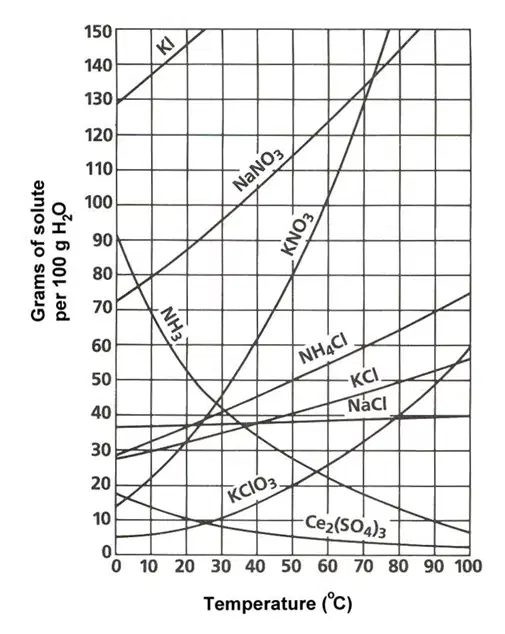
Based on the solubility curve, how much NH4Cl will dissolve in 100g of water at 50 degrees?
30g
40g
50g
60g
Based on the solubility curve, how much KClO3 will dissolve in 100g of water at 30 degrees?
10g
20g
30g
40g

