wayground logo

Free Printable Worksheets

Font size

S
M
L
XL
Worksheets

Geometry Chapter 2 Practice

Total questions: 86

Worksheet time: 1hrs 26mins

Name
Class
Date
1.
What is always the 1st statement in reason column of a proof?
a)
Prove
b)
Given
c)
Reason
d)
Statement
2.
Identify the property used here:
39=39
a)
Reflexive
b)
Symmetric
c)
Transitive
d)
Substitution
3.
What is reason 2?
a)
Addition Property of Equality
b)
Subtraction Property of Equality
c)
Multiplication Property of Equality
d)
Division Property of Equality
4.
Identify the property of equality.
If 9=x, then x=9
a)
Reflexive
b)
Symmetric
c)
Transitive
d)
Substitution
5.
What is reason 3?
a)
Addition Property of Equality
b)
Subtraction Property of Equality
c)
Multiplication Property of Equality
d)
Division Property of Equality
6.

What is the fifth Reason?

a)

Symmetric Property of Equality

b)

Subtraction Property of Equality

c)

Multiplication Property of Equality

d)

Division Property of Equality

7.

Name the Property that this statement illustrates:

If x = y, then 3x = 3y.

a)

Multiplication Property Of Equality

b)

Addition Property Of Equality

c)

Symmetric Property Of Equality

8.
Step 2 is what
a)
Substitution property (simplify)
b)
Multiplication property of equality
c)
Division property of equality
d)
Distributive Property
9.
What is step 6
a)
Subtraction property of equality
b)
Addition property of equality
c)
Division property of equality
10.
What is Addition property of equality
a)
a.   If a=b, then a+c=b+c
b)
b.  If a=b, then a-c=b-c
c)
c.  If a=b, then ac=bc
d)
d.  If a=b, then a/c=b/c
11.
If 3x + y = 14 and y = 9, then 3x + 9 = 14.
a)
Reflexive Property of Equality
b)
Symmetric Property of Equality
c)
Transitive Property of Equality
d)
Substitution Property of Equality
12.
For any numbers a, b, and c, if a = b and b = c, then a = c.
a)
Transitive Property         
b)
Symmetric Property
c)
Reflexive Property
d)
Substitution Property
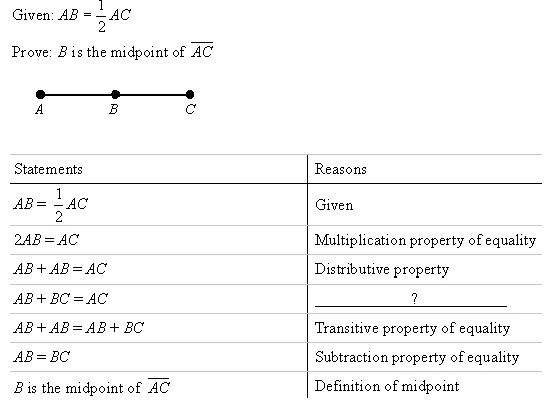
13.
Fill in the reason for 5. 
a)
Addition Postulate
b)
Substitution property
c)
Definition of midpoint
d)
Segment Addition Postulate
14.
Fill in the statement for number 4. 
a)
RA=RE +AE
b)
EL = EA + AL
c)
RE +EA= EA +AL
d)
RA = EL
15.
Fill in the reason for number 3. 
a)
Reflexive property
b)
Symmetric Property
c)
Transitive property
d)
Substitution property
16.
Fill in the statement for number 3. 
a)
HA = AY
b)
HA = AP
c)
A is the midpoint of HP
17.
What is the justification (reason)?
a)
reflexive property
b)
definition of segment bisect
c)
definition of a midpoint
d)
substitution property
18.

Given: B is the midpoint of AC. What should you conclude?

a)

AB + BC = AC

b)

AB = BC

c)

A is the segment bisector of BC

d)

ABC is a straight angle

19.

Which of the following is an example of the transitive property?

a)

If x = 5 and and x = y, then y = 5.

b)

If x = y then y = x

c)

x = x

d)

If 2x + 4 = 2, then x = -1

20.

What is the missing statement in the proof?

a)

Addition property

b)

Segment Addition Postulate

c)

Substitution property

d)

Transitive property

21.
If O is between FX, then FO + OX = FX.
a)
Segment Addition Postulate
b)
Angle Addition Postulate
c)
Definition of Congruent Segments
d)
Vertical Angles Theorem
22.

If B is the midpoint of segment AC, then AB = BC.

a)

Definition of Congruent Segments

b)

Definition of Midpoint

c)

Vertical Angles Theorem

d)

Definition of Angle Bisector

23.
What is the reason?
a)
Definition of congrucent
b)
Definition of midpoint
c)
Definition of segment
d)
Segment Addition 
24.
What is the reason?
a)
Transitive 
b)
Substitution
c)
Middle Man
d)
Replacing 
25.
Name the property of equality or congruence that justifies going from the first statement to the second statement.
a)
Reflexive Property of Equality
b)
Symmetric Property of Equality
c)
Symmetric Property of Congruence
d)
Reflexive Property of Congruence
26.
Name the property of equality or congruence that justifies going from the first statement to the second statement.
a)
Reflexive Property of Congruence
b)
Symmetric Property of Congruence
c)
Distributive Property
d)
Transitive Property of Congruence
27.

What is the justification?

a)

Definition of congruence

b)

Reflexive Property of Congruence

c)

Segment Addition Postulate

d)

Definition of Midpoint

28.

What is the justification?

a)

Segment Addition Postulate

b)

Definition of Midpoint

c)

Addition Property of Equality

d)

Complement Theorem

29.

What is the justification?

a)

Transitive Property of Equality

b)

Subtraction Property of Equality

c)

Division Property of Equality

d)

Substitution Property of Equality

30.

What is the justification?

a)

Definition of Congruence

b)

Segment Addition Postulate

c)

Transitive Property of Congruence

d)

Definition of Midpoint

31.
a)

Multiplication Property of Equality

b)

Segment Addition Postulate

c)

Definition of Midpoint

d)

Symmetric Property of Congruence

32.

Which property is being used above?

a)

Addition Property

b)

Multiplication Property

c)

Subtraction Property

d)

Division Property

33.

What is reason 1?

a)
b)
c)
d)
34.

What is reason 2?

a)
b)
c)
d)
35.

What is reason 3?

a)
b)
c)
d)
36.

What is reason 4?

a)
b)
c)
d)
37.

What is reason 5?

a)
b)
c)
d)
38.

What is reason 1?

a)
b)
c)
d)
39.

What is reason 2?

a)
b)
c)
d)
40.

What is reason 3?

a)
b)
c)
d)
41.

What is reason 4?

a)
b)
c)
d)
42.

What is reason 5?

a)
b)
c)
d)
43.

What is reason 6?

a)
b)
c)
d)
44.

What is reason 7?

a)
b)
c)
d)
45.

The conclusion from this diagram is that angle 1 and angle 2 are a linear pair.

What's the reason for this conclusion?

a)

m1+m2=180m\angle1+m\angle2=180

b)

Definition of linear pair

c)

Linear pair postulate

d)

definition of supplementary

46.

Given: m1+m2=90°Given:\ m\angle1+m\angle2=90\degree  
Conclusion: 1 comp 2Conclusion:\ \angle1\ comp\ \angle2  

Give the reason for the conclusion.

a)

Definition of supplementary

b)

Definition of complementary

c)

Definition of a right angle

d)

Definition of perpendicular

47.

Make a conclusion from this given statement.Make\ a\ conclusion\ from\ this\ given\ statement.   BD bisects ABC\overrightarrow{BD}\ bi\sec ts\ \angle ABC  

a)

m \angle  ABD + m \angle  DBC = m \angle  ABC

b)

1/2 \cdot  m \angle  ABC = m \angle  DBC

c)

m \angle  ABD = m \angle  DBC

d)

\angle  ABC \cong   \angle  DBC

48.

The conclusion from this diagram is that angle 1 and angle 2 are a linear pair.

What's the reason for this conclusion?

a)

m1+m2=180m\angle1+m\angle2=180

b)

Definition of linear pair

c)

Linear pair postulate

d)

definition of supplementary

49.

Given: 1 is a right angleGiven:\ \angle1\ is\ a\ right\ angle
Give a conclusion and reason for the conclusion.

a)

m1=180m\angle1=180  Definition of straight angle

b)

m1=90°m\angle1=90\degree  Definition of perpendicular

c)

m1=90°m\angle1=90\degree  Definition of right angle

d)

190°\angle1\ne90\degree  Definition of right angle

50.

Given: BABCGiven:\ \overrightarrow{BA}\perp\overrightarrow{BC}  
Give a conclusion for the given and a reason for the conclusion.

a)

mB=90° m\angle B=90\degree\  Definition of right angle

b)

mB=90°m\angle B=90\degree  Definition of perpendicular

c)

B is a right angle\angle B\ is\ a\ right\ angle  Definition of perpendicular

d)

B is a right angle\angle B\ is\ a\ right\ angle  Definition of right angle

51.

Which option best fills in the blank in the proof?

a)

Substitution Property

b)

Definition of Linear Pair

c)

Definition of Supplementary Angles

d)

Angle Addition Postulate

52.
The type of reasoning where a person makes  conclusions based on observations and patterns is called...
a)
Inductive reasoning
b)
Deductive reasoning
c)
Conjecture
d)
Experiments
53.
What is a conjecture?
a)
A statement believed to be true based on observations.
b)
An example which disproves an hypothesis.
c)
the performance of tricks that are seemingly magical
54.
Complete the conjecture.  Think of examples to help.
The product of any two odd numbers is _____________
a)
even
b)
odd
c)
zero
d)
positive
55.
Where would the next red square be?
a)
bottom left
b)
top right
c)
top left
d)
bottom right
56.
What are the next two numbers in this pattern?
12, 17, 22, 27, ___, ___
a)
32, 37
b)
30, 37
c)
30, 33
d)
32, 35
57.
Used to prove that a conjecture is false.
a)
Counterexample
b)
Inductive Reasoning
c)
Concluding statement
d)
Conjecture
58.

A type of reasoning that uses general facts, definitions, and accepted properties in a logical order to write a logical argument.

a)

Inductive

b)

Deductive

c)

Logic

d)

Reasoning

59.

The sum of the interior angle of a square is 360.

The sum of the interior angle of a rectangle is 360.

The sum of the interior angle of parallelogram is 360.

The sum of the interior angle of a rhombus is 360.

What is the possible conclusion base on the given information?

a)

The sum of the exterior angles of a quadrilateral is 360.

b)

The sum of the interior angles is 360.

c)

The sum of the interior angles of a quadrilateral is 360.

d)

The interior angle of a quadrilateral is 360.

60.

An unproven statement which is based on observations.

a)

Reasoning

b)

Conclusion

c)

Conjecture

d)

Logic

61.

Determine the next 2 possible terms in the list.

400, 200, 100, 50, . . .

a)

20, 10

b)

25, 12

c)

25, 12.5

d)

25, 10

62.
a)
1
b)
15
c)
20
d)
12
63.
What comes next?
a)
The next term will have 16 blocks
b)
The next term will have 15 blocks.
c)
The next term will have 14 blocks.
d)
This is the end of the pattern.
64.

Which of the following DOES NOT describe inductive reasoning?

a)

process of reasoning based on known facts

b)

reaches conclusion based on a pattern of specific examples

c)

reaches conclusion based on past events

d)

starts with an observation and works its way up

65.

Reasoning based on facts, definitions, accepted properties, and the laws of logic is called ____________ reasoning.

a)

Inductive

b)

Deductive

66.
All bears are mammals, all mammals have kidneys; therefore all bears have kidneys. 
a)
Deductive
b)
Inductive
67.
Obtuse angles are greater than 90 degrees.  This angle is 110 degrees, so it is obtuse. 
a)
Deductive
b)
Inductive
68.
All observed houses on South Street have roofs that are falling apart.  Sherry lives on South Street.  Her roof is falling apart. 
a)
Deductive
b)
Inductive
69.

You see the numbers 2, 4, .... and decide the next number must be a 6


What type of reasoning was used?

a)

Inductive

b)

Deductive

70.
Using the statements:
If it is Friday, then I will get paid.
It is Friday.
Write the conclusion.
a)
It is not Friday
b)
It is Friday
c)
I will not get paid
d)
I will get paid
71.
Using the Law of Syllogism, which of the following completes the statement to form a valid conclusion?
If it is snowing heavily, then school will be canceled.
If school is canceled, the big test will not be given today.
It is snowing heavily, then...
a)
Look out for the snowplows while driving to school.
b)
The big test will not be given today.
c)
The roads will be hard to drive on.
d)
You should call the school to see if school is canceled.
72.
Which is a valid conclusion from these statements?
If a quadrilateral is a rhombus, then it is a parallelogram.
If a quadrilateral is a parallelogram, then its opposite angles are congruent.
a)
Opposite angles of a quadrilateral are congruent
b)
Opposite angles of a rhombus are congruent
c)
Every quadrilateral is a rhombus
d)
Every parallelogram is a rhombus
73.
Which statement is a valid conclusion based on the argument?
If a polygon is a regular pentagon, then the polygon has exactly five congruent angles.
The polygon is a regular pentagon.
a)
Therefore, the polygon is a rectangle.
b)
Therefore, the polygon is a regular quadrilateral.
c)
Therefore, the polygon has exactly five congruent angles.
d)
Therefore, the polygon has congruent sides.
74.
(1) If you drive safely, then the life you save may be your own.
(2) AJ drives safely.
(3)  The life AJ saves may be his own.
Is statement (3) logical given the Law of Detachment, Syllogism, Contrapositive, or is it invalid?
a)
Law of Detachment
b)
Law of Syllogism
c)
Law of Contrapositive
d)
invalid
75.
p→q
q→r
∴p→r
Which law is modeled?
a)
Law of Syllogism
b)
Law of Detachment
c)
Law of Contrapositive
d)
Law of Shannon
76.
p→q
p
∴q
Which law is modeled?
a)
Law of Syllogism
b)
Law of Detachment
c)
Law of Contrapositive
d)
Law of Shannon
77.
If an angle is 40⁰, then it is acute.
∠A is 40⁰.
Using the Law of Detachment, what is the logical statement to conclude?
a)
∠A is complementary to ∠B
b)
∠A is acute.
c)
∠A is obtuse.
d)
∠A is 40⁰
78.
Use Law of Syllogism to make a conclusion.
 If a number is divisible by 10, then it is divisible by 2.  If a number is divisible by 2, then it is even.
a)
If a number is divisible by 10, then it is even,
b)
If a number is even, then it is divisible by 10.
c)
If a number is divisible by 2, then it is even.
d)
If a number is even, then it is divisible by 2.
79.
Using the Law of Detachment, what can you conclude?
If x has a value of 4, then 2x has a value of 8.
The value of x is 4.
a)
x = 4
b)
no conclusion can be made
c)
2x does not have a value of 8
d)
2x has a value of 8
80.
Use Law of Syllogism to make a conclusion.
If the perimeter of a square is 20 ft, then the length of a side is 5 ft.
If the length of a side of a square is 5 ft, then the area is 25 ft2.
a)
If the side of a square is 5 ft, then the perimeter is 20 ft.
b)
If the perimeter of a square is 20 ft, then the area is 25 ft2
c)
If the area of a square is 25 ft2, then the side length is 5 ft. 
d)
If the are of a square is 25 ft2, then the perimeter is 20 ft.
81.
What can be concluded from the following statements?
If Tom goes fishing then he brings a pole.
If Tom brings his pole then he catches a fish.
a)
If Tom goes fishing then he catches a fish.
b)
If Tom brings his pole then he goes fishing
c)
 If Tom catches a fish then he brought his pole.
d)
If Tom brings his pole then he catches a fish.
82.

________, also known as logical reasoning, is the process of reasoning logically from given statements or facts to a conclusion.

a)

Inductive Reasoning

b)

Deductive Reasoning

c)

Biconditional Statements

d)

Contrapositive statements

83.

Which law of logic is this:


If it is July, then school is out.

If school is out, then Ms. Prose is happy.

Therefore, if it is July, then Ms. Prose is happy.

a)

Law of Detachment

b)

Law of Contrapositive

c)

Law of Syllogism

d)

No Law

84.

All land animals can walk. Dog is a land animal.

a)

Therefore, dog cannot walk.

b)

Therefore, land animals are dogs.

c)

Therefore, dogs can walk.

d)

Therefore, dogs are land animals.

85.

What is a counterexample of the statement below?

"If an animal has wings, then it can fly."

a)

Duck

b)

Penguin

c)

Rabbit

d)

Snake

86.
If possible, use the Law of Detachment to draw a conclusion from the two given statements. If not possible, write not possible.
Statement 1: If x = 2, then 2x – 10 = –6.
Statement 2: x = 2 

a)
2x – 10 = –6 
b)
x = 2
c)
 If 2x – 10 = –6, then x = 2
d)
not possible