wayground logo

Free Printable Worksheets

NEW

Font size

S
M
L
XL
Worksheets

QUIZIZZ: Heat transfer and effects

Total questions: 28

Worksheet time: 28mins

Name
Class
Date
1.

Which option describes a specific characteristic of heat transfer through conduction?

a)

The objects that are transferring heat must be in contact with each other.

b)

The heat moves from the object with higher temperature to the one with lower temperature.

c)

One object emits heat to another object through electromagnetic waves.

d)

The object that releases heat increases its temperature.

e)

It produces a circular motion from hot to warm areas.

2.

Which of the following is NOT a possible effect of heat on a substance?

a)

Temperature increase.

b)

Temperature decrease.

c)

 Change in state.

d)

Thermal expansion.

e)

Mass decrease.

3.

Boiling Water

a)

Conduction

b)

Convection

c)

Radiation

4.

Curling Iron

a)

Conduction

b)

Convection

c)

Radiation

5.
What is the transfer of heat by direct contact?
a)
Convection
b)
Electromagnetic waves
c)
Radiation
d)
Conduction
6.
What is a transfer of heat energy by electromagnetic waves?
a)
Radiation
b)
Convection
c)
Conduction
d)
Heat
7.
What is the transfer of heat by movement of liquids or gases?
a)
Radiation
b)
Convection
c)
Conduction
d)
Heat
8.
Heat transfers from an area of ________temperature to an area of ______ temperature.
a)
high to low
b)
low to high
c)
high to high
9.

Which of the following would reduce the dissipation of energy from a house to the surroundings?

a)

insulation

b)

large walls

c)

thin walls

d)

metal walls

10.

___________________ are materials that ALLOW heat and electricity to move easily through them.

a)

Conductors

b)

Insulators

11.
What is the measurement of the average kinetic energy of a substance?
a)
Kinetic energy
b)
Temperature
c)
Thermal energy
d)
Potential energy
12.
What is the energy of the movement of particles in a substance?
a)
Potential energy
b)
Kinetic energy
c)
Thermal energy
d)
Temperature
13.

What method of heat transfer is this an example of?

a)

Conduction

b)

Convection

c)

Radiation

14.

What method of heat transfer is this an example of?

a)

Convection

b)

Conduction

c)

Radiation

15.

Near the ceiling of a room the air is warmer; the warm air rises because of __________.

a)

conduction

b)

convection

c)

radiation

16.
The movement of thermal energy from an object at a higher temperature to an object at a lower temperature is called ____________.
a)
thermal
b)
expansion
c)
temperature
d)
heat
17.
Thermal energy always moves from ____________ objects to ______________ objects.
a)
cooler, warmer
b)
warmer, cooler
c)
faster, slower
d)
slower, faster
18.
Thermal energy stops moving when the objects have the same temperature.
a)
True
b)
False
19.
An increase in the volume of a substance when the temperature increases is called ___________________________________.
a)
kinetic energy
b)
thermal expansion
c)
temperature
d)
heat
20.

The amount of energy required to raise the temperature of 1 kilogram of a substance by 1 kelvin is called its

a)

specific heat

b)

heat transfer

c)

change of state

d)

melting point

21.
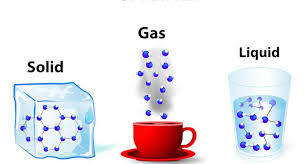
In which state of matter are the particles only vibrating?
a)
Gas
b)
Liquid
c)
Solid
d)
Plasma
22.
Of these three states of matter, which one has the most kinetic energy? 
a)
Solid 
b)
Liquid 
c)
Gas
23.
The change from a gas to a liquid by cooling
a)
condensation
b)
evaporation
c)
sublimation
d)
deposition
24.
Both the melting point and __________ point occur at the same temperature.
a)
condensation
b)
boiling
c)
freezing
d)
sublimation
25.
Both the boiling point and __________ point occur at the same temperature.
a)
condensation
b)
deposition
c)
freezing
d)
sublimation
26.

As particles are heated they will

a)

contract

b)

expand

27.

As particles are cooled they will

a)

contract

b)

expand

28.

When one substance is changing state. the temperature stays constant (does not change).

a)

TRUE

b)

FALSE