Wayground logo

Free Printable Worksheets

Font size

S
M
L
XL
Worksheets

Intro to Cells

Total questions: 28

Worksheet time: 49mins

Name
Class
Date
1.
Robert Hooke, Anton van Leeuwenhoek, Theodor Schwann, Rudolf Virchow, and Matthias Schliden were all responsible for what theory?
a)
The Theory of Gravity
b)
The Theory of Relativity
c)
The Cell Theory
d)
The Theory of Continental Drift
2.
What tool do you use to view the cells?
a)
metric ruler
b)
centrifuge
c)
microscope
d)
telescope
3.
All living things are made up of...
a)
cells
b)
cell tissues
c)
organ
d)
organ systems
4.
All cells come from___________ cells.
a)
pregnant
b)
pre-existing
c)
paternal
d)
pin size
5.
Rocks are not living because
a)
they never move
b)
they aren't needed for humans
c)
they are not made of cells
d)
they don't break down
6.
what is a cell classified as?
a)
a basic unit of structure and function of all living organisms
b)
a unit based on only plants and animals that are living
7.
All organisms are made of:
a)
organelles
b)
cytoplasm
c)
DNA
d)
cells
8.

All cells -----

a)

come from other dead cells

b)

come from other living cells

c)

crystallize out of the air

9.
Cells are often called "the ____ of life."
a)
bread
b)
road map
c)
building blocks
d)
meaning
10.

  There are three parts to the cell theory. Which is NOT one of those parts?

a)

All organisms are composed of one or more cells.

b)

The cell is the basic unit of structure and organization in organisms.

c)

Cells spontaneously arise from carbon and nutrients carried in the bloodstream.

d)

All cells come from pre-existing cells.
11.
Bacteria is what kind of cell?
a)
Eukaryotic
b)
Prokaryotic
12.
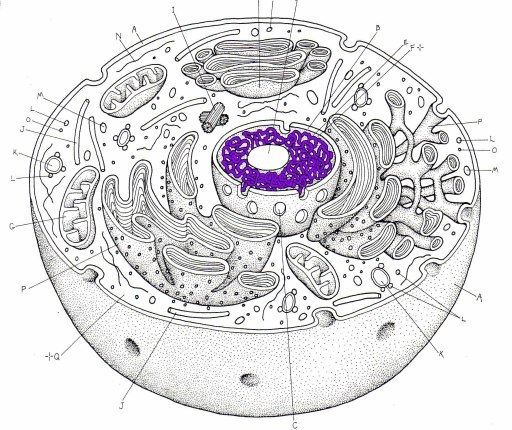
What kind of cell is this?
a)
Eukaryotic
b)
Prokaryotic
13.
Cells can only be seen with the help of a...
a)
hand lens 
b)
magnifying glass
c)
3D glasses 
d)
microscope 
14.
All living things are made of...
a)
atoms 
b)
cells 
c)
bacteria 
d)
plants 
15.

Prokaryotic

a)

A cell that has NO nucleus

b)

A cell that has a nucleus

c)

An organism with one cell

d)

An organism with many cells

16.

Eukaryotic

a)

A cell that has NO nucleus

b)

A cell that has a nucleus

c)

An organism with one cell

d)

An organism with many cells

17.

What kind of cells do animals have?

a)

Prokaryotic

b)

Eukaryotic

18.

What is DNA?

a)

Genetic material

b)

An organelle

c)

A type of cell

d)

An organism

19.

Which is true about prokaryotic and eukaryotic cells?

a)

They both have mitochondria.

b)

They are both highly complex cells.

c)

They both have DNA.

d)

They both have a nucleus.

20.

Which type of cell has cytoplasm?

a)

Only prokaryotic

b)

Only eukaryotic

c)

Both prokaryotic and eukaryotic

21.

What is the function of the mitochondria?

a)

Structure that manufactures ribosomes

b)

Structures that converts nutrients to energy

c)

Stack of membranes that packages chemicals

d)

Structure that contains DNA and directs the cell

22.
I store water in both plant and animal cells. What am I?
a)
cytoplasm
b)
ribosomes
c)
vacuole
d)
lysosomes
23.
What cell part is NOT found in all cells?
a)
Cell Wall
b)
Cell Membrane
c)
Cytoplasm
d)
Genetic Material
24.

Is the jelly-like substance in the cell that contains the organelles

a)

ribosome

b)

cytoplasm

c)

cell wall

d)

chloroplast

25.

The control center of the cell that HAS DNA

a)

cytoplasm

b)

ribosomes

c)

lysosomes

d)

nucleus

26.

Sac within the cytoplasm that STORES fluid, plants have a larger one that stores food and water.

a)

vacuole

b)

lysosome

c)

cell wall

d)

ribosome

27.

This structure is only found in plants and prokaryotes (Gives it a rigid shape)

a)

cell wall

b)

cytoplasm

c)

centriole

d)

nucleus

28.

The outer part of the cell that is in both plants and animal cells.

"The fence"

a)

cell membrane

b)

cell wall

c)

nucleus

d)

cytoplasm