
Font size
 Worksheets
Unit 1: Early North American Cultures and Unit 2: Exploration
Total questions: 50
Worksheet time: 39mins
What religious goal inspired many European explorers?
To visit holy sites
to live in poverty
to spread their beliefs
to learn about other faiths
The movement of people, animals, plants, and cultures between the Eastern and Western hemispheres:
expedition
Columbian Exchange
slave trade
navigation
The French and English explorers were looking for which shortcut through the Americas?
The Atlantic Thruway
The Cape of Good Hope
The Northwest Passage
The Strait of Magellan
Conquistador is a spanish word that means.....
crazy man
soldier
conqueror
Why did the conquistadors bring priests with them to the Americas?
To help the Spaniards hold religious services
To perform weddings between Spanish soldiers and native women
To teach the Spanish soldiers about Christianity
To convert the native peoples to Christianity
Which exchange most impacted the native populations in Mesoamerica?
Gunpowder
Smallpox
Horses
Cacao
Which of the following is NOT one of the 3 G's for exploration?
Gold
Goods
Glory
God
Choose the three primary motivations for European exploration.
gold & wealth
God and religion
spread of technology
the conquering of China
glory and personal/political fame
What was the major reason European rulers sought to colonize North America?
They needed people from North America to settle in Europe.
They sought to learn more about Native American cultures.
They sought to expand their power with riches from the "New World."
They wanted a place to send their criminal population.
Early European explorers who came from the "New World" were looking for a Northwest Passage in order to -
prove the world was round
improve trade with Native Americans
explore the Great Lakes
find a shorter route to Asia
This term refers to the process of establishing foreign control over an area by developing settlements, this is known as -
Invasion
Exploration
What is Marco Polo most known for?
Traveled to the South Pacific and brought back items to sell for a huge profit.
Exploring Egypt's Nile River
Traveled to Asia and brought back items to sell for a huge
profit.
Discovering North America
Which European Explorer found a way to sail around the tip of Africa near the Cape of Good Hope?
John Cabot
Bartolomeu Dias
Vasco da Gama
Henry Hudson

Which of the following explorers found a way to sail around Africa to India, as pictured in the map above?
Jacques Cartier
John Cabot
Francis Drake
Vasco da Gama

What animal was a staple food source for people living on the North American plains?
buffalo
cow
deer
moose
When someone changes their lifestyle to fit their environment, they are making a(n)
adaptation
theory
culture
artifact
A person, plant, or animal that is native to a place is also called
political
civilized
patriotic
indigenous
A _______ is a small group of people with a shared heritage, language, and traditions.
civilization
country
tribe
state
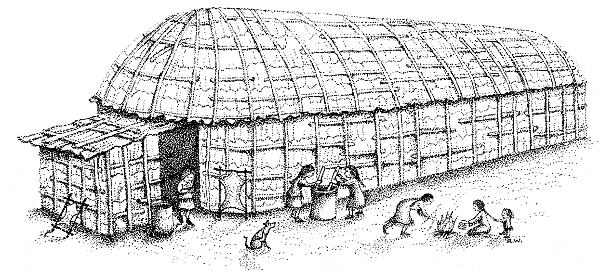
Which Native American group lived in wigwams and longhouses?
Mound Builders
Eastern Woodlands
Plains
Cliff Dwellers
Which Native American group lived as nomads following the buffalo herds?
Plains
Mound Builders
Northwest
Eastern Woodlands
Which describes a shared characteristic of Native American groups?
They all lived in tepees and wigwams and hunted on horseback.
They all believed women and men were equals and could be leaders.
They all depended on nature and the land for survival.
They all developed societies that disappeared mysteriously.
Which describes the work of an archaeologist?
studies legal documents
studies people's traditions and customs
studies man-made materials from the past
studies ancient languages
What describes the Iroquois League?
a group of Indians who migrated to the Rocky Mountains
a defense alliance of Eastern Woodland nations
a group of Indian peoples of the Pacific Northwest
a gathering of tribal leaders from the Great Plains
Which had the greatest influence on the way different Native American culture groups developed?
the time period in which they settled in North America
the geography and climate of the area where they settled
the kind of writing and language they used
the beliefs of the group about the ways plants and animals should be used
an American Indian village of the Southwest made of stone and adobe buildings built very close together
pueblo
navajo
Nez Perces
Inuits
What cultural area did the Navajos and Pueblos live?
Califorina
Artic
Southwest
Pacific Northwest
The first Americans may have come by crossing the Bering Strait
True
False
What does the word migrate mean?
to leave
to move
to stay
to sleep
What does the word hunter-gathers mean?
someone who is vegetarian
someone who hunts animals and collects wild plants for food
someone who only farms for food
someone who only kills animals for food
What does the word agriculture mean?
the system of harvesting crops
the system of watering crops
the system of planting crops
the system of growing and harvesting crops
What does the word irrigation mean?
the practice of using a sprinkler to water the crops
the practice of bringing water to fields by means of ditches
the practice of using fertilizer to grow crops
the practice of bringing water to the field by using buckets
The land bridge theory says humans arrived in North America from what continent?
Asia
Africa
South America
What did the Inuits make their houses from?
Adobe brick
Wood
Ice and snow
Stone

What was one effect of the Columbian Exchange on European society?
A variety of new food items were introduced
Horses were acquired for the first time
The population decreased due to disease
The Christian Church was eliminated

What is the most appropriate title for this map?
The Industrial Revolution
Imperialism in America
The Age of Discovery
Triangular Trade
Which of the following is NOT true of the trade pattern shown on the map above?
Colonies provided natural resources for the mother country
Captives from Africa were transported to North America
England was home to more natural resources than North America
England had colonies in North America
After contact with Europeans, the vast majority of Native Americans died of...
disease
famine
drought
dehydration
The term "mother country" refers to...
the country of indigenous people
the country importing (receiving) manufactured goods
the country using its colonies for profit
the land being colonized
Europeans found African slaves were more reliable than Native Americans because ___
African slaves were fearful of learning European farming techniques
African slaves were less likely to succomb to or die from European diseases
Native American slaves were fearful of Europeans
Native American slaves were too expensive to purchase
The Atlantic Slave Trade lasted roughly ___
75 years
150 years
275 years
400 years
The slave trade impacted the Americas by___
providing a cheap source of labor that strengthened economies
spreading African culture and traditions around the world
promoting settlement of many newly discovered areas
All of the above are correct
Enslaved Africans were brought across the Atlantic Ocean to the Americas and West Indies through the ___
Middle Passage
Transcontinental railroad
Trail of tears
Exodus of 1879
Captives experienced horrible conditions such as ___
Being chained together with little room to move, forced to lie on their backs, and barely fed
Unlimited walking room and welfare checks
Constant pampering and meals
None of the above are correct
At first, Native Americans were used as means of labor, but a lack of immunity to _____________ led to millions of them dying.
African diseases
Native diseases
European Diseases
Diseases transferred via cattle
The Triangular Trade refers to the exchange of goods and slaves between__
Europe, Africa, and the Americas
The Americas, Asia, and Africa
Africa, Asia and China
Antarctica, Africa, and China
To maximize the amount of slaves they transported, many ships___
Killed over ½ of the slaves they purchased
Had slaves stand freely on the decks
Packed as many slaves aboard as they could
Purchased small numbers of slaves per trip
To escape captivity aboard slave ships slaves ___
Jumped overboard
Refused to eat (dying of malnutrition)
Fought back or led uprisings
All of the above are correct

