
 Worksheets
8F and 8G Review
Total questions: 54
Worksheet time: 28mins
According to Dalton’s theory, elements:
are always solids.
contain only one kind of atom.
can be split up into simpler substances.
contain at least two different kinds of atom.
Which of these diagrams shows the particles in a compound?


Which of the following always happens during a chemical reaction?
Compounds react and split up into free atoms.
Elements join together to make new elements.
Atoms are broken down into smaller particles.
The atoms in the reactants are rearranged to make the products.
Which of the following is a chemical change?


The main difference between a chemical change and a physical change is that in a chemical change you always get
a change of state.
heat given out.
a change in colour.
a new substance being formed.
Which of the following could have the formula XY2?


Which element is very unreactive?
Helium
Lithium
Hydrogen
Fluorine
Which of the following describes a group 1 element?
a very reactive metal
a very unreactive metal
a very reactive non-metal
a very unreactive non-metal

Where are most non-metals found in the periodic table?
A
B
C
D

Which of the following substances will be a liquid at 350 °C?
A
B
C
D
Which list contains three typical properties of non-metals?
good conductor of heat, brittle, low melting point
good conductor of electricity, strong, high melting point
poor conductor of heat, strong, high melting point
poor conductor of electricity, weak, low melting point
The elements were arranged in the periodic table in order of increasing:
density
reactivity
melting point
masses of atoms
The way something looks, feels, smells, and tastes are physical properties.
True
False
Anything that has mass and takes up space.
(everything is made of this)
mass
matter
volume
reflectivity

The amount of space and object takes up?
mass
volume
reflectivity
conductivity
A chemical property describes how matter __________.
smells
reacts with another type of matter
looks under a microscope
dissolves when made into a solution
A student mixes yellow powder with water. Which observation would prove a CHEMICAL change occurred?
The powder DISSOLVED in the water
The water turned the COLOR yellow
The bag's TEMPERATURE changed
The STATE OF MATTER changed
Which of the following options provides evidence of a CHEMICAL change?
Wood is burned releasing ash and smoke
Rocks separate when soil is sifted
Water turns to ice when you put it in the freezer
Salt dissolves in water
When iron is exposed to air over a long period of time, it forms rust. This is an example of what?
A new substance forming
Color change: no new substance
Shape change: no new substance
Burning: a new substance
What happens to the atomic numbers as you move from left to right on the periodic table?
Increase
Decrease
Stay the same
Nothing
Select the group that is the most reactive metals
Transition Metals
Alkali Earth Metals
Alkali Metals
Halogens
Steel is made up of...
iron and carbon
copper and iron
tin and carbon
aluminium and nickel
All alloys are mixtures
True
False

All metal elements melt at the same boiling point.
True
False
Which of these pictures shows the particles in a solid, pure metal?


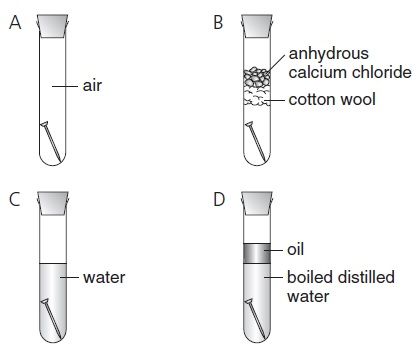
Which diagram shows the most favourable conditions for rust to appear on the nail?
A
B
C
D
What is the scientific name for rust?
Iron hydroxide
Iron oxide
Rust oxide
Rust hydroxide
The reaction with oxygen at the surface of a metal is called...
Rusting
Galvanising
Corrosion
Reduction
The process of covering metal with a protective layer of a different metal to prevent corrosion is called...
Rusting
Galvanising
Corrosion
Electrolysis
What is this the definition of? "A substance that changes the speed of a reaction without being permanently changed itself."
Metal
Metal oxide
Chemical
Catalyst
In the formula TiO2, how many oxygen atoms are present?
1
2
3
4
What is corrosion?
When hydrogen is introduced into the metal, it becomes brittle.
When metal heated upon melting point, it melts.
When metal reacts with oxygen, it forms an oxide layer on its surface.
I have no idea
Metal + acid --> ?
Salt + Hydrogen
Salt + Oxygen
Sugar + Oxygen
Oxygen + Hydrogen
What is the salt "?"
Mg + H2SO4 --> "?" + H2
MgS
MgSO2
MgSO4
MgH2
What is the salt "?"
Fe + HCl --> "?" + H2
FeCl
FeCl2
FeH2
FeClO
In most time, why can't we see salt when metal + acid ?
Since salts are too small.
Since salts are mostly colorless and soluble to the liquid.
Since salts are kinds of gas.
Since salts are too shy.

