
Font size
 Worksheets
Economics
Total questions: 189
Worksheet time: 28hrs 51mins

Which of these is a progressive tax?
airport tax
income tax
property tax
sales tax
Who primarily uses our tax money? (hint: choose 2 correct answers)
Your employer
The state government
The Federal government
Local Businesses
What types of taxes contribute to Federal tax revenue? ( hint: choose 4 correct answers :)
Corporate Income Tax
Income Tax
Estate Tax
Excise Tax
the Federal Government earns most of its money from...
Corporate Tax
Social Security and Retirement
Individual Income Tax
Which of the following items would you pay an Excise tax on? (Select all that apply)


What is gross income?
The amount of money you get in your bank account
The amount of money you earn
Your taxable wages
The total amount of money you have
What is a deduction?
money the government withholds from your paycheck
money you subtract from your taxable income to lower the amount of taxes you owe
a person who depends on you financially
money your employer withholds from your paycheck to pay taxes on your behalf
Why does the US government enforce antitrust laws?
To ensure the development of public goods and services
To create incentives for research and development
To develop large-scale efficient industries
To ensure competition in the marketplace
Jane is a movie producer. She has just produced a new movie and she wants to ensure that she has the exclusive right to distribute the film.
What is the role the government would most likely play in protecting Jane’s property rights in this situation?
Copyright law would prevent other people from showing the movie without her permission.
Creative commons licensing would give her control of advertisements for the movie.
Patent law would give her control of the machinery used to produce her movie.
Trademark law would prevent others from discussing the movie in print.
How does the federal government protect a company’s name or symbol?
It issues a trademark
It issues a copyright
It issues a license
It issues a patent

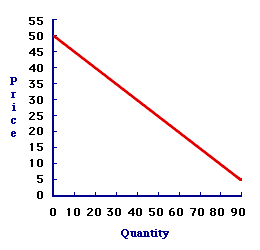

Supply is
how much consumers are willing to buy.
how much a producer (a business) is able and willing to make for sale to consumers.
the goods that are left over after a sale.
All of the above
What does the law of demand say
consumers will buy less of something when the price goes down
consumers will buy more of something when price increases.
consumers will buy more of something when prices decrease.
None of the above.
Supply and demand determine
needs and wants
all goods produced
the price for a good or service
All of the above
Equilibrium is
when there is a surplus
when there is a shortage
when there is both a surplus and a shortage
when the producer and the consumers agree on a price
Mr. Sherman goes to the ticket booth to buy tickets for a Lakers game. Mr. Sherman is told that the game is sold out and no tickets are available. Which best explains why there are no basketball tickets available?
A new type of television set uses 3-D images. many stores will have large quantities of the older style televisions. What will happen to the price of these older televisions?


What is the purpose of a free-market system?
to protect the conditions that enable specialization
to stimulate the growth of the gross domestic product
to raise the standard of living for everyone in the country
to allow consumers and producers to make their own decisions
Consumer surplus decreases when the price in that market increases.
True
False
Trade without the use of money
banter
theft
barter
purchase
Consumer Price Index (CPI) measures
height
weight
happiness
inflation
Before 1971 the American dollar was backed by?
wheat
gold
corn
oil

People and communities are forced to make economic decisions due to the fundamental economic problem of what?
taxes
scarcity
supply and demand
natural resources

Which of the following is NOT a factor of production?
Capital Resources
Labor
Government
Natural Resources

When making a trade-off decision, which term describes the value of the option NOT taken?
Opportunity Cost
Surplus
Shortage
Equilibrium

Which term best describes people like Mark Zuckerburg, Bill Gates, and Oprah Winfrey?
Middle Class
Government Agents
Public Servants
Entrepreneurs

Which of the following is considered a capital resource?
solar power
a forest
airplane
part-time employee

Which term identifies a share in a publicly traded firm?
tax
bond
stock
wage

Which of the following is NOT a factor of production
Entrepreneurship
Natural Resources
Capital Resources
Tax Revenues

Which economic law states that consumers are more willing an able to purchase goods and services when prices decrease?
law of gravity
law of averages
law of supply
law of demand

What situation will likely result if the price of a good is set above equilibrium price?
Inflation
Shortage
Surplus
Bankruptcy

Which of the following would likely cause the demand curve for housing to shift left?
a decrease in the population
an increase in home mortgage interest rates
an increase in general income
a decrease in automobile loans
Economic booms can cause problems as well as create benefits because they are often accompanied by ________
deflationary pressures.
excessive labour-force participation.
inflationary pressures.
pressure on the government budget deficit to rise.
Which group/s that tends to be most hurt by unexpected inflation?
banks
employers
fixed-income earners
variable-income earners
When demand changes a lot with the price of a good that is
Elastic
Inelastic
The Law of Supply says that as price_________supply___________
Increases, Decreases
Increases,Increases
Decreases, Increases
Decreases, Decreases
The Law of Demand says as price ___________ demand___________.
Increaseses, Increases
Decreases, Decreases
Decreases, Increases
Increases, Decreases
Items that have supplies that are increased with difficulty are_____________
Elastic
Inelastic

Refer to Table 2. If the price is $8.00
A surplus of 30 units would exist and price would tend to drop
A shortage of 60 units would exist and price would tend to rise
A shortage of 30 units would exist and price would tend to rise
A surplus of 60 units would exist and price would tend to drop

Which of the following graphs shows the demand and supply curves for Table 3?


Which of the following describes the relative elasticity in demand for toothpaste?
Demand is inelastic because it is a luxury item
Demand is elastic because there are no substitutes
Demand is inelastic because it makes up a large share of most people’s budget
Demand is inelastic because it is a low-cost necessity
When the quantity demanded for a product is less than the quantity supplied, the market
has prices that are too low
is in equilibrium
has a surplus
is controlled by a monopoly
Who is responsible for making fiscal policy decision?
The Department of Commerce
The federal government's overall approach to spending and taxes is called
Physical Policy
Fiscal Policy
The Federal Reserve
Monetary Policy
Which of the following would stimulate the economy?
Decrease taxes
Raise taxes
Government spends more on Science research
Government cuts organizations like the National Science Foundation
The headline below indicates which type of policy:
"Fed unleashes another big rate hike in bid to curb inflation"
Fiscal policy
Monetary policy
Monetary policy decisions are made by:
Congress
Senate
The Fed
President
Taxing and Spending are tools of
fiscal policy
monetary policy
Is a joint effort between the executive and legislative branches
fiscal policy
monetary policy
In order to help the economy grow, the government will decrease or lower taxes. This allows people to have more money and buy more goods and services.
fiscal policy
monetary policy
What can the government do to slow the economy in order to reduce inflation?
lower taxes
raise taxes
spend more
To help the economy grow, the government can
increase spending
decrease spending
lower the minimum wage
raise taxes
The action by the FED to adjust the size of the money supply, and to adjust interest rates in order to keep prices down and employment high.
fiscal policy
monetary policy
In order to help the economy grow, the FED may____________the reserve requirement, allowing banks to loan more people money so that they spend more
lower
raise
spend more
save more
In order to slow the economy, the FED may____________ the reserve requirements and there will be less money to loan out to people.
increase
decrease
spend more
tax more
The amount that all banks have to keep in the reserve and they can't loan out to people
monetary lending
fiscal spending
reserve requirement
lending policy
The interest rate the FED charges banks to borrow money will be lowered to help the economy grow and raised to slow the economy
reserve requirement
discount rate
bank rate
monetary bank
How many phases make up the business cycle?
2
4
6
8
Macroeconomics approaches the study of economics from the viewpoints of
individual firms
individual consumers
government units
the entire economy
GDP is the process of declining during a(an)
peak
contraction
expansion
trough

If a news headline says, "Finally!!! 2 straight months of increased jobs."
Where on the business cycle is the current economy?
Peak
Contraction
Trough
Expansion
If a news headline says, "3 months of consecutive job losses is impacting consumer confidence."
Where on the business cycle is the current economy?
Peak
Contraction
Trough
Expansion

Which of the following is an expansion, or recovery?
A
B
C
D
If GDP falls for at least two quarters, it is considered what stage of the business cycle?
Expansion
Recession
Prosperity
Recovery
At what point in the business cycle is GDP the highest?
Peak
Expansion
Recovery
Trough
This is the term for the total amount of all goods and services in the economy that households, businesses, and government will buy at each level of prices?
Aggregate Equilibrium
Aggregate Demand
Aggravated Surplus
Aggregate Supply
In which direction will both aggregate demand and aggregate supply curves shift if there is an increase respectively?
Left
Right
What is a salary?
getting paid hourly depending on how much you work
getting paid the same amount throughout 1 year's worth of time
How does a teacher get paid?
Salary
Wage
Gross domestic product is the total ____ produced within a country in a given time period.
market value of all final and intermediate goods and services
market value of all final and intermediate goods and services plus investment and depreciation
amount of final and intermediate goods and services
market value of all final goods and services
GDP per capita is found by dividing a country's GDP by it's
population.
average birth rates.
number of households.
People in countries with a high GDP per capita might live longer because they can afford the the things they need to survive, like food and water.
True
False
Countries with a higher GDP per capita usually have more people who know how to read and write because there may be more money for schools and education.
True
False
What type of GDP shows the AVERAGE level of wealth in a country per resident?
What type of GDP is calculated with the current year's prices and does NOT change because of inflation?
a measure of how well people live, based on their wealth and how much "stuff" people have
standard of living
quality of life
income inequality
Which of the following is true of real GDP?
It is adjusted for changes in prices; like inflation
It is always equal to the nominal GDP
Unemployment is defined as
the percentage of people in the population who do not have a job
the percentage of people in the labour force who do not have a job
the percentage of people in the population who do not have a job and are actively looking for one
the percentage of people in the labour force who do not have a job and are actively looking for one
Wants
Necessary items for life that are paid monthly/yearly such as food, housing, transportation, utilities, insurances
Expenses that equal all the fixed and variable expenses added together
Things or tems that a person would like to own or purchase that is not necessary for life; Ex. entertainment, video games, etc.
Income from all possible sources
Budget
Anything that you might incur an expense for
Is a spending plan for managing your money that includes income and expenses
All expenses deducted from income before net pay can result.
Income after all deductions have been paid.
Total monthly income
Income from only one source
Total income of your parents and siblings added to your income.
Income from all possible sources.
A spending plan of expenses
Needs
Necessary items that are paid monthly./yearly such as food, housing, transportation, utilities, & Insurance
Things you would like to have but are not necessary for life.
Income from all sources that are spent for necessary items
Anything that you might incur an expense for.
Total Expenses
Is a spending lan for managing your money that includes income and expenses.
All expenses deducted from income before net pay can result
Expenses tat remain the same month after month such as mortgages, rent, car payments & insurances
Expenses that equal all the fixed expenses and variable expenses
Pay Stub
Expenses that increase/decrease monthly or yearly EX: TV provider, internet, food, entertainment, utilities
Hard or electronic copy of earnings that show all deductions and results in net pay
Federal or State tax on your gross income
Income left over after paying all expenses for the month or year.
Fixed expenses
Is a spending plan for managing your money
Income from all possible sources
Expenses that equal all the fixed & variable expenses.
Expenses that remain the ssame month after month EX: mortgages, rent, car payments insurances
Variable expenses
Necessary things or items that are paid monthly
Expenses that increase/decrease monthly/yearly EX: Utilities, food, entertainment, internet, TV provider
Is a spending plan for managing your money that includes income and expenses.
Expenses that remain the same over a period of time.
Deductions
Hard or electronic copy of earnings
Anything that you might incur an expense for
All expenses deducted from gross pay that results in net pay.
Federal or state tax paid after net pay is received
Income tax
Federal, state, and local taxes taken out as deductions from a person or business revenue source
An occupation that allows for advancement opportunities
Anything you might incur an expense for.
Income after tax
Gross Income
Hard copy of revenue
Income from all sources before deductions such as retirement, health insurance, federal, state, and local taxes, etc
all expenses for the month
income left over after taxes
Net pay
Revenue before deductions
State and local taxes
Income after all deductions have been paid
I don't know i just want pizza and wings
Which is MORE important to budget for- needs or wants?
needs
wants
Emma makes $300 each paycheck and is paid twice a month. Can she afford to pay for an apartment that charges $700 rent?
yes
no
David pays $500 a month in rent, $200 for groceries, and $300 for his car payment. How much are his expenses?
$1,010
$900
$1,100
$1,000
You want to be spending ____ than what you are making.
more
less
If you earn $900 a month and spend $500 on rent, $200 on groceries, and $75 on utilities, do you have enough money to pay $50 a month for TV?
yes
no
Sam earns $1,000 a month and pays $600 in rent, $300 on groceries, $250 for his car, and $30 for streaming subscriptions. Is this a smart budget?
yes
no
Which of the following is a benefit of using a budget?
Helps to keep track of the money you receive
Helps to prioritize your spending
Helps reach short- and long-term financial goals
All of the above
Which of the following should NOT be considered when setting a current budget?
Your financial goals
Needs and wants
Savings
Future income
___________ are good places to look to find your current expenses when building your budget.
Banks and credit unions
Grocery stores and concerts
Bank and credit statements
Online research websites
Bank statements, credit statements, and records of cash expenses help you to estimate your ________.
emergency fund needs
credit score
expenses
available investments
Which of the following is NOT a good way to track your spending?
In your head
Notebook and pencil
Envelope Method
Online software of app
Which of the following is NOT true about emergency funds?
They are used for anything listed on the budget.
They can keep you from borrowing money from friends and family.
They help you prepare for unexpected expenses.
They help remove the worry about expenses not in the budget.
Unexpected expenses…
can make it hard to stick to your budget.
may cause you to be unable to pay necessary bills.
should be planned for.
all of the above.
Which of the following expenses would be a good reason to spend money from an emergency fund?
Repair your laptop that you use for homework.
Upgrade your phone to the latest model.
Buy new track shoes because they’re in style.
Purchase concert tickets to see your favorite artist.
How can you ensure you don't go over your budget?
Round up your expense estimates to add a buffer
Use most of your budget for entertainment expenses
Find a friend that enjoys going shopping
Buy all of your wants at one time.
a plan for how you spend your money
budget
discretionary expense
commission
gross income
this type of expense stays the same each month
fixed income
variable expense
discretionary expense
fixed expense
What is the best way to describe a Zero-Based Budget?
Run your bank account down to zero
Not having a budget
A cash flow plan that assigns an expense to every dollar of your income
Having more expenses than you have income
Generally, the more education you receive, the higher your lifetime earnings will be.
True
False
The amount of money you're paid, after all taxes and deductions are taken out of your paycheck is called ________.
Gross pay
Year-to-date pay
Net pay
Total pay
Which of the following is a possible tax or deduction that they may show up on your paycheck?
Federal income tax
Contributions to retirement savings
FICA
All of these
The W-4 tax form is used to ___________.
file your tax return.
determine how much your gross pay should be.
tell your employer how much federal income tax to withhold from your paychecks to send to the IRS.
avoid paying income taxes on your paychecks.
Your employer sends you a _______ form that tells you how much you've made and how much you've paid in taxes in the last year.
W-9
W-4
W-2
1040
What do taxes pay for?
Operation of financial institutions
Schools, government departments, roads, and emergency services
Privately-owned businesses
None of the above
The gig economy offers ________.
The migration of workers to high-tech jobs.
The total availability of employment and labor in the economy.
Flexible, short-term, and independent jobs.
An economic system in which assets or services are shared between individuals.
Which of the following would you need in order to fill out your 1040?
Your credit card statement
Your job offer
Your W-2
Your employer benefits documentation
When considering a job offer, you should consider how much you're being paid and any other employee benefits before you accept the offer.
TRUE
FALSE
Healthcare, paid time off, disability insurance, and matching contributions to a retirement account are all types of _________ available from your employer.
benefits
pensions
allowances
deductions
The definition of gross pay is:
The lowest pay rate allowed under state or federal law.
A directive for the government on how much to deduct from your pay for taxes.
When your paycheck is automatically deposited into the bank on a scheduled payday.
Total pay - the number of hours worked x hourly wage.
What is Form W-4 Employee's Withholding Allowance Certificate?
The lowest pay rate allowed under state or federal law.
A directive for the government on how much to deduct from your pay for taxes.
When your paycheck is automatically deposited into the bank on a scheduled payday.
Total pay - the number of hours worked x hourly wage.
Alexis worked 24 hours last week. At a rate of $12 per hour, what was Alexis' gross pay?
$36
$144
$288
$312
Gross income minus deductions equals your net income.
If Amorelle made $384 in gross income and her deductions are $122, what is her net income?
$506
$406
$262
$266
David's gross income: $127.25
David's deductions: $25.20
David's net pay: ?
$102.05
$102.45
$112.05
$152.45
Dayanara's gross income was $550. What was her net income if her deductions were $110 for payroll taxes and $22.50 for health insurance?
$132.50
$417.50
$440.00
$638.50
Used for verifying the identity and employment authorization of individuals hired for employment in the United States.
W-2
w-4
I-9
Resume
(Otherwise known as the "Employee's Withholding Allowance Certificate") is an Internal Revenue Service (IRS) tax form completed by an employee to indicate the taxes they want withheld from their pay.
W-2
W-4
I-9
Resume
The form that an employer must send to an employee and the Internal Revenue Service (IRS) at the end of the year.
W-2
W-4
I-9
Resume
By law an employer must pay for a portion of _______.
a. childcare
b. Social Security
c. fitness programs
d. legal assistance
A W-4 is filled out for an employer to determine your _______.
a. Taxes paid
b. Total deductions
c. Tax withholding
d. Total earnings
The Internal Revenue Service:
a. enforces the federal securities laws
b. eliminates and prevents anticompetitive business practices
c. issues guidelines for worker safety
d. administers and enforces federal tax l
Employers may offer all of the following types of insurance as an employee benefit EXCEPT:
a. health insurance
b. car insurance
c. life insurance
d. dental insurance
Which of these is a progressive tax?
airport tax
income tax
property tax
sales tax
Which of the following is a possible tax or deduction that they may show up on your paycheck?
Federal income tax
Contributions to retirement savings
FICA
All of the above
Your employer sends you a _______ form that tells you how much you've made and how much you've paid in
taxes in the last year.
1040
W-2
W-4
W-9
What do you need in order to fill out your 1040?
Your W-2
Your routing and bank account number
A record of any other supplemental income
All of the above
What do you NOT need in order to fill out your 1040?
Your W-2
Your routing and bank account number
A record of any other supplemental income
Your employer benefits documentation
Healthcare, paid time off, disability insurance, and matching contributions to a retirement account are all
types of _________ available from your employer.
benefits
pensions
deductions
allowances

