wayground logo

Free Printable Worksheets

NEW

Font size

S
M
L
XL
Worksheets

Periodic Table, Electrons & Nuclear Review

Total questions: 43

Worksheet time: 1hrs 12mins

Name
Class
Date
1.

Elements on the periodic table are arranged in order of ________________.

a)

average atomic mass

b)

atomic number

c)

metallic characteristics

d)

number of neutrons

2.

Elements in the same ___________ share similar chemical and physical properties because ______________.

a)

block, they have electrons in the same orbital sublevel

b)

period, they have the same number of energy levels

c)

group, they have the same number of valence electrons

d)

triad, they have the same number of valence electrons and energy levels

3.

Conducts electricity and heat very well

Select all that apply.

a)

Metals

b)

Nonmetals

c)

Metalloids

4.

Poor conductors

Select all that apply.

a)

Metals

b)

Nonmetals

c)

Metalloids

5.
Rows on the period table are called _____ while columns are called _____.
a)
groups, families
b)
groups, periods
c)
periods, groups
d)
families, groups
6.
Which group of the periodic table is composed of inert (not reactive)  gases?
a)
alkali metals
b)
alkaline earth metals
c)
halogens
d)
noble gases
7.
Which is a halogen?
a)
Helium
b)
Chlorine
c)
Oxygen
d)
Neptune
8.
Which periodic group has the smallest atomic radius?
a)
Alkali metals
b)
Halogens
c)
Noble Gases
d)
Transition metals
9.
Which of the following will have a larger radius than Zinc?
a)
Gallium
b)
Aluminum
c)
Magnesium
d)
Strontium
10.

Which of the following atoms has the greatest atomic radius?

a)

nitrogen

b)

phosphorus

c)

potassium

d)

cesium

11.

Which element in period 4 has the highest electronegativity?

a)

potassium

b)

calcium

c)

copper

d)

bromine

12.

Which of these elements in group 1A has the largest atomic radius?

a)

cesium

b)

rubidium

c)

potassium

d)

sodium

13.
Which of the following is an Alkali Metal? 
a)
Magnesium
b)
Chromium
c)
Sodium
d)
Fluorine 
14.
Which of the following is an Alkaline Earth Metal? 
a)
Calcium
b)
Lithium
c)
Phosphorus
d)
Copper 
15.
Which of the following is a transition metal? 
a)
Iron
b)
Oxygen
c)
Neon
d)
Barium
16.
Which of the following is a Halogen? 
a)
Bromine
b)
Rubidium
c)
Argon
d)
Beryllium
17.
Which of the following is a Noble Gas? 
a)
Krypton
b)
Chlorine
c)
Radium
d)
Gallium
18.
Which of the following is the most reactive group of metals? 
a)
Alkali
b)
Alkaline Earth
c)
Halogen
d)
Transition Metals
19.
Which of the following is the most reactive group of non-metals? 
a)
Alkali
b)
Alkali Earth
c)
Halogen
d)
Noble Gas
20.
How many valence electrons does an alkaline earth metal have? 
a)
1
b)
2
c)
7
d)
8
21.
How many valence electrons does a halogen have? 
a)
1
b)
2
c)
7
d)
8
22.
What do you start electron configuration with?
a)
1s2
b)
1d10
c)
1f14
d)
1p6
23.
What electron configuration matches an oxygen ion?
a)
1s22s22p63s2, 3p64s23d104p5
b)
1s22s22p4
c)
1s22s22p6
d)
1s22s22p63s23p64s23d1
24.

What atom matches this electron configuration?

[Ar]4s23d10

a)

Zinc

b)

Copper

c)

Nickel

d)

Germanium

25.

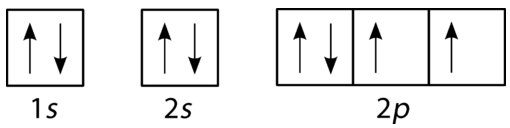
This orbital diagram represents:

a)

Carbon

b)

Boron

c)

Nitrogen

d)

Oxygen

26.

What is incorrect about this orbital diagram?

a)

Both arrows in the 2p box should be pointing up

b)

There are too many electrons in the 1s orbital

c)

In the 2p boxes, there should only be 1 electron in the first 2p box and one in the 2nd 2p box

d)

All the arrows should be pointing up

27.

Which orbital diagram violates of Hund's Rule?

a)

A

b)

B

c)

C

d)

D

28.

This orbital diagram represents

a)

Nitrogen

b)

Oxygen

c)

Carbon

d)

Neon

29.

Which of these is correct?

a)
b)
c)
30.
This could be the dot diagram of 
a)
Ne
b)
Si
c)
Al
d)
Be
31.
This is a correct dot diagram for fluorine (F)
a)
true
b)
false
32.

What are valence electrons?

a)

The innermost electrons

b)

The outermost electrons

33.

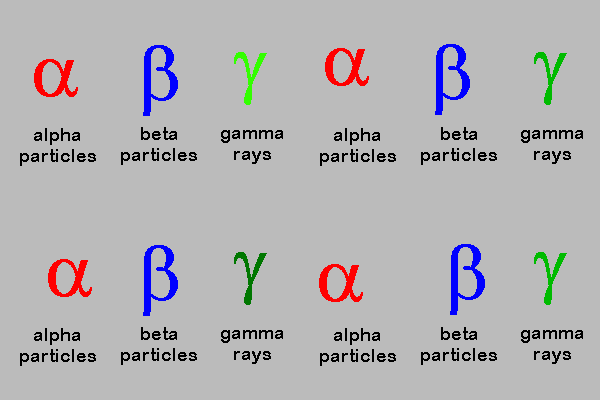
In order of most to least penetrating radiation we have

a)

Alpha , Beta, Gamma

b)

Beta , Gamma , Alpha

c)

Gamma, Beta, Alpha

d)

Gamma, Alpha, Beta

34.
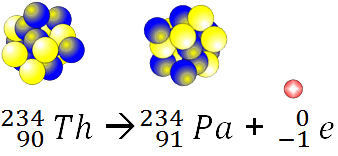
Which type of nuclear radiation is being emitted here?
a)
Alpha
b)
beta
c)
gamma 
d)
none
35.

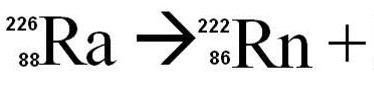
Complete the nuclear equation and determine the type of decay that is occurring in this reaction.

a)

alpha, 42He

b)

beta, 0-1e

c)

gamma

d)

none

36.
Alpha particles have a _____ charge.
a)
+2
b)
0
c)
+1
d)
-1
37.

Beta particles have a _____ charge.

a)

+2

b)

0

c)

+1

d)

-1

38.
This is an example of...
a)
Fission  reaction
b)
Fusion reaction
c)
Decomposition reaction
d)
Combustion
39.

_______is the splitting of atomic nuclei

a)

Fission

b)

nuclear reaction

c)

Fusion

d)

bayler reaction

40.

_____is the joining of atomic nuclei

a)

Fusion

b)

chain reaction

c)

Photosynthesis

d)

Fission

41.

Which process occurs naturally in the centre of stars like the Sun

a)

Bi-multiple reaction

b)

Fission

c)

chemical

d)

fusion

42.

How is the alpha particle written in a nuclear equation?

a)

42He

b)

24He

c)

0-1e

d)

00γ

43.
Solve this equation for alpha decay.
85209At = ___ + 24He
a)
83205Bi
b)
86209Rn
c)
81207Tl
d)
85208At