
 Worksheets
Revision for 2210 ON2022
Total questions: 75
Worksheet time: 40mins
Convert the hex number into binary:
1A
0001 1010
1010 0001
0001 1011
0001 1100
Convert the hex number into binary:
42
0100 0010
0010 0100
0011 1001
0001 1100
Convert the hex number into binary:
24
0100 0010
0010 0100
0011 1001
0001 1100
Convert the binary number into hex:
1001 0110
96
84
28
8f
Convert the binary number into hex:
0001 1111
1e
1d
1c
1f
Convert the binary number into hex:
0001 1110
1e
1d
1c
1f
Address that can be used to identify a device on a network
IP Address
MAC Address
Assigned by the manufacturer
IP Address
MAC Address
•Identifies which device on the network the data was sent from
IP Address
MAC Address
It is composed of manufacturer's ID and serial ID code which are represented in hexadecimal numbers and separated with dash or colon.
IP Address
MAC Address

What are the types of IP address
Static
Dynamic
Static and dynamic
None of them
Full form of 'IP' Address
Internet Protocol
International Palindrome
Internet Process
Internal Protocol
Address that can be used to locate a device on a network
IP Address
MAC Address
Assigned by the network
IP Address
MAC Address
Locates the device on a network.
IP Address
MAC Address
What does HTML stand for?
Hyper Tremendous Movie Lines
Hyper Text Markup Language
Hey Thanks for Making me Late
It is the essential part of the HTML document; it includes the semantics
(meaning) and structural mark-up of the document.
HTML Structure
HTML Presentation
It is the style of the document; i.e. how the document will look (or
even sound if it includes multimedia elements).
HTML Structure
HTML Presentation
Bits are set sequentially down the same wire
Serial
Parallel
_________________ is Perfect for transmitting over longer distances as there are no synchronisation issues
Serial
Parallel
Multiple bits are sent simultaneously down different wires (channels) within the same cable
MIDI Interface
Serial
Parallel
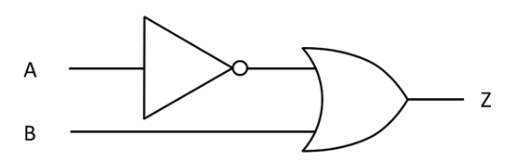
What is the Logic Expression for this circuit?
Z = NOT (A AND B)
Z = NOT (A OR B)
Z = (NOT A) AND B
Z = (NOT A) OR B
Used to transmit data between areas of the processor.
Data bus
Address bus
Control bus
This register holds the address of the next instruction when the current instruction is executed by the CPU.
MAR
MDR
PC
CIR
ACC
This register receives and stores the binary value that is stored in MDR then passes it to Control Unit to decode.
MAR
MDR
PC
CIR
ACC
What is the name of the unit in the CPU that performs arithmetic and logic operations?
ALU
CU
MAR
MDR
What is the name of the unit in CPU that controls and coordinates all parts of the computer system?
Arithmetic unit
Logic unit
Control unit
Registers

What does the MAR stand for?
Memory Address Register
Memory Addressed Register
Memory Access Register
Memory Aardvark Register
Used to transmit control signals between areas of the processor.
Data bus
Address bus
Control bus
Used to transmit addresses between areas of the processor.
Data bus
Address bus
Control bus
This is made up of many layers of glass that act like a capacitor
Infra-red heat
Infra-red optical
capacitive
resistive
This makes use of an upper layer of polyester(a form of plastic) and a bottom layer of glass
infra-red optical
infra-red heat
capactive
resistive
Uses an array of sensors in a form of a grid
infra-red heat
infra-red optical
resistive
capacitive
This is a medium cost technology
infra-red heat
infra-red optical
capacitive
resistive
It is the most inexpensive technology
infra-red heat
infra-red optical
capacitive
resistive
Does not allow multi touch capabilities
infra-red heat
infra-red optical
capacitive
resistive
This is a medium cost technology
infra-red heat
infra-red optical
capacitive
resistive
It is the most inexpensive technology
infra-red heat
infra-red optical
capacitive
resistive
Screen visibility is poor in strong sunlight
infra-red heat
infra-red optical
capacitive
resistive
The screen is very durable
infra-red heat
infra-red optical
capacitive
resistive
_______ is reencoding a file in a way that uses fewer bits than the original, but keeps most or all of the information intact.
Encoding
Compression
Expansion
Summarizing
__________ compression means that the file is identical, bit for bit, to the original uncompressed file.
Lossy
Lossless
Compressed
File
_________ compression is another technique that changes the original file a little bit.
Lossy
Lossless
Compressed
File
Lossy compression is commonly used for image, video, and audio files because human sight and hearing are imperfect and cannot detect small losses in the data.
TRUE
FALSE
Compressed files consume less storage space and transmit _________ than uncompressed files
much more slowly
much more quickly
larger
more information
What would you use Compression for?
Making a file smaller
Increasing the files size
Modifying a file
Why is it necessary to compress files?
File compression enables data to be transferred quickly.
Disk space needed on internet servers is reduced. This allows the servers to store more files / information with less disk space.
File compression is a process to reduce the disk space to store that file.
File compression is a mandatory preference for some of the internet servers to transfer files.
Why compress your files?
Less file size
To look cool
To make the file nicer looking
To be epic
Used to convert the instructions into machine code for the processor the code is being run on.
Assembler
Compiler
Interpreter
Translates all lines of code into machine code, before executing the program.
Compiler
Interpreter
Reports all syntax errors at the same time, the program is not run until all errors are corrected.
Compiler
Interpreter
Useful when a program has been finished and is ready for testing or distribution.
Compiler
Interpreter
Code does not need re-translating each time the program is run.
Compiler
Interpreter
Produces an executable file.
Compiler
Interpreter
Source code is not required to run the program, only the executable file.
Compiler
Interpreter
No other software is required to run the executable file
Compiler
Interpreter
You need to have finished a section of code before testing it
Compiler
Interpreter
Translates one line of code into machine code and then executes (runs) it.
Compiler
Interpreter
Reports a syntax error as soon as it is picked up, and stops the program running until corrected.
Compiler
Interpreter
Useful when writing a program.
Compiler
Interpreter
Code needs to be re-translated each time the program is run
Compiler
Interpreter
Does not produce an executable file.
Compiler
Interpreter
Source code is required to run the program.
Compiler
Interpreter
Translator is required to run the program
Compiler
Interpreter
You can test part of a program without completing it all
Compiler
Interpreter

