
 Worksheets
Polar Ice Unit Review (Thermo)
Total questions: 20
Worksheet time: 11mins
If two objects have different temperatures when they come in contact, heat will flow from the warmer object to the cooler one UNTIL ____________
one reaches a temperature of zero
one runs out of energy
they both have equal temperature

<-- There are four cups of hot cocoa. The cup sizes are shown. The temperature of the cocoa in each cup is 25 degrees C.
Which cup has the MOST thermal energy?
Venti
Trenta
Tall
All are the same temperature, so they have the SAME thermal energy

Diagram shows a hot metal bob is immersed in water at a temperature of 30°C.
If the initial temperature of the metal bob is 60°C, what is the temperature of the water when thermal equilibrium is achieved between the metal bob and the water?
Higher than 60 °C
Lower than 30 °C
Between 30-40 °C
Between 55-60 °C

A boy tries to break a metal wire by bending and straightening the wire repeatedly. After a while, the wire becomes hot. The metal wire becomes hot because...
the forces between particles decrease
the wire absorbs heat from the surrounding air
the wire's particles are moving faster (kinetic energy increases)

Diagram shows a pan used to fry pancakes.
What is the suitable characteristic of the material used as the bottom surface of the pan?
Low melting point
Good conductor (low specific heat)
Good insulator (high specific heat)
How do we say Δ in science and math?
Alpha
Beta
Delta
the average kinetic energy of the particles of a substance
temperature
heat
the energy transferred between objects due to a difference in temperature
temperature
heat
calorimetry


What happens to the temperature if I add ice cubes to a glass of soda
The heat transfers from the coke to the ice
The heat transfers from the ice to the coke
Which state of matter has the most energy?
Solid
Liquid
Gas
All are the same
Which state of matter is the least dense?
Solid
Liquid
Gas
All are the same

Heat will always transfer from...
Hot to Cold
Cold to Hot
High density to Low density
Low energy to High energy

As you rub hand warmers between your hands you are using ______ to transfer thermal energy.
Conduction
Convection
Radiation

If a warm front blows into an area with colder air, what will happen?
The cold air and warm air become the same temperature
The warm air stays at the bottom, pushing the cold air up because it is less dense
The warm air rises to the top because it is less dense than the cold air

Two cups starting at 40 degrees are left outside for three hours. After the three hours Cup A (Styrofoam) is at 52 degrees and Cup B (Aluminum) is at 68 degrees.
Which is the better conductor?
Cup A
Cup B

What is the temperature of the metal cube when thermal equilibrium is achieved between the cube and the liquid?
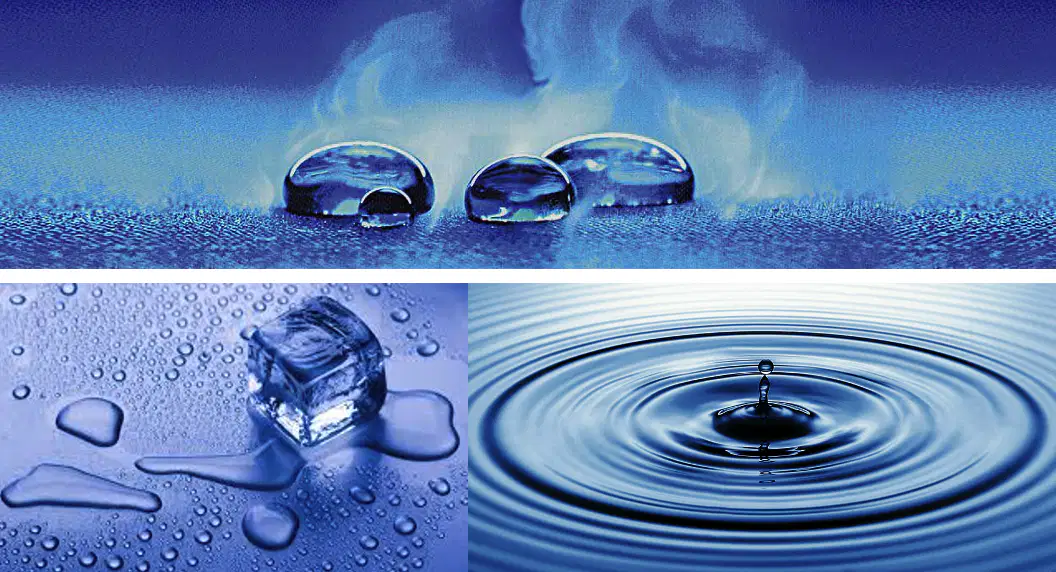
Which physical state of water contains particles with the LOWEST kinetic energy?
Water
Ice
Steam
Melting ice

Which phase change is being represented in the particle diagram?
melting
evaporation
condensation
freezing
After baking, some cookies cooled from 100ºC to 40ºC.
What is their temperature change ( ΔT )?

