wayground logo

Free Printable Worksheets

Font size

S
M
L
XL
Worksheets

Ohms, Series and Parallel Circuits Summative Assessment

Total questions: 45

Worksheet time: 38mins

Name
Class
Date
1.
What size resistor would produce a 3 Amp current flow with a 12 Volt battery
a)
1 Ohm
b)
3 Ohms
c)
4 Ohms
d)
12 Ohms
2.
What is current measured in?
a)
Ω (Ohms)
b)
V (Volts)
c)
A (Amps)
d)
W (Watts)
3.
What is resistance measured in?
a)
Ω (Ohms)
b)
V (Volts)
c)
A (Amps)
d)
W (Watts)
4.
What is Resistance?
a)
The flow of electrons
b)
Electric potential difference
c)
A battery
d)
The ability to reduce the flow of electrons
5.
Electricity that flows in a closed path is called a
a)
path
b)
current
c)
circuit
d)
light
6.
What is the Voltage of a circuit that has a resistance of 5 Ω and a current of 2 A?
a)
25 V
b)
10 V
c)
2.5 V
d)
0.4 V
7.

If the battery produced 12.6 Volts what would be the current flow for a 6 Ohm resistor?

a)

2.1 Amps

b)

2.4 Amps

c)

1.71 Amps

d)

15 Amps

8.
How many Volts would we need to produce a current flow of 8 Amps through a 6 Ohm resistor
a)
12 volts
b)
24 volts
c)
1.3333
d)
48 volts
9.
This circuit has a 24 volt battery and the resistor is 8 ohms. How many amps are running through the circuit?
a)
3 Amps
b)
192 Amps
c)
2 Amps
d)
4 Amps
10.
What word means how hard it is for electrons to flow through.
a)
Current
b)
Voltage
c)
Resistance
d)
Power
11.
The flow of electricity requires a
a)
complete path
b)
incomplete path
c)
insulated current
d)
complex circuit
12.

Which best describes a parallel circuit?

a)

Electricity flows along one pathway.

b)

The flow of electricity comes from one source.

c)

Electricity flows along more than one pathway.

d)

The flow of electricity comes from more than one source.

13.

What is the formula for current?

a)

I = V / R

b)

I = R / V

c)

I = V x R

d)

I = (V x R) / 2

14.

What is the formula for voltage?

a)

V = (I x R) / 2

b)

V = I / R

c)

V = R / I

d)

V = I x R

15.

What is the formula for resistance?

a)

R = I / V

b)

R = V / I

c)

R = V x I

d)

R = (V x I) / 2

16.

If an electric ceramic brush has a current of 0.3 amps and a voltage of 120 volts, what is the resistance?

a)

18Ω

b)

36Ω

c)

200Ω

d)

400Ω

17.

If a computer has 10.0A of current and 11Ω of resistance, what is its voltage?

a)

0.9V

b)

1.1V

c)

55V

d)

110V

18.
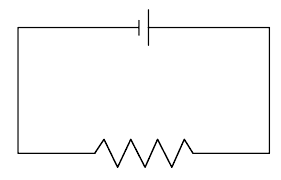
What kind of circuit is this?
a)
Series
b)
Consecutive
c)
Parallel
d)
Training
19.
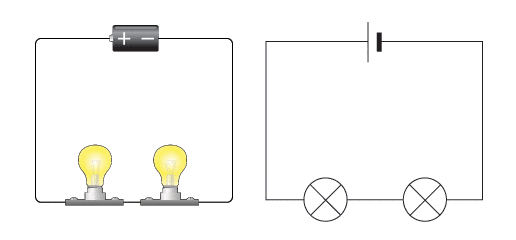
What kind of circuit is this?
a)
series
b)
parallel
20.
This circuit has more than one loop. When one light goes out, the others stay on. 
a)
closed circuit
b)
series circuit
c)
parallel circuit
d)
open circuit
21.
A series circuit has how many pathways for the electrons to flow?
a)
Two
b)
One
c)
Many
d)
Zero
22.
In a series circuit, if one receiver is disconnected, nothing will work.
a)
true
b)
false
23.
The picture shows an electrical circuit. This circuit is a series circuit because: 
a)
It has 3 light bulbs.
b)
The same current flows through all three light bulbs.
c)
It uses a single battery.
d)
The electrical current is divided between the three light bulbs.
24.

This circuit is easy to repair and less likely to overheat

a)

open circuit

b)

closed circuit

c)

parallel

d)

series

25.

One of the advantages of _________ circuits is that they ensure all components in the circuit have the same voltage

as the source.For instance, all bulbs in a string of lights have the same brightness.

a)

open

b)

multiple

c)

series

d)

parallel

26.

In a parallel circuit if one of the light bulbs burns out the rest _________.

a)

stop the flow of electricity

b)

will go out

c)

can still light up

27.

This is an example of a _______ circuit

a)

close

b)

parallel

c)

series

28.

A series circuit has ____ path(s) that the electric current can take.

a)

one

b)

two

c)

three

29.

This is needed in a circuit to start the electrons moving.

a)

battery

b)

switch

c)

wire

30.

What type of circuit is this picture?

a)

parallel

b)

series

c)

open

31.

How many path(s) does the parallel have?

a)

has only one path for current to travel

b)

does not allow electricity to travel through it

c)

has more than one path for current to travel

32.
The flow/movement of electric charges 
a)
Voltage
b)
Resistance 
c)
Current 
d)
Circuit 
33.
The tendency for a material to oppose the flow of electrons, changing electrical energy into thermal energy and light.
a)
Voltage
b)
Current
c)
Resistance
d)
Circuit 
34.
According to this law, the current in a circuit equals the voltage difference divided by the resistance. 
a)
Law of Conservation of Energy 
b)
Ohm's Law 
c)
Law of Conservation of Charges
d)
Newton's First Law 
35.

SI unit of current is

a)

ampere

b)

metre

c)

ohm

d)

volt

36.

SI unit of voltage is

a)

ampere

b)

metre

c)

ohm

d)

volt

37.

SI unit of resistance is

a)

ampere

b)

metre

c)

ohm

d)

volt

38.

What is a Series Circuit?

a)

A circuit with more than one path way for current to flow

b)

A circuit with one path way with one switch.

c)

An electric circuit with a single path for current to flow.

d)

Two circuits with one path way for current to flow

39.

What is Parallel Circuit?

a)

A wire that has a battery and a switch.

b)

A circuit that contains more than one path for current flow.

c)

A circuit that contians one path for current flow

d)

A circuit with a switch

40.

How many paths does a series circuit have?

a)

1

b)

2

c)

3

d)

4

41.

What type of circuit is this? Select all that are true.

a)

Series

b)

Parallel

c)

Open circuit

d)

Closed circuit

42.

The voltage of the entire circuit is 18V. What is the voltage of Lamp B

a)

18V

b)

3V

c)

9V

d)

6V

43.

Why is electrical wiring usually made from copper?

a)

Because copper is shiny

b)

Because copper conducts electricity

c)

Because copper is not magnetic

d)

Because copper insulate electricity

44.
An incomplete circuit is shown.
To complete the circuit, a wire should be placed from —
a)
Point D to Point C
b)
Point B to Point C
c)
Point A to Point D
d)
Point B to Point D
45.
This circuit has a battery, buzzer, and switch.
When the switch is closed the buzzer will sound because -

a)
the switch gives energy to the battery
b)
the buzzer is made of special plastic
c)
the wires are cooled by the surrounding air
d)
electricity can flow in a complete path