Wayground logo

Free Printable Worksheets

Font size

S
M
L
XL
Worksheets

Sci 8 Unit 2 Review - Chemistry of Life

Total questions: 66

Worksheet time: 50mins

Name
Class
Date
1.

Which of the following are states of matter?

a)

Gas

b)

Solid

c)

Liquid

d)

Plasma

2.
Matter that has its own shape and takes up space.
a)
solid
b)
liquid
c)
gas
3.
Matter that always fills the shape in a container, such as air.
a)
solid
b)
liquid
c)
gas
4.
Milk takes the shape of its container because it is a:
a)
solid
b)
liquid
c)
gas
5.
Molecules are closest together in a 
a)
Solid
b)
Liquid
c)
Gas
d)
plasma
6.
What term describes a liquid changing to a solid?
a)
Deposition
b)
Sublimation
c)
Evaporation
d)
Freezing
7.
At higher temperatures
a)
particles in an object have less energy
b)
particles in an object move faster
c)
a gas contracts
8.
A gas
a)
has a definite shape but no definite volume
b)
has a definite volume but no definite shape
c)
has fast-moving particles
9.
Boiling
a)
liquid to gas
b)
gas to solid
c)
gas to liquid
d)
solid to liquid
10.

___________ is anything that has mass and takes up space.

a)

Molecules

b)

Matter

c)

Volume

11.

________ is the amount of space an object takes up.

a)

Mass

b)

Matter

c)

Volume

12.

What is the process called when a gas turns into a liquid?

a)

Condensation

b)

Melting

c)

Freezing

d)

Evaporation

13.

What is the process called when a solid changes to a liquid?

a)

Freezing

b)

Evaporation

c)

Melting

d)

Condensation

14.
When a solid changes its phase and turns into a gas it is known as
a)
deposition.
b)
melting.
c)
condensation.
d)
sublimation.
15.
The drops of water that appear on the outside of a glass of cold juice on a warm day are an example of?
a)
Sublimation: A solid turning into a gas.
b)
Condensation: A gas changing to a liquid.
c)
Evaporation: A liquid changing to a gas.
d)
Deposition: A gas changing to a solid.
16.
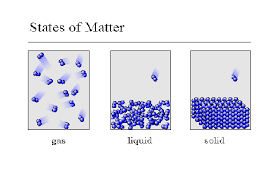
Which container shows the particles of a liquid?
a)
Container A
b)
Container B
c)
Container C
17.
Evaporation is a change of state from ______ to ______.
a)
Solid, Liquid
b)
Gas, Solid
c)
Liquid, Gas
d)
Gas, Liquid
18.
Dry ice is an example of what phase change.
a)
freezing
b)
melting
c)
vaporization/boiling
d)
sublimation
19.
What happens when my glass of water is sitting in the sun and disappears into a gas?
a)
evaporation
b)
burning
c)
melting
d)
freezing
20.
Which subatomic particle has a positive (+) charge?
a)
Neutron
b)
Proton
c)
Electron
21.
True or False - Protons and Neutrons have about the same mass.
a)
True - They have about the same mass
b)
False - They do not have about the same mass
22.
Which subatomic particle has a negative (-) charge?
a)
Proton
b)
Electron
c)
Neutron
23.
Which subatomic particle has a neutral or no charge?
a)
Proton
b)
Electron
c)
Neutron
24.
Which two subatomic particles make up the nucleus of an atom?
a)
Protons and Electrons
b)
Neutrons and Electrons
c)
Electrons and Protons
d)
Protons and Neutrons
25.
Where are the Electrons found in the structure of an atom?
a)
In the nucleus
b)
In spaces around the nucleus
26.
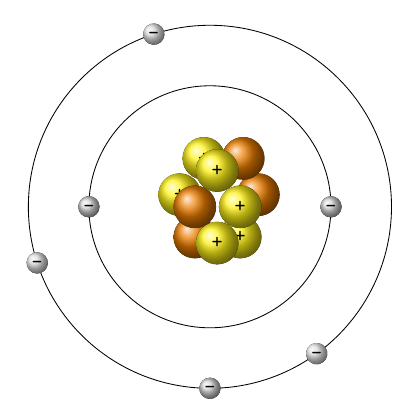
How many electron shells/levels does this atom have?
a)
1
b)
2
c)
3
d)
4
27.
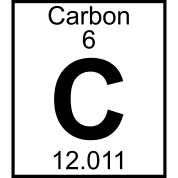
How many protons does this atom have?
a)
3
b)
6
c)
4
d)
2
28.

The mass of an atom is

a)

equal to the number of protons

b)

the protons + electrons

c)

the protons + neutrons

d)

the protons + neutrons + electrons

29.

In a neutral atom,

a)

protons = electrons

b)

protons = neutrons

c)

neutrons = electrons

d)

protons = neutrons = electrons

30.
Value representing the number of protons in an element
a)
Atomic Mass
b)
Mass Number
c)
Valence Electrons
d)
Atomic Number
31.
All ____________ are made up of two or more atoms bonded together.
a)
atoms
b)
molecules
c)
electrons
d)
elements
32.
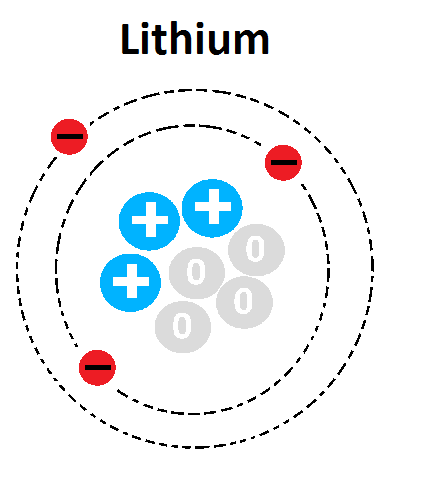
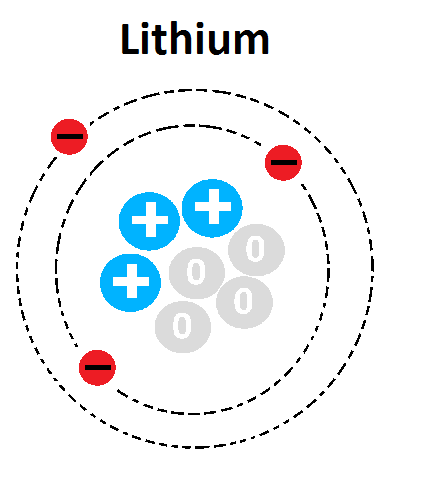
What is the atomic number of this atom?
a)
1
b)
3
c)
4
d)
7
33.

What is the atomic mass of this atom?

a)

1

b)

3

c)

4

d)

7

34.
What does the C represent?
a)
atomic mass
b)
atomic number
c)
element name
d)
chemical symbol 
35.
what does the 6 represent?
a)
Atomic mass
b)
atomic number
c)
chemical symbol
d)
element name
36.
How is the number of neutrons in the nucleus of an atom calculated?
a)
Add the number of e- and p+ together
b)
Subtract the number of e- from p+
c)
Subtract the number of p+ from the mass number
d)
Add the mass number to the number of e-
37.
Attractions between the negative Oxygen atom of one water molecule and the positive Hydrogen atom of another water molecule are called
a)
Covalent bonds
b)
Ionic bonds
c)
Polar bonds
d)
Hydrogen bonds
38.
Water is a universal solvent because it...
a)
It can be found anywhere
b)
It freezes when it gets cold
c)
floats when frozen
d)
Dissolves most substances
39.
Which of the following is LEAST likely to dissolve in water?
a)
nonpolar fats and oils
b)
polar sugar molecules
c)
salt made of a positive sodium ion and a negative chloride ion
d)
all of the substances will dissolve easily in water
40.

Water has _____ specific heat. Meaning, it takes _____ time to warm up a large amount of water.

a)

high/ long 

b)

high/ short

c)

low/long

d)

low/ short

41.
What two elements make up water?
a)
Helium and oxygen
b)
Hydrogen and oxygen
c)
helium and carbon
d)
oxygen and carbon
42.
Large bodies of water, such as lakes and oceans, do not quickly fluctuate in temperature. What is the reason for this phenomenon?
a)
Water is an acid.
b)
Water is a versatile solvent.
c)
Water has a high heat capacity.
d)
 Water acts as a buffer.
43.

What is the chemical formula of water?

a)

H2O

b)

CO2

c)

O2

d)

N2

44.

In a water molecule, Oxygen has a _______ charge.

a)

negative

b)

positive

c)

neutral

45.

In a water molecule, Hydrogen has a _____ charge

a)

positive

b)

neutral

c)

negative

46.

Water's attraction to other substances is called-

a)

sticking

b)

molecule

c)

cohesion

d)

adhesion

47.
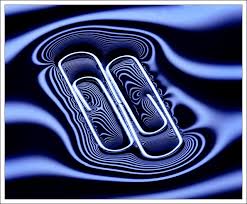
The tightness across the surface of water that enables paper clips to float is ____________.
a)
adhesion
b)
capillary action
c)
surface tension
d)
polarity
48.
Which statement explains why water molecules stick together?
a)
both sides are negative
b)
one side has a positive charge and the other side has a negative charge
c)
one side has a negative charge adn the other side has a neutral charge
d)
both sides are positive
49.
When a molecule has an opposite electrical charge on each end, it is known as what?
a)
cohesion
b)
polar molecule
c)
hydrogen bond
d)
solution
50.
When water molecules stick easily to other water molecules, this is called what?
a)
cohesion
b)
adhesion
c)
solution
d)
polar molecule
51.
Why does ice float?
a)
As water freezes, it expands and its density decreases.
b)
As water freezes, it takes up more hydrogen from the atmosphere, causing it to have a greater buoyancy.
c)
As water freezes, air becomes trapped between the hydrogen bonds of water molecules.
d)
As water freezes, it takes up more oxygen from the atmosphere, causing it to have a greater buoyancy.
52.
Proteins are made of monomers called ___________
a)
Nucleotides
b)
Monosaccharides
c)
Amino Acids
d)
Glycerol and fatty acids
53.
DNA and RNA are examples of 
a)
Carbohydrates
b)
Lipids
c)
Proteins
d)
Nucleic Acids
54.
Nucleotides are monomers of
a)
Carbohydrates
b)
Lipids
c)
Proteins
d)
Nucleic Acids
55.
Monosaccharides are monomers of
a)
Carbohydrates
b)
Lipids
c)
Proteins
d)
Nucleic Acids
56.
Waxes, oils and fats are examples of
a)
Carbohydrates
b)
Lipids
c)
Proteins
d)
Nucleic Acids
57.
What is the function of nucleic acids?
a)
store genetic information
b)
store energy (long-term)
c)
store energy (short-term)
d)
build skin, hair, nails, muscles
58.
Which of the following organic compounds is the main source of energy for living things?
a)
carbohydrates
b)
lipids
c)
nucleic acids
d)
proteins
59.
Which macromolecule stores energy, insulates us, and makes up the cell membrane?
a)
lipids
b)
proteins
c)
carbohydrates
d)
nucleic acids
60.
What are the monomers of DNA?
a)
glycerols
b)
amino acids
c)
fatty acids
d)
nucleotides
61.
Lipids can be digested into what smaller subunits?
a)
nucleic acids
b)
amino acids
c)
fatty acids
d)
glucose
62.
All polymers are made up of...
a)
monosaccharides
b)
monomers
c)
proteins
d)
None of these
63.
All organic compounds contain the element
a)
carbon
b)
nitrogen
c)
phosphorus
d)
sulfur
64.

Enzymes belong to which class of macromolecules?

a)

lipids

b)

carbohydrates

c)

proteins

d)

nucleic acids

65.

DNA belongs to which class of macromolecules?

a)

proteins

b)

nucleic acids

c)

carbohydrates

d)

lipids

66.

Sugar belongs to which class of macromolecules?

a)

proteins

b)

lipids

c)

nucleic acids

d)

carbohydrates