
 Worksheets
Waves and Information Technologies Topic 6
Total questions: 68
Worksheet time: 51mins
In a busy airport, with the large number of devices communicating wirelessly, how are the signals kept from going to the wrong place?
Each device has an internal code that has to match the code of an incoming transmission.
Different devices operate on different wavelengths of the electromagnetic spectrum
The signals are routed through the wireless network like a post office sorts mail by zip code.
Devices with larger antennae use higher frequencies and devices with smaller antennae use lower frequencies to communicate.
Chloe is trying to filter out noise from both an analog and a digital signal. Which type of signal is generally more challenging to clean up?
analog, because it is a continuous signal with infinite values, making noise removal difficult
analog, because it is a discrete signal made up of ones and zeroes, making noise removal difficult
digital, because it is a continuous signal with infinite values, making noise removal difficult
digital, because it is a discrete signal made up of ones and zeroes, making noise removal difficult
Nora and Daniel are working on a project to improve communications for various devices. Which of the following are ways that software can be used in communication technologies?
better antennae for better range
ability for encryption for security
thicker wires for durability
increasing bandwidth for speed of transmissions

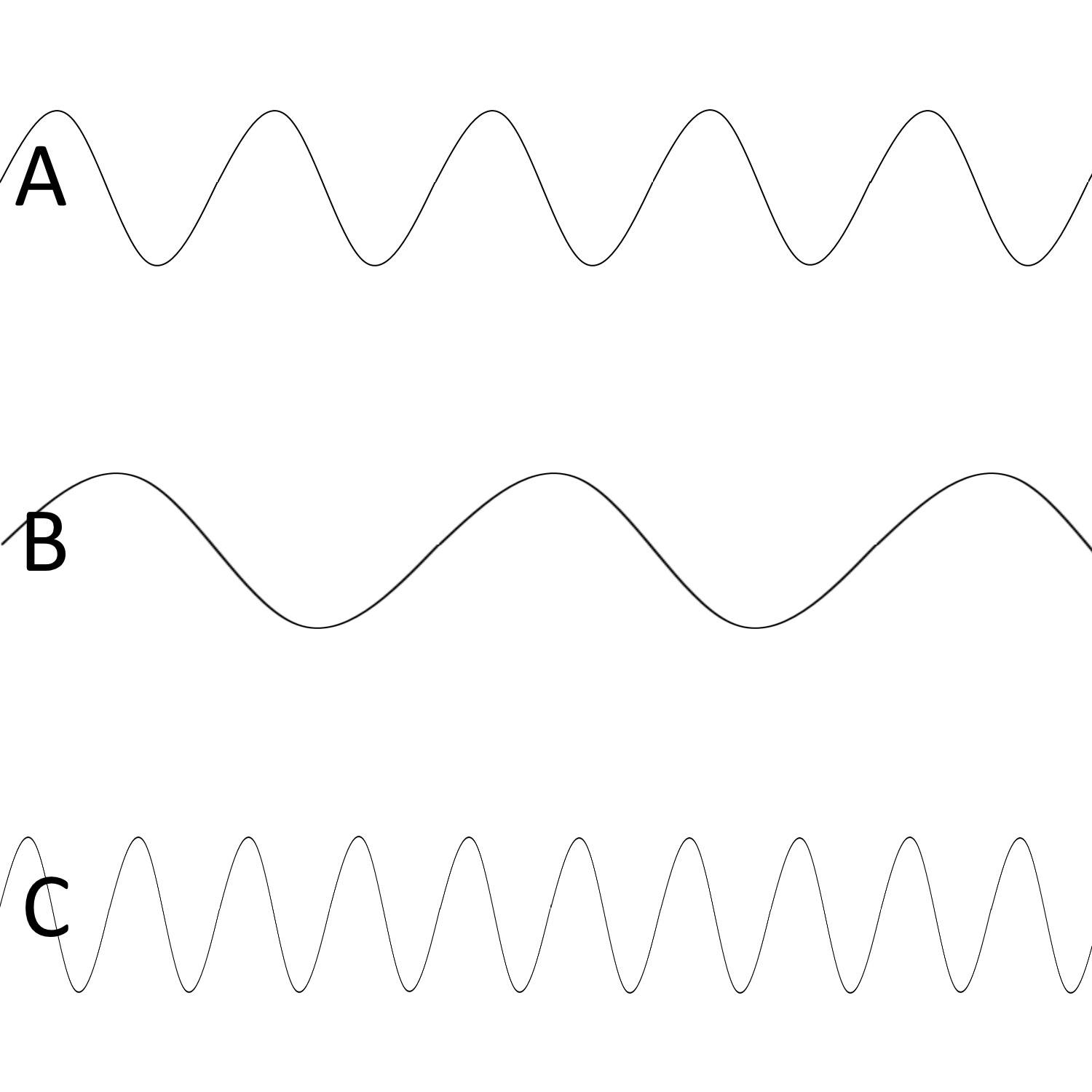
The two waves in the image are traveling at the same speed. Which statement best describes the difference between the waves?
wave A has a higher frequency than wave B
wave A has a lower frequency than wave B
wave A has a higher amplitude than wave B
wave A has a lower amplitude than wave B
When a wave travels through a medium, what is primarily being transferred?
A. energy
B. particles
C. both particles and energy
D. neither particles nor energy

In the figure shown below, point B is called a ______.
amplitude
crest
wavelength
trough

In the figure shown below, what is the distance of the wavelength?
Point 4
Point 2
Point 6
Point 5
While observing the ocean from the pier, Sarah noticed that she could count the same number of waves passing by every 15 seconds. What was Sarah measuring?
wavelength
frequency
speed
amplitude

The amplitude of the wave in the diagram below is given by letter
A
B
C
D

The wavelength of the wave in the diagram below is given by letter
A
B
C
D
E

Which wave in the diagram below has the highest frequency?
A
B
C
D

What part of a wave does the area labeled b in the diagram below represent?
crest
trough
amplitude
wavelength
A transverse wave moves through a medium _______________ to the direction of particle movement.
perpendicular
parallel
A longitudinal wave moves through a medium ____________ to the direction of particle movement.
perpendicular
parallel

In the sound wave, what are the correct labels for areas 1 and 3?
1 = rarefaction, 3 = compression
1 = crest, 3= trough
1 = trough, 3 = crest
3 = rarefaction, 1 = compression
Jacob was fascinated by the way Morse code is transmitted. He learned that the signal is sent through bursts of energy known as a(n) ____________ when the circuit is completed by closing a switch.
wave pulse
wave beat
wave thump
wave stop

A stretched Slinky is attached to two fixed points is compressed on one end and released, as shown in the picture. The resulting wave travels back and forth between the two fixed ends of the spring until it comes to a stop. This mechanical wave is an example of a ____________ wave.
longitudinal
superpositioned
transverse
refracted
William wanted to convert the analog recording of his band's live performance into a digital signal so that he could put it on his mp3 player. What could Noah do to get the highest quality digital signal from the analog recording?
lower amplitude of analog signal
higher amplitude of analog signal
lower sampling rate of analog signal
higher sampling rate of analog signal
Tyler and Aiden are learning about communication methods. What symbols could they use in their notes like binary code so that other's can't read their messages?
voice and recording
analog and digital
dots and dashes
pixels and bits
Ethan is working on a project where he needs to store a large number of images. What would be a benefit of reducing the number of pixels in these images?
less storage space
better quality
better for creating large posters
less boxy-looking
What is true about a digital signal?
A. They are easily distorted or affected by interference
B. They require more information.
C. They take up more space.
D. They are generally considered more reliable.
What is the period of today's information technology called?
cell phone age
technology age
information age
sharing age
What would Charles be studying if he focused on software development at a tech company?
the soft parts of the technology, such as the rubber coating around the wires
the antenna within the technology that sends and receives the data
the computer that runs the physical parts of the technology
the programming that makes the physical parts of the technology run
Which of the following is an advantage of analog signals?
Less prone to interference
Travels farther
Requires less power
Carries more detailed information
In longitudinal waves on a spring, the parts where the coils are closer together are called _____.
A. contractions
B. longitudes
C. rarefactions
D. compressions
When Zoe and Ava surf at the beach, they love riding the highest point of a wave, which is called the _____.
trough
amplitude
crest
frequency
Which option below lists the type of signal denoted by binary 1s and 0s?
digital
linear
static
analog
Benjamin and Abigail are in a park. They hear a dog barking and a cat meowing. Which option below lists the type of signal generated by these sounds?
linear
digital
analog
static
Which item would be an example of something that stores data in an analog way?

A. CD

B. Vinyl record

C. USB stick

D. computer hard drive

The graphs below compare the wavelength and frequency of three different types of waves in the electromagnetic spectrum. Of these choices, which wave has the highest energy?
A. gamma
B. gamma and X-ray have the same energy
C. microwave
D. X-ray
During a science class, Addison learned that a _______ is equal to one wave per second and is the unit of frequency.
Meters (m)
Yards (yd)
Kilometers (km)
hertz (hz)
During a science class, Harper and Daniel were discussing different types of waves. Harper asked, 'Which of these CANNOT travel through the vacuum of space?'
x-rays
sound waves
gamma rays
radio waves

Which answer choice explains what analog means?
Electrical
Mechanical / Wind up
Data expressed as single digits usually 0 and 1
Smooth and continuous data

Which of the following answer choices explains what digital means?
Data expressed as single digits, usually 0 and 1
Smooth and continuous data
Electrical
computerized

What kind a wave is pictured?
Analog wave
Digital wave
Radiowave
Microwave
What types of waves can travel through empty space AND mediums?
Longitudinal
Mechanical
Electromagnetic

The height of a wave from its resting point (B).
Frequency
Wave speed
Wavelength
Amplitude
The length of a wave, from crest to crest or trough to trough. (D)
Frequency
Wave speed
Wavelength
Amplitude
As wavelength decreases, the crests of the wave:
become wider
become shorter
get closer together
get farther apart
If a wave has a long wavelength, it will have __________ energy.
High
Medium
Low
If a wave has a high frequency, it will have __________ energy.
High
Medium
Low

The picture above shows a water wave hitting the beach. Which of the following is true about this process?
Energy is transferred from the water to the shore, but the water does not travel with the energy.
Water is transferred to the shore, but energy does not travel with the water.
As energy transfers from the water to the shore, the water travels with the energy.
Neither energy nor water is transferred to the shore.

The material through which a wave travels is called the ___________________
medium
substance
disturbance
vacuum
Frequency is expressed in units called ___________________
Newtons (N)
Microns (Mc)
Hertz (Hz)
Periods (Pd)
Computers use a series of ___________________ numbers to encode information
large
multiple
single
binary
Which of the following statements best explains why digital waves are commonly used in high-frequency wireless networks instead of analog waves?
Small disruptions in analog waves are more easily corrected than in digital waves.
It is easier to correct small disruptions in digital waves than in analog waves.
Analog waves cannot reach large enough wavelengths to be used in wireless networks.
Analog waves cannot reach high enough amplitudes to be used in wireless networks.


Which Yoshi has more information?
A
B

Which wave has a high frequency?
A
B

identify the parts of the wave #3 represents the wave's _________________.
amplitude
frequency
trough
crest
identify the parts of the wave #2 represents the wave's _________________.
amplitude
frequency
wavelength
identify the parts of the wave #1 represents the wave's _________________.
amplitude
frequency
wavelength

Which wave has a lower amplitude?
A
B
The more pixels you have in an image the better the quality of the image
True
False
The ________ lasted from 1945 to the present.
Industrial Revolution
Progressive Age
Information Age
A computer needs both hardware and software to work
true
false
A wave pulse is considered
a pulse of information sent as a pattern in a controlled flow of current through a circuit
information sent as patterns in the form of electromagnetic waves, such as radio waves
a pulse of energy that travels through the circuit when it is closed

