
 Worksheets
Waves Review (Act. 1-6)
Total questions: 66
Worksheet time: 51mins

What is A?
crest
trough
compression
rarefaction
How high or low a sound is; depends on the frequency
pitch
frequency
sound
medium
What is transported by a wave?
air
energy
matter
particles

The diagram shows a cartoon of a sound wave produced while a student is speaking.
What happens to the sound wave when the student speaks louder?
The amplitude increases
the wavelength will double
the speed will increase
the amplitude will decrease
A boy has a cork on his fishing line in a lake. His brother throws a rock in the lake near where he is fishing, and the waves created from the rock splashing cause the boy's cork to bob up and down for over a minute. What is the medium for the waves in this scenario?
the cork
the water
the rock
the fishing line
The distance between two corresponding parts of a wave is its
amplitude
frequency
wavelength
velocity
Longitudinal waves have:
crests and troughs
crests and compressions
compressions and rarefactions
troughs and rarefactions
Longitudinal waves move:
at a right angle compared to the direction the wave is traveling
in a circle compared to the direction the wave is traveling
matter
in the same direction as the wave is traveling

How are sound waves like ripples in a pond?
They are both types of electromagnetic radiation.
They travel faster in water than they do in the air.
They radiate outward from a central point.
They have the same wavelengths.
Sound is measured in
pitch
hertz
frequency
decibels
What are 2 ways we can protect our ears?
Reduce Reuse Recycle
Earplugs, turning down the volume
Which state of matter do sounds travel fastest in?
Solid
Liquid
Gas
Plasma

Calculate the speed of sound if a sound wave travels 680 m in 2 seconds.
1360 m/s
340 m/s
The speed of sound is always the same
250 m/s
Calculate the speed of sound if a sound wave travels 1020 m in 3 seconds.
3060
365 m/s
340 m/s
250 m/s

This is a picture of:
Audiograss
Audiogran
Audiogram
Selfie
the results from the hearing tests are often displayed in the form of _______________________
an audiologist
an audiogram
a person who can advise patients about their hearing health and recommend any treatment that they might need
a teacher
an audiologist
Waves DO NOT transfer ______?
Matter
Energy

You can't hear sounds in outer space because there is no
medium
light
energy
heat

Binary waves contain data represented with 2 values which are
up or down
0 or 1
happy or sad
right or left
An advantage a digital wave has over an analog wave is
It can be perfectly duplicated.
It is cheaper to make.
It is longer and conserves energy.
It doesn't cause cancer.
What is the main difference between analog and digital technology?
Digital technology reproduces sound more faithfully than analog technology
Analog technology stores information as sound waves; digital technology stores it as strings of ones and zeroes
Analog technology can be used to record sound and images; digital technology can only be used to record sound
Analog technology is based on binary code; digital technology is based on electromagnets
An example of a digital wave looks like


An advantage a digital wave has over an analog wave is
It can be perfectly duplicated.
It is cheaper to make.
It is longer and conserves energy.
It doesn't cause cancer.

Which answer choice explains what analog means?
Electrical
Mechanical / Wind up
Data expressed as single digits usually 0 and 1
Smooth and continuous data

What kind a wave is pictured?
Analog wave
Digital wave
Radio wave
Microwave

What type of wave is pictured?
Transverse wave
Longitudinal wave
Waving goodbye
Stadium wave

What type of wave is pictured?
Transverse wave
Longitudinal wave
Wave, what wave?
Slinky wave
The number of times the wavelength occurs in one second, measured in units called hertz.
Amplitude
Wavelength
Medium
Frequency
In order to calculate speed of a wave that is traveling, you multiply...
wavelength x frequency
frequency x amplitude
amplitude x wavelength

Which wave has more energy? Why?
Top wave because the amplitude is smaller
Bottom wave because the amplitude is larger
They are the same because the wavelengths are equal

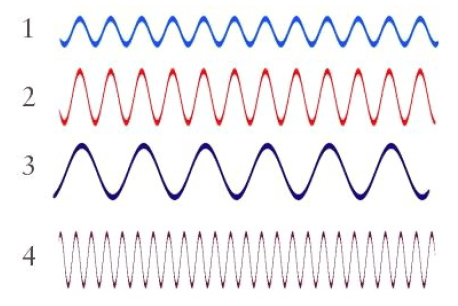
Which transverse wave has the highest frequency?
1
2
3
4

The highest point or peak of a transverse wave, point B and F, is the ________________ .
trough
amplitude
crest

_____________ is a measurement of how long or short a wave is. (Point B to Point F or Point D to Point H)
wavelength
amplitude
compression

As the frequency of a wave increases, the wavelength
increases
decreases
stays the same

______ and _______ are Inversely Proportional. When a wave's Wavelength is Long, the wave's Frequency is Low and when a wave's Wavelength is Short, the wave's Frequency is High.
Longitudinal Wave and Amplitude
Wavelength and Frequency
Wavelength and Amplitude
Amplitude and Nothing else
Which wave would have more energy, a wave with a high amplitude or low amplitude?
high amplitude
low amplitude
The measurement of the length of a wave from one point of the wave to the next identical part of the wave (for example, top to top or bottom to bottom)
Crest
Amplitude
Frequency
Wavelength
The number of waves that passes a certain point in a set period of time
Frequency
Amplitude
Wavelength
Amplength

Which vocabulary term is used to identify the distance between points C & E?
Amplitude
Crest
Frequency
Wavelength
Which one shows the amplitude of a wave?


As the wavelength increases, the frequency ____
increases
decreases
remain same
none of the above
In a transverse wave, particles vibrate perpendicular to the direction that the wave is traveling
True
False
none of the above

