
NEW
Font size
 Worksheets
Unit Three Intro
Total questions: 45
Worksheet time: 56mins
Select the element most likely to gain an electron
Bromine
Fluorine
Chlorine
Iodine
Select the element with the largest atomic radius
Potassium
Scandium
Gallium
Arsenic
Select the element most likely to lose an electron
Magnesium
Sulfur
Barium
Oxygen
Select the sequence that correctly orders from smallest to largest atomic radius
Sn, Y, Ru
Cu, Ga, Br
Al, S, Na
F, N, Li
Where on the periodic table can nonmetals be found?
Top
Bottom
Left
Right
Select the group that is the most reactive metals
Transition Metals
Alkali Earth Metals
Alkali Metals
Halogens
Select the element with the highest ionization energy
Sodium
Aluminum
Phosphorous
Chlorine
Select the element Alkali Earth Metal found in Period 4
Calcium
Potassium
Titantium
Krypton
Select the element that is a metalloid
Gallium
Boron
Oxygen
Magnesium
Select the element below that is least reactive
Hydrogen
Chlorine
Lithium
Neon
Select the element that has 3 valence electrons
Calcium
Sodium
Aluminum
Sulfur
Select the element that is a nonmetal
Copper
Lead
Hydrogen
Sodium
What element is found in Group 5 period 4?
Zirconium
Magnesium
Strontium
Vanadium
What group contains elements with 7 valence electrons
Noble Gasses
Alkali Earth Metals
Halogens
Transition Metals
Which element is most likely to lose an electron?
Zinc
Arsenic
Bromine
Potassium
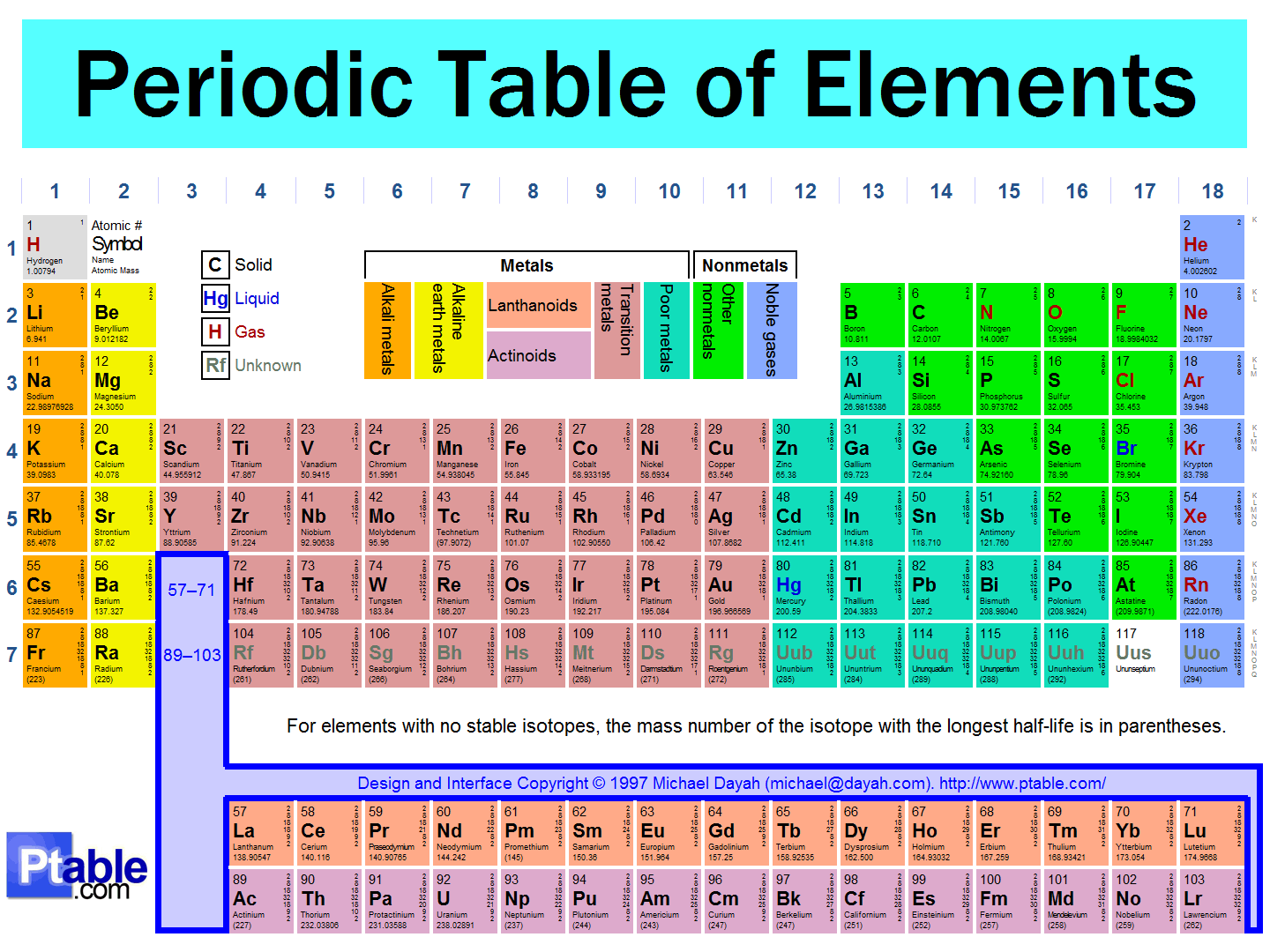
The vertical (up and down) columns in the Periodic Table are called
groups
towers
periods
atomic numbers


Which of the following elements is the most reactive?
Francium
Iron
Aluminum
Xenon
Which of the following elements is in the same period as Magnesium?
Carbon
Oxygen
Phosphorus
Arsenic
Which of the following elements is in the same group as Barium?
Lithium
Calcium
Cesium
Aluminum
The majority of elements are ____
Metals
Nonmetals
Metalloids
Noble Gases
As you move down a Group on the periodic table, what happens to the size of the atoms?
they stay the same
they get larger
they get smaller
Going down the group, the atomic radius of elements increases. Why is that so?
The number of shell (n) increases
Shielding effect increases
Nucleus attraction towards valence electrons weaker
All of the above

If a potassium atom lost one electron, what would be the symbol for that ion?


The energy it takes to remove one electron from an atom
Atomic Radii
Ionization Energy
Electronegativity
Electron Afinity
Oxidation Number
The tendency of an atom to attract a shared pair of electrons
Atomic Radii
Ionization Energy
Electronegativity
Electron Afinity
Oxidation Number
Atomic radii trends is . . . .
generally decrease along each period of the table, from the alkali metals to the noble gases; and increase down each group.
generally increase along each period of the table, from the alkali metals to the noble gases; and increase down each group.
generally increase along each period of the table, from the alkali metals to the noble gases; and decrease down each group.
generally decrease along each period of the table, from the alkali metals to the noble gases; and decrease down each group.
Ionization energy trends is . . . .
becomes greater up and to the right of the periodic table.
becomes greater down and to the right of the periodic table.
becomes greater up and to the left of the periodic table.
becomes greater down and to the left of the periodic table.
Electronegativity trends is . . . .
increases on passing from left to right along a period, and decreases on descending a group.
increases on passing from left to right along a period, and increases on descending a group.
decreases on passing from left to right along a period, and decreases on descending a group.
decreases on passing from left to right along a period, and increases on descending a group.

