wayground logo

Free Printable Worksheets

Font size

S
M
L
XL
Worksheets

Apothecary

Total questions: 45

Worksheet time: 2hrs 15mins

Name
Class
Date
1.
Where does photosynthesis take place in the plant cell?
a)
Nucleus
b)
Cytoplasm
c)

Chloroplast

d)
Mitochondria
2.
What are the two products of photosynthesis?
a)
Oxygen and Carbon Dioxide
b)

Oxygen and Sugar

c)
Sunlight and Sugar
3.
Pigment in green plants that captures the energy in sunlight is called _______.
a)
Pigment
b)
Chlorophyll
c)
Stomata
d)
Green Thing
4.
Which of the following is the correct equation for PHOTOSYNTHESIS?
a)
CO+ light + H2O --> O+ Sugar
b)
CO+ sugar + H2O --> O+ light
c)
O2 + light + H2O --> CO+ Sugar
d)
CO+ O2 + H2O --> Light+ Sugar
5.
What are the products of photosynthesis?
a)
water and carbon dioxide
b)
oxygen and glucose
c)
oxygen and carbon dioxide
d)
oxygen and water
6.
What are the reactants of photosynthesis?
a)
carbon dioxide and oxygen
b)
water and oxygen
c)
carbon dioxide and water
d)
water and glucose
7.
Which gas is removed from the atmosphere during photosynthesis?
a)
hydrogen
b)
oxygen
c)
nitrogen
d)
carbon dioxide
8.
Which statement about photosynthesis is correct?
a)
Plants get the energy they need for photosynthesis from water.
b)
Plants get the energy they need for photosynthesis from soil.
c)
Plants get the energy they need for photosynthesis from sunlight.
d)
Plants do not require energy to perform photosynthesis.
9.
What is the "waste" gas (product) produced during photosynthesis?
a)
oxygen
b)
nitrogen
c)
helium
d)
hydrogen
10.
How does carbon dioxide get into the leaves of a plant?
a)
It's absorbed by the roots
b)
It's made in a chemical reaction in the stem
c)
It enters through the stomata
d)
It goes through the flowers
11.

What is the Vascular Bundle made up of?

a)

Palisade cells

b)

Xylem

c)

Mesophyll

d)

Phloem

12.

In which direction does the does the phloem flow in?

a)

Right

b)

Up

c)

Down

d)

Up and down

13.
Most of the chloroplast cells are found in the
a)
upper epidermis
b)
pallisade mesophyll layer
c)
lower epidermis
d)
stomata
14.
The water needed for photosynthesis comes into the leaves through the
a)
upper epidermis
b)
stomata
c)
guard cells
d)
xylem cells
15.
The important gases, carbon dioxide and oxygen, enter and leave the leaf through the
a)
upper epidermis
b)
phloem
c)
stomata
d)
guard cells
16.
Plants need to take in oxygen gas for respiration
a)
only at night 
b)
only during the day
c)
both during the day & the night
17.

Identify structure 10 in the diagram.

a)

Lower epidermis

b)

Vascular bundle

c)

Stomata

d)

Palisade mesophyll

18.
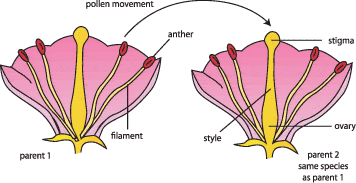
The ovary, style, and the stigma make up the female part of a plant called the ?
a)
stamen
b)
petals
c)
stem
d)
carpel (pistil)
19.

Pollen grains are produced by ?

a)

the anther

b)

the stigma

c)

the flowers

d)

the leaves

20.

Which number or numbers identify the stamen?

a)

3,4

b)

5, 6, 7

c)

2

d)

8, 9

21.
Which of these includes a plant embryo (seed), a food supply, and a protective covering?
a)
flower
b)
fruit
c)
stem
d)
stamen
22.
The seeds of apple would probably be disbursed by?
a)
animals
b)
wind
c)
water
d)
fire
23.
Seeds can be disbursed by animals, water, and __________ ?
a)
wind
b)
earthquakes
c)
fire
d)
blizzards
24.
Pollen comes from the male or female parts of the flower?
a)
male
b)
female
25.
Which part may develop into a fruit?
a)
E
b)
D
c)
C
d)
A
26.
The male reproductive structure of a flower is the ___.
a)
pistil
b)
ovary
c)
stamen
d)
ovule
27.
Pollination can occur between flowers of the same plant. 
a)
True 
b)
False 
28.
Pollination is the process by which pollen
a)
causes people to sneeze
b)
is formed inside a plant
c)
moves from stamen to stigma
d)
moves from stigma to stamen
29.
Brightly colored parts of flowers that attract insects.
a)
petals
b)
pistils
c)
stamen
d)
filaments
30.

process of reproduction involving a single parent that results in offspring that are genetically identical to the parent

a)

asexual reproduction

b)

fertilization

c)

sexual reproduction

d)

tissue

31.

a reproductive process that involves two parents that combine their genetic material to produce a new organism, which differs from both parents

a)

asexual reproduction

b)

pollination

c)

sexual reproduction

d)

tissue

32.

Which cause athlete’s foot, ringworm, and thrush?

a)

protozoa

b)

bacteria

c)

viruses

d)

fungi

33.
Most fungi reproduce by using . . . 
a)
Budding
b)
Eggs
c)
Spores
d)
Zoanthropy
34.

Which of the following is a unicellular fungus?

a)

Foraminifera

b)

Yeast

c)

Amoeba

d)

Algae

35.
Why is yeast used to bake bread? 
a)
The waste gas, CO2, makes bread rise
b)
The alcohol produced makes bread dangerous
c)
The yeast consumes O2, causing bread to rise
36.
When respiration occurs with oxygen, it is called _______
a)
anaerobic
b)
aerobic
c)
light-dependent
d)
fermentation
37.

The term "anaerobic" means :

a)

with oxygen.

b)

without oxygen.

c)

alive.

d)

nonliving.

38.

What are the waste products from fermentation? (Choose all that apply)

a)

starch

b)

carbon dioxide

c)

glucose

d)

alcohol

39.

All fermentation produces some amount of alcohol.

a)

true

b)

false

40.

Which product of anerobic respiration in yeast is useful in brewing alcoholic drinks?

a)

Carbon dioxide

b)

Glucose

c)

Lactic acid

d)

Ethanol

41.

Which sugar is used in anerobic respiration?

a)

Starch

b)

Glucose

c)

Amino acids

d)

Lactic acid

42.

Identify the organism that releases ethanol when it respires anerobically

a)

Human

b)

Fruit fly

c)

Yeast

d)

Eagle

43.

Which word equation shows anaerobic respiration in yeast?

a)

glucose → ethanol

b)

glucose → ethanol + carbon dioxide

c)

glucose → lactic acid

d)

glucose → lactic acid + carbon dioxide

44.
Fungi obtain water and nutrients through hyphae.  What are hyphae?
a)
Hair-like structures to gather food in water environments
b)
Structures that help fungi to gather light.
c)
Structures that produce spores.
d)
Fibrous strands that will grow toward food or water.
45.
Fungi were originally classified as plants but later they were classified separately.  Which of the following characteristics of fungi separates them from plants?
a)
They reproduce asexually.
b)
They are able to grow in dry conditions.
c)
They are unable to make their own food.
d)
They can move from one place to another.