wayground logo

Free Printable Worksheets

NEW

Font size

S
M
L
XL
Worksheets

Chapter 3 review

Total questions: 55

Worksheet time: 5hrs 35mins

Name
Class
Date
1.

The rule of scientific notation is to write all exponents with a base of ____.

a)

50

b)

5

c)

100

d)

10

2.
Write in scientific notation:
0.00071363
a)
7.1363 x 10⁻³
b)
7.1363 x 10⁻⁴
c)
7.1363 x 10⁴
d)
7.1363 x 10³
3.

How would you write 0.0005 in scientific notation?

a)

50 x 10-5

b)

5 x 10⁻⁴

c)

5 x 10⁻³

d)

.5 x 103

4.
Change from standard form to scientific notation:  450,000
a)
4.5  x  105
b)
45  x  105
c)
4.5  x  104
d)
4.5  x  106
5.

How would you write 564,000,000 in scientific notation?

a)

5.64 x 10⁻⁷

b)

5.64 x 10⁶

c)

5.64 x 10⁸

d)

56.4 x 10⁷

6.

Choose the bigger number.

a)

2.45×1062.45\times10^{-6}  

b)

7.3×1087.3\times10^{-8}  

7.
Write 2.08 x 10²  in standard form.
a)
208
b)
0.0208
c)
20,800
d)
0.208
8.
Multiply:
(9.4 x 10⁶)(3.2 x 10⁵)
a)
30.08 x 10¹¹
b)
3.8 x 101
c)
3.008 x 10¹²
d)
2.9375 x 101
9.
(9.6×103) × (6.7×102)
a)
64.32×10⁵
b)
6.432×10⁶
c)
64.32×10⁶
d)
64.32×10⁵
10.
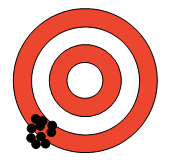
This bullseye demonstrates...
a)
High Accuracy & High Precision
b)
High Accuracy & Low Precision
c)
Low Accuracy & High Precision
d)
Low Accuracy & Low Precision
11.
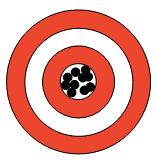
?
a)
High Accuracy & High Precision
b)
High Accuracy & Low Precision
c)
Low Accuracy & High Precision
d)
Low Accuracy & Low Precision
12.
Describe the accuracy and precision of the image
a)
Accurate and Precise
b)
Accurate and not precise
c)
Not Accurate and Precise
d)
not accurate and not precise
13.

How close a measurement is to the accepted value is called..

a)

Accuracy

b)

Precision

c)

Significant

d)

Estimate

14.
A set of data are all close to each other, but they are not close to the actual value.  This set of data can be described as...
a)
accurate
b)
precise
c)
both precise and accurate
15.

Which student had the MOST ACCURATE results?

a)

Ash

b)

Casey

c)

Blake

16.

The attendance for the basketball game was estimated to be 15,000 people but 12,500 people attended. What was the percent error?

a)

16.67%

b)

20%

c)

2500%

d)

80%

17.

The students measured length during a science experiment, they got 12 cm. But the actual measurement was 14.25 cm. What was the percent error?

a)

15.79%

b)

18.75%

c)

2.25%

d)

18%

18.
How many significant figures: 216 m
a)
1
b)
2
c)
3
d)
0
19.
How many significant figures: 2016 m
a)
1
b)
2
c)
3
d)
4
20.
How many significant figures: 153.0 mL
a)
1
b)
2
c)
3
d)
4
21.
How many significant figures: 0.012 km
a)
1
b)
2
c)
3
d)
4
22.
How many significant figures: 1000 mL
a)
1
b)
2
c)
3
d)
4
23.
How many significant figures: 100.000 cL
a)
1
b)
3
c)
5
d)
6
24.
How many significant figures: 0.001 g
a)
4
b)
3
c)
2
d)
1
25.
How many significant figures: 4.20 cm
a)
1
b)
2
c)
3
d)
4
26.
How many significant figures: 0.010 L
a)
1
b)
2
c)
3
d)
4
27.

How many significant figures: 450 m

a)

3

b)

2

c)

1

d)

0

28.
How many sig figs are there?
100000000
a)
1
b)
9
c)
10
29.
How many sig figs are there?
0.000008
a)
1
b)
2
c)
6
d)
7
30.

How many significant figures are there in 1008 grams?

a)

1

b)

2

c)

3

d)

4

31.
How many sig figs are there?
27000000
a)
2
b)
5
c)
8
32.
How many sig figs are there?
5.00000008
a)
2
b)
6
c)
9
33.
Round 0.010229 to four sig figs
a)
1022
b)
1023
c)
0.01023
d)
0.01022
34.
Solve and give your answer with the correct number of significant figures
(12.470)(271)
a)
3366.9
b)
3.37x10³
c)
3400
d)
3370
35.
Solve and give your answer with the correct number of significant figures
129.6/3
a)
43.0
b)
43
c)
 4x101
d)
40
36.

Convert

100oC100^oC  to Kelvin

a)

373 K373\ K  

b)

273 K273\ K  

c)

212 K212\ K  

d)

0 K0\ K  

37.

Convert

450 K450\ K  to Celsius

a)

723oC723^oC  

b)

277oC277^oC  

c)

177 oC177\ ^oC  

d)

623oC623^oC  

38.

Mass is the amount of _______ an object has

a)

Matter

b)

weight

39.

The unit for mass is...

a)

Newton

b)

grams

c)

mililiters

d)

centimeters

40.

A crayon has a mass of 10.0 g and volume of 5.0 mL. What is the density? Use D=m/v

a)

30 g/mL

b)

15 g/mL

c)

1.0 g/mL

d)

2.o g/mL

41.

A piece of copper has a mass of 89g and a volume of 10.0 cm3. What would be the density of the copper? use formula D=m/v

a)

0.89 g/cm3

b)

89 g/cm3

c)

8.9 g/cm3

d)

890 g/cm3

42.

What is the volume of 150.0 grams of lead if it has a density of 11.3 g/cm3? use dimensional analysis... remember the the number with the divide sign as the conversion factor and box it.. use it for later... start with the 150.0 grams of lead..

a)

13.3 g

b)

13.3 cm3

c)

.075 g

d)

1695 cm3

43.
Calculate the mass of a substance which has a volume of 35.0 cm3 and a density of 0.50 g/cm3.(All calculations should have the correct sig figs)
a)
17.5 g
b)
0.014 g
c)
18 g 
d)
70. g
44.
Converting between units is easily done using ____________.
a)
conversion factors
b)
chemistry magic
c)
math magic
d)
just plain ol' magic
45.
Convert the following:
0.25 meters to centimeters
a)
25 cm
b)
0.25 cm
c)
2.5 cm
d)
250 cm
46.
Convert the following: 
35 milliseconds to seconds
a)
0.035 seconds
b)
0.35 seconds
c)
3.5 seconds
d)
0.0035 seconds
47.
Convert the following:
8.1 cm converted into nanometers
a)
8.1 x 10⁷ nm
b)
8.1 x 10⁹ nm
c)
8.1 x 10¹¹ nm
d)
8.1 x 10⁻⁷ nm
48.
Convert the following:
0.46 mL to microliters (μm)
a)
4.6 x 102 μm
b)
4.6 x 10⁻² μm
49.
32.9 km = ___________ cm
a)
32,900
b)
329,000
c)
3,290,000
d)
32,900,000
50.

Convert 5 cm to mm: hint use Meters as the middle man

a)
5,000mm
b)
0.5 mm
c)
0.05 mm
d)
50 mm
51.

6 kg = _____ g

a)

6

b)

6000

c)

600

d)

.006

52.

Convert 210 mm to cm. Hint - use Meters as the middle man

a)

2.1 cm

b)

21 cm

c)

210 cm

d)

2100 cm

53.

Convert 3000 g to kg

a)

0.3 kg

b)

3 kg

c)

30 kg

d)

300 kg

54.

Convert 525 ml to cl. hint- use Liters as the middle man

a)

52.5 cL

b)

5.25 cL

c)

0.525 cL

d)

0.0525 cL

55.

42 L - _______mL

a)

4200

b)

0.0042

c)

4.2

d)

42,000