Worksheets
Water, Biomolecules, Cell membrane and Transport
Total questions: 39
Worksheet time: 26mins
How does the cell membrane maintain homeostasis for the cell?
It contains the DNA which gives instructions to the cell.
The cell membrane produces ATP energy for the cell.
The cell membrane determines what can enter and exit the cell.
The cell membrane provides structure to cells.

What clues indicate that the image is showing an active transport process?
All other answers
The molecules are being pushed against the concentration gradient.
Energy usage is being shown with an explosion symbol.
ATP is present and being used.
What would happen to a human cell if it was put in hypotonic conditions?
It would shrivel up
Nothing would happen because the concentrations are balanced.
It would expand and could possibly burst.
The cell would exhibit turgor pressure with its neighboring cells.
Which situation describes Endocytosis?
Cell membrane wraps around larger nutrients to pull them into the cell forming a vesicle.
A protein carrier allows larger molecules to flow through the membrane
Water follows a concentration gradient through a membrane.
A vesicle fuses with the membrane, releasing waste out of the cell.
Which situation describes Osmosis?
A protein in the membrane uses ATP energy to actively push small molecules against the gradient.
A protein carrier or channel allows larger molecules to flow through the membrane
Water follows a concentration gradient through a membrane.
A vesicle fuses with the membrane, releasing waste out of the cell.
Which situation describes exocytosis?
A protein in the membrane uses ATP energy to actively push small molecules against the gradient.
A protein carrier or channel allows larger molecules to flow through the membrane
Water follows a concentration gradient through a membrane.
A vesicle fuses with the membrane, releasing waste out of the cell.
Which situation describes facilitated diffusion?
A protein in the membrane uses ATP energy to actively push small molecules against the gradient.
A protein carrier or channel allows larger molecules to flow through the membrane
Water follows a concentration gradient through a membrane.
A vesicle fuses with the membrane, releasing waste out of the cell.
A concentration gradient allows molecules to flow _______________.
From high concentration to low.
From low concentration to high.
through a solid medium using energy.
through a membrane no matter the size of the molecule.
What is the function of Carbohydrates?
Store and transmit genetic information.
Catalyze chemical reaction within cells.
Store long-term energy for cells.
Store short-term energy for cells.
What is the function of Lipids?
Store and transmit genetic information.
Catalyze chemical reaction within cells.
Store long-term energy for cells.
Store short-term energy for cells.
Which is not a function of proteins?
Enzymes - Speed up chemical reactions.
Structures - parts of cells used to support the cell and body.
Long-term energy - stored for later use.
Membrane channels - allows larger molecules to cross the membrane.
Which accurately describes the cell membrane?
A porous lipid membrane with Nucleic acids stored inside.
Three layers of lipids with a protein capsid surrounding.
Two layers of proteins with phospholipids and carbohydrates surrounding it.
two layers of back-to-back phospholipids with proteins mixed throughout.
Diffusion is a form of __________ transport.
Passive
Active
Easy
Free

Some cells move large particles out of the cell through the process of:
Protein Synthesis
Endocytosis
Exocytosis
Cytoplasmic Streaming

The sodium potassium pump is an example of
Passive Transport
Active Transport
Facilitated Diffusion
Endocytosis
Human red blood cells contain 0.9% sodium chloride as a component of their cytoplasm. What would happen if an IV solution containing 3.5% sodium chloride is introduced into a person?
The red blood cell would get bigger and burst.
The red blood cell would stay the same size.
The red blood cell would shrink.
The red blood cell would first loose water and then absorb water.

10. Your friend is feeling irritable, lightheaded and dizzy. They are also feeling a bit of confusion and brain fog. Which biomolecule would you recommend your friend consume?
Protein
Carbohydrates
Nucleic Acid
Lipid
2. Which biomolecules contains your genetic information?
Proteins
Lipids
Carbohydrates
Nucleic Acids
9. Amino Acids are the monomers of __________.
Nucleic Acids
Proteins
Carbohydrates
Lipids
Just under an orca's skin lies a thick layer of blubber. Blubber helps insulate a whale from heat loss. Based on this information, which biomolecule is blubber primarily made of?
Lipids
Nucleic Acids
Proteins
Carbohydrates
7. Glycerol and fatty acids are the monomers of _________.
Lipids
Carbohydrates
Proteins
Nucleic Acids
8. The monomer of Nucleic Acids is known as _________.
Amino Acid
Fatty Acid
Nucleotide
Saccharide
1. The four most common elements found in biomolecules are __________.
Sulfur, Phosphorus, Carbon, Oxygen
Carbon, Oxygen, Nitrogen, Hydrogen
Sulfur, Nitrogen, Carbon, Iron
Carbon, Nitrogen, Hydrogen, Sulfur
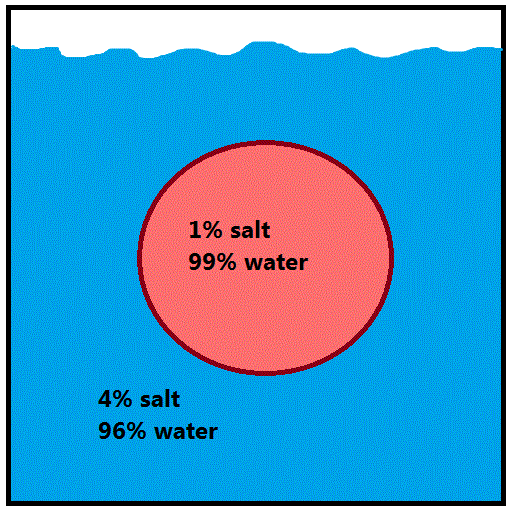

Nemo and other ocean dwelling fish cannot survive in freshwater because......
freshwater is hypertonic to Nemo's cells and will result in water leaving them causing the cells to shrink
freshwater is hypotonic to Nemo's cells and will result in water leaving them causing the cells to shrink
freshwater is hypertonic to Nemo's cells and will result in water entering them causing the cells to swell and burst
freshwater is hypotonic to Nemo's cells and will result in water enter them causing the cells to swell and burst

In the cell pictured, which way would water move?
Into the cell, causing the cell to swell
Out of the cell, causing the cell to shrink
In and out of the cell equally, keeping the shape the same

In the cell pictured, where would water move?
Into the cell, causing it to swell
Out of the cell, causing it to shrink
In and out of the cell equally, causing the shape to stay the same

In the cell pictured, which way would water move?
Into the cell, causing the cell to swell
Out of the cell, causing the cell to shrink
In and out of the cell equally, keeping the shape the same
What is cohesion?
The ability of a molecule to "stick" to itself
The ability of a molecule to "stick" to other molecules
Large amounts of energy are required to change the temperature of a substance
A well-organized and efficient team

What do the green bonds represent?
Covalent Bond
Hydrogen Bond
Ionic Bond

What characteristic is shown in the image?
Polarity
Hydrogen Bonds
Cohesion
Adhesion
What property of water allows for water to act as a temperature regulator for the world?
Cohesive Behavior
Expansion Upon Freezing
High Specific Heat
Universal Solvent

What property of water causes these Alka-Seltzer tablets to dissolve?
Universal Solvent
Expansion Upon Freezing
Cohesive Behavior
High Specific Heat