
NEW
Font size
 Worksheets
Kepler and Gravity Review
Total questions: 30
Worksheet time: 46mins
Two factors effecting the strength of gravity between 2 objects are...
weight and mass
distance and weight
mass and matter
mass and distance
The gravitational force between two object is 5000 N. What would the force be if both masses were doubled in size?
9.8 N
20,000 N
2500 N
10,000 N
What would the force between them be if the distance between them were doubled?
two identical 50,000 kg asteroids are separated by 1000 m and have a gravitational force of 6.7 N? What would the force between them be if they were 2000 m apart?
2500 N
3.3 N
3.45 N
1.67
Two spherical objects have masses of 8000 kg and 1500 kg. Their centers are separated by a distance of 1.5 m. They have a gravitational force between then of 0.0036 N. What would it be if the distance was 3 m instead?
5.4 X 10⁻⁴ N
1.2 X 10⁷ N
9 X 10⁻⁴ N
5.33 N
Which configuration will result in the greatest gravitational force?
small masses far apart
large masses far apart
small masses close together
large masses close together
of F?
Two objects with equal masses of 1 kg each are separated by a distance of 1 m. The gravitational force between the objects is:
Slightly less than G
Slightly greater that G
Equal to G
Half as much of G
An object with a mass of 48 kg measured on Earth is taken to the Moon. What is the weight of the object on the Moon’s surface if the acceleration due to gravity on Moon is one-sixth of that on Earth?
80 N
48 N
288 N
8 N

When force is 20 N, mass is 5 kg, what is acceleration?
25 m/s/s
5 m/s/s
100 m/s/s
4 m/s/s
Which Planet moves the fastest?
Mercury
Earth
Jupiter
Saturn
Kepler's Second Law says
Planets move faster when closer to the Sun
Planets move faster when further from the Sun
Planets orbit in an Ellipse
The ratio of the orbital period and the average distance is equal for each planet
What force helps planets move faster?
Coulomb
Electricity
Gravity
Newton
One of the two foci in our solar system needs to be the
A planet
Jupiter
Earth
The Sun
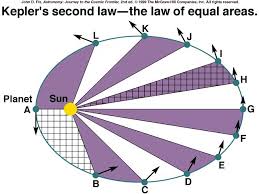
Where is the planet moving fastest

The value of eccentricity can range from ________ to ________.
0.1 to 0.9
-1 to 0
0 to 100
0 to 1
If a planet is 2AU from it's star and take 3 years to orbit it. Another planet is 5 AU away, what is it's period?
2.8 years
12 year
140 years
19 years
If a planet is 10AU from the sun, what's it's period?
29 years
12 years
31.6 years
4 years
If a planet revolves around the sun once every 35 Earth years, what is it's average distance from the Sun?
11AU
10.7AU
11.7AU
10AU
A planet orbits a star with a radius of 1 AU. What is its orbital period?
0.5 years
1 year
2 years
1.5 years
If a moon orbits it's planet at a distance of 300 km, with a period of 2 months, how long would the period be for another moon 200 km away??
3 months
1.06 months
1.18 months
8 months
A planet has a period of 1 Earth year. What is its orbital radius?
0.5 AU
1 AU
2 AU
3 AU
A planet with an orbital period of 8 years orbits at what distance?
1 Astronomical Unit
2 Astronomical Units
4 Astronomical Units
8 Astronomical Units

