
Font size
 Worksheets
Unit 3 Study Guide
Total questions: 52
Worksheet time: 2hrs 14mins
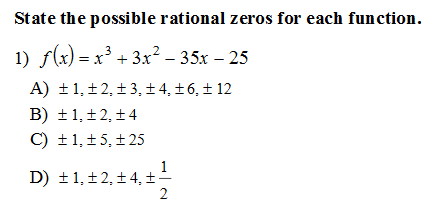
List the possible rational zeros of
f(x) = x3 - 4x2 -4x + 16
1, 2, 4, 8, 16
±1,±2,±4,±8,±16
±1,±4,±41
-2 and-4
The degree of the polynomial determines the max number of roots.
True
False
What is another way to say "where a function crosses the x-axis"?
x-intercept
zero
root
all of these.

Select ALL the zeros of the equation.
-7
0
-5
-6
Select ALL the x-intercepts for the equation? f(x) = (x−3)(x+2)(x+2)
(-3, 0)
-2
(-2, 0)
3
P(x)=3x4-7x2-2x7-x+4
P(x) = 3x4+4x-8 have?
Given that x=1 zero of the function f(x)=x3−9x2+2x+6 use synthetic division to help you find all of the other zeros. All solutions must be exact - no approximate answers.
x=4±i10
x=4±i22
x=4±22
x=−4±22
is -3 a POSSIBLE zero of f(x)=3x3+2x2−5x+2
no, 3 is not a factor of 3
yes
no, 2 is not a factor of 3
no, 3 is not a factor of 2


f(x) = 2x3 - 3x2 + 4x -10
State the maximum number of turns the graph of f(x) could make.
3
2
1
0

f(x) = (x-5)(2x+3)(7x-4)(x+6)


Does this parabola have a minimum or maximum and what is its value?
minimum: 2
maximum: 2
minimum: 5
maximum: 5
Which function has an axis of symmetry of x = 0?


None of the above

Identify the y-intercept
(0, -3)
(3, 0)
(0, 3)
(2, 1)


On the interval of (0, 2) what is happening?
the graph is decreasing
the graph is increasing
the graph remains constant

How would you describe the point at (0,6)?
Relative Minimum
Absolute Minimum
Relative Maximum
Absolute Maximum

What is the end behavior for the graph?
x → ⁻∞, y→ ⁻∞ and
x→ ∞, y→ ⁻∞
x → ⁻∞, y→ ∞ and
x→ ∞, y→ ∞
x → ⁻∞, y→ ⁻∞ and
x→ ∞, y→ ∞
x → ⁻∞, y→ ∞ and
x→ ∞, y→ ⁻∞

What is the end behavior of this graph?
x → ⁻∞, y→ ⁻∞ and
x→ ∞, y→ ⁻∞
x → ⁻∞, y→ ∞ and
x→ ∞, y→ ∞
x → ⁻∞, y→ ⁻∞ and
x→ ∞, y→ ∞
x → ⁻∞, y→ ∞ and
x→ ∞, y→ ⁻∞

Find the decreasing interval
(-1, infinity)
(-infinity, -1)
(-infinity, 4)
(4, infinity)

Which TWO statements are true?
The function has an x intercept when x=−1
The function has an x intercept when x=0
The function has a y intercept when y=0
The function has a y intercept when y=2


Use the graph to determine the X-intercepts
(-1,0) and (-3,0)
(1,0) and (3,0)
(0,1) and (0,3)
(0,-1) and (0,-3)

What is the decreasing interval on the function shown?
(−∞, 1)
(−∞, 2)
(2, ∞)
(1, ∞)

Which of the following is the correct equation for the function graphed?
f(x)=(x−1)2 (x+2)2
f(x)=(x+1)2(x−2)2
f(x)=(x−1)(x+2)
f(x)=(x+1)(x−2)
What is the degree of the polynomial? f(x)=−2x(x+3)2(x−7)(x+5)3
6
7
5
3

What is the degree of the function graphed?
5
1
3
2

What is the degree of the function graphed?
3
5
7
6


Identify the degree of the polynomial and the sign of the leading coefficient
Degree - Even
Degree - Odd
Degree - Even
Degree - Odd
What is the leading coefficient for the polynomial function f(x) = -6x4 + x8 + 5x2 - 2
1
5
-2
-6

For the pictured polynomial, how many relative maximas are there?
1
2
3
4
For the pictured polynomial, how many relative minimas are there?
1
2
3
4
Match the graph to the function based on what you know about degree, the lead coefficient, and end behavior.
f(x) = -x4 + x3 + 5x2 + x + 6

Where is the function positive and where is it negative?
positive (-2,1) and (3,∞) and negative (-∞,-2) and (1,3)
positive (-∞,-1) and (2,∞) and negative (-1,2)
positive (-1,4) and negative (2,-2)
positive (∞,3) and (1,-2) and negative (3,1) and (-2,-∞)

As x --> -∞, f(x) --> ____
As x --> +∞, f(x) --> ____
-∞
-∞
+∞
+∞


